
EVERYTHING THE BUILD NEEDS BEFORE & ALONGSIDE IT
A project built on a handshake and a vague scope will accumulate surprises. A project built on detailed estimates, written schedules, open job costing, documented change orders, managed inspections, and a quality assurance program runs on information — and finishes the way it started, on time and on budget.
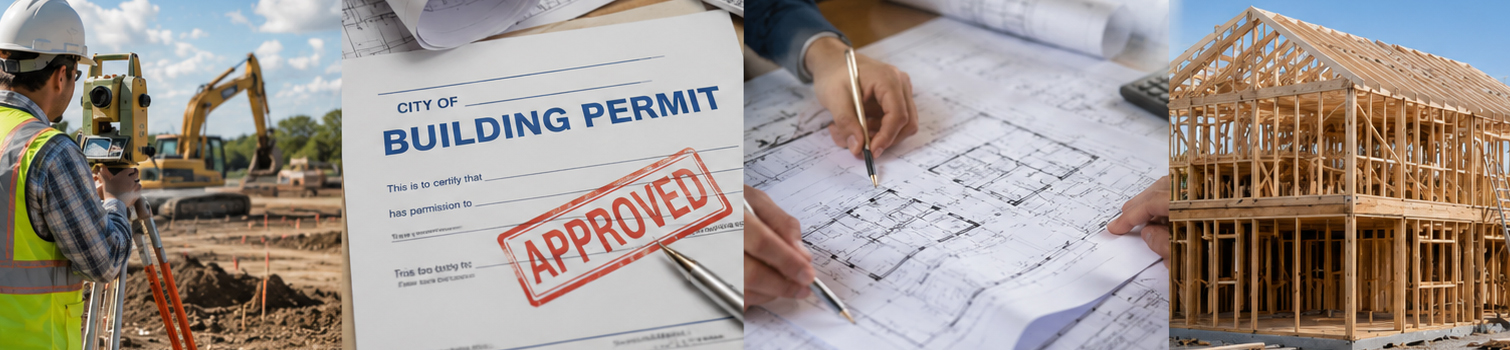
One Team. Every Layer.
Most construction projects involve at least four separate professional relationships: the architect who designs the building, the engineer who stamps the structure, the contractor who builds it, and the interior designer who finishes it. Each of these parties has its own timeline, its own priorities, and its own understanding of what the others have decided. The gaps between them — the details that fall through because no one person owns the transition — are where most projects accumulate their most expensive problems.
RainFire Builders manages every operational service as an integrated scope — coordinating design, permitting, engineering, interior specification, smart home rough-in, accessibility details, and energy performance together with the construction schedule rather than sequentially after it. The result is fewer surprises, faster permit approvals, tighter construction document quality, and a finished product where the systems and finishes were designed to work together from the beginning.
Projects Closed with a Certificate of Occupancy
Utah Municipalities We Permit In
Operational Service Disciplines
Coordination Gaps – One Team Owns It All
Site & Feasibility
Site analysis, surveying, soils report, utility verification, zoning review, ADU feasibility, and setback analysis — before design begins. Design for the site you have, not the site you assumed.
Design & Engineering
Architecture from SD through CDs, structural and civil engineering, interior design selections, smart home and automation rough-in design, energy performance specification, and accessibility details — integrated into permit-ready construction documents.
Permitting & Pre-Con
Complete permit package submission to AHJ, plan check coordination, long-lead material ordering, production schedule finalization, smart home rough-in coordination with MEP sequencing, and final budget alignment before mobilization.
Build, Verify & Close
Construction with QA phase sign-off, inspection management through CO, smart home installation and programming, final energy testing (blower door), accessibility verification, solar interconnection, and complete project documentation at closeout.
OPERATIONAL DISCIPLINES
OPERATIONAL DEEP DIVES
What We Manage
Alongside Every Build
Seven core operational services — plus three supporting disciplines — are managed as an integrated scope on every RainFire Builders project. Each service has its own sub-pages with deep technical content for every specific area.
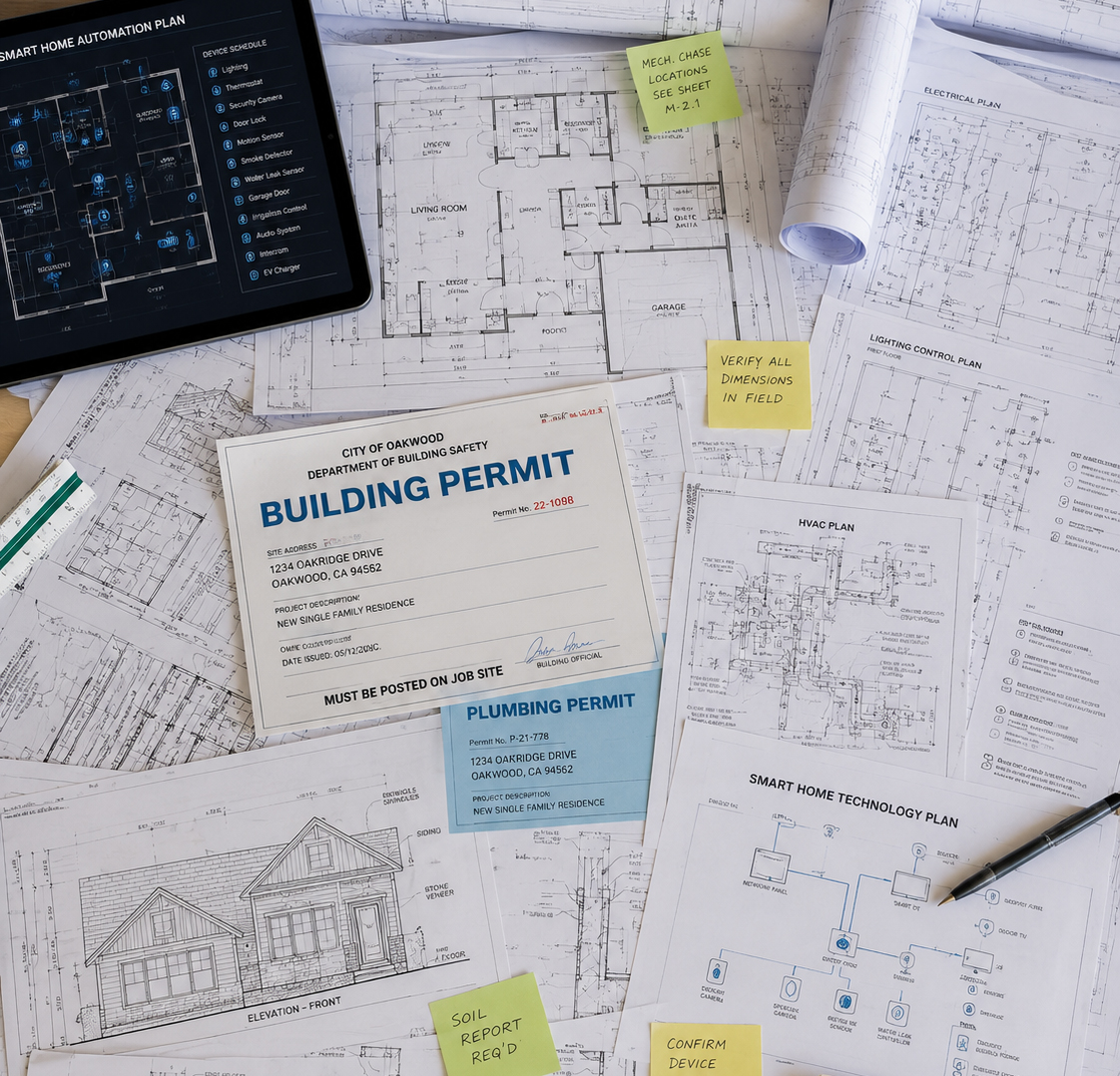
Permitting
RainFire Builders manages the complete permit lifecycle on every project — from application package preparation through final certificate of occupancy — across every Utah municipality we serve. We know the current processing timelines, local code amendments, and plan check preferences for each jurisdiction: Sandy and South Jordan (2–4 weeks), Salt Lake City (4–8 weeks), and high-activity jurisdictions (up to 12 weeks). No construction begins before the permit is posted on-site. No project closes without a CO on file. Building, mechanical, electrical, plumbing, WUI fire zone, and HOA design review — all coordinated under one project manager.
- Building, mechanical, electrical, and plumbing permit applications
- Complete plan check-ready drawing packages for each AHJ
- Plan check comment response and resubmittal management
- WUI fire zone review in Sandy, Draper, and Cottonwood Heights
- HOA design review coordination and submittal management
- ADU permit compliance under Utah HB 82 per municipality
- All permits tracked to final certificate of occupancy
Utah Code Compliance & Building Authorization
Design & Architecture
RainFire Builders coordinates the full architectural design process — from initial schematic design through the permit-ready construction documents that become the basis of your construction contract. Contractor involvement during the design phase prevents the most expensive problem in construction: design decisions that look right on paper and are difficult or impossible to build within budget. We coordinate licensed architects and designers, provide constructability input during design development, and produce or review construction document packages to confirm they are permit-ready and buildable before submission. Design and construction working from the same team eliminates the coordination gaps that accumulate between separate architects and builders.
- Schematic design (SD) for initial concept and massing
- Design development (DD) with detailed material and system specs
- Construction documents (CDs) — permit-ready, engineer-stamped
- Constructability review during design — cost input before CDs are final
- ADA Chapter 4 and accessibility compliance in design
- Material and finish specification coordination with interior design
- As-built documentation and red-line drawing updates
Schematic Design Through Construction Documents
Engineering
Every significant construction project on the Wasatch Front requires engineering — licensed PE stamps for structural systems, soils reports for foundation design, civil engineering for site drainage and grading, and Manual J load calculations for HVAC sizing. Most Wasatch Front communities are in Seismic Design Category D per ASCE 7-22, which requires SDC D-specific structural design for foundations, shear walls, and hold-downs on every new structure. RainFire Builders coordinates all required engineering disciplines — identifying what is needed, engaging the appropriate licensed engineers, reviewing for constructability, and ensuring engineering coordination with the permit package before submission.
- Structural engineering — PE-stamped drawings for permit
- SDC D seismic design: shear walls, hold-downs, ASCE 7-22
- Geotechnical investigation and soils report coordination
- Civil engineering: grading, drainage, stormwater
- Retaining wall engineering for walls over 4 feet (IRC R404)
- Special Inspection Program (SIP) per IBC Chapter 17
- HVAC Manual J load calculation and Manual D duct design
Structural, Geotechnical, Civil & Mechanical PE Coordination
Interior Design
Interior design on a RainFire Builders project is not a separate service delivered after the construction contract is signed — it is integrated into the pre-construction process, so that tile selections drive shower rough-in heights, cabinetry layouts drive blocking locations, lighting design drives electrical circuits, and material specifications drive schedule and procurement timing. When interior design and construction planning are coordinated together, the result is a finished space where everything fits, everything was ordered on time, and nothing was installed before the designer changed their mind. Interior design services range from full space planning and finish selection through material procurement, vendor coordination, and construction document integration.
- Space planning and functional layout optimization
- Finish material selection: tile, flooring, paint, wallcovering
- Cabinet and custom millwork design to AWI Quality Standards
- Lighting design and fixture selection for construction coordination
- Color palette development and material sample boards
- Vendor coordination and procurement management
- NCIDQ-aligned specification standards for residential projects
Space Planning, Finish Selection & Material Coordination
Smart Home Automation
Smart home automation in new construction or major remodeling is a rough-in decision — the low-voltage wiring, conduit pathways, panel locations, and hub infrastructure that make whole-home automation possible must be designed and installed during the MEP rough-in phase, before drywall. Retrofitting smart home infrastructure into a finished home is expensive and disruptive. RainFire Builders designs and installs smart home rough-in on every qualifying project — coordinating lighting control, audio/video, security, HVAC, shade control, and EV charging as an integrated system from the first plan set. Finished automation equipment — Control4, Savant, Lutron RadioRA, or Caseta — is installed and programmed during the finish phase, after a rough-in that was designed to support it.
- Whole-home lighting control: Lutron Caseta (wireless) and RadioRA 3 (hardwired)
- Automated motorized shading: Lutron and Somfy integration
- Multi-zone audio/video distribution and home theater rough-in
- Smart security, access control, and IP camera systems
- HVAC integration: Ecobee, Nest, and Control4/Savant HVAC control
- EV charging circuit and smart charger integration (NEC 2020)
- Voice control: Josh.AI (privacy-first), Amazon Alexa, Google Home
Control4 · Savant · Lutron · Z-Wave & Custom Integration
Green & Energy Efficiency
RainFire Builders’ green and energy services operate across three performance levels: baseline code compliance (IECC 2021 for Utah’s Climate Zone 5/6), performance certification (ENERGY STAR for Homes, LEED for Homes), and net-zero/high-performance (Passive House principles, net metering, solar PV). Utah’s Wasatch Front averages 5.5–6.5 peak sun hours per day — among the highest solar irradiance in the United States — making solar PV one of the highest-return clean energy investments in the country for Rocky Mountain Power customers. Every RainFire Builders new construction project is built to the IECC 2021 minimum with a passing blower door test; projects targeting ENERGY STAR or LEED receive enhanced specifications and third-party verification coordination.
- IECC 2021 compliance: R-49 attic, R-20 wall, 5.0 ACH50 blower door (Zone 5)
- ENERGY STAR for Homes coordination (HERS index ≤ 80)
- LEED for Homes certification process management
- Solar PV system design, installation, and Rocky Mountain Power interconnection
- Battery storage and net metering optimization
- Mechanical ventilation with heat recovery (HRV/ERV) design
- Passive design: orientation, solar gain, thermal mass, shading
IECC · LEED · ENERGY STAR · Net Zero & Solar
Accessibility & Aging in Place
Aging-in-place design applies the seven principles of Universal Design to residential construction — creating homes that are functional and accessible across the full range of human ability and across the full arc of a resident’s life, without the institutional appearance of medical-grade accessibility products. The features that make a home work at age 80 also make it work better at 40: a curbless shower is a beautiful design choice as much as an accessibility feature; wider doorways improve furniture moving and baby stroller access as well as wheelchair clearance; grab bar blocking behind tile is invisible until it’s needed. RainFire Builders incorporates CAPS (Certified Aging in Place Specialist) standard details into every project that requests them — and recommends specific low-cost provisions (like grab bar blocking) on every bathroom project as a default.
- Zero-step entries and threshold transitions throughout
- 36-inch minimum clear doorway widths per ADA Chapter 4
- Grab bar blocking in all bathrooms (NKBA-recommended heights)
- Curbless shower design with linear drain for full accessibility
- Roll-under sinks and adjustable-height counters
- Lever-style door hardware throughout (no round knobs)
- Stair lift rough-in and elevator shaft provisions for multi-story
Universal Design · ADA Principles · CAPS-Aligned
COMMON QUESTIONS
Operations FAQs
The questions clients most commonly ask about RainFire Builders’ operational services — answered honestly.
RainFire Builders manages the complete operational layer of every project — permit application and management across all Utah municipalities, design and architecture coordination from schematic design through construction documents, structural and geotechnical engineering, interior design for material selection and space planning, smart home automation design and installation, accessibility and aging-in-place modifications, and green and energy-efficiency design including IECC compliance, LEED coordination, and solar PV. Managing these services through the same contractor who performs the construction eliminates the coordination gaps between design professionals and builders that cause most mid-project surprises.
Utah’s Wasatch Front has more than 15 active municipalities with distinct building departments, fee schedules, review processes, and local code amendments. RainFire Builders tracks current processing timelines for each jurisdiction we regularly serve: Sandy and South Jordan (2–4 weeks), Salt Lake City (4–8 weeks), high-activity jurisdictions (up to 12 weeks). We submit complete, accurate permit packages for each specific AHJ’s requirements, respond to plan check comments, manage WUI fire zone reviews in foothill communities, coordinate HOA design approvals, and track every permit to final certificate of occupancy. No project starts construction before the permit is issued.
RainFire Builders coordinates the full design process — from initial schematic design through permit-ready construction documents. For projects requiring licensed architectural drawings, we work with licensed architects and designers to produce permit-ready CDs that meet Utah AHJ requirements. Contractor involvement during design prevents the most expensive problem in construction: design decisions that look right on paper but are difficult or impossible to build within budget. The design process includes schematic design (SD), design development (DD), and construction documents (CDs) — the final dimensioned, engineer-stamped drawings submitted for permit.
RainFire Builders installs and integrates: Control4 and Savant (whole-home premium automation with single-app control of lighting, A/V, HVAC, security, and shades); Lutron Caseta (wireless, budget-friendly lighting control) and RadioRA 3 (hardwired, highest reliability); Josh.AI (privacy-first voice control), Amazon Alexa, and Google Home; Ring, ADT, and custom IP camera security systems; EV charger integration (NEC 2020); and smart thermostat control (Ecobee, Nest). Smart home rough-in — low-voltage wiring, conduit, panel and hub locations — is designed and installed during MEP rough-in before drywall, regardless of when the finished automation equipment is installed.
Aging-in-place design applies Universal Design principles to create homes that are accessible and functional across the full range of human ability — without the institutional appearance of medical-grade accessibility products. RainFire Builders’ scope (CAPS-standard aligned) includes: zero-step entries, 36-inch minimum clear doorway widths (ADA Chapter 4), lever-style hardware throughout, blocking behind bathroom walls for future grab bars at NKBA-recommended heights, curbless shower design, roll-under kitchen and bathroom counters, non-slip flooring, and elevator shaft or stair lift provisions. These features add minimal cost when designed into construction and are far more expensive to retrofit after the fact.
Three performance levels: baseline code compliance (IECC 2021 — R-49 attic, R-20 wall, 5.0 ACH50 blower door for Zone 5); performance certification (ENERGY STAR for Homes HERS ≤ 80; LEED for Homes); and net-zero/high-performance (Passive House principles, R-60 attic, R-30+ wall with continuous exterior insulation, HRV/ERV, triple-pane windows, solar PV). Solar PV is installed and coordinated with Rocky Mountain Power’s net metering program. Utah’s Wasatch Front averages 5.5–6.5 peak sun hours per day — among the highest in the country — making solar one of the highest-return energy investments available to Utah homeowners.
As early as schematic design — ideally at SD. Pre-construction services produce: a detailed conceptual cost plan at the current design phase; a constructability review identifying design decisions that are expensive to build; value engineering options with specific dollar impacts; a long-lead material list for early ordering; and a preliminary production schedule. Changes made at the SD stage cost hours of design revision; the same changes at the CD stage cost days and permit re-submittal fees; after construction starts, they cost 10–50× more. The pre-construction services fee is modest relative to what they prevent.
Utah HB 82 (2023) requires most municipalities to allow ADUs on single-family lots, but implementation varies significantly by jurisdiction — owner-occupancy requirements, size limits, detached vs. attached restrictions. RainFire Builders tracks current ADU regulations for every municipality we serve and advises clients on what is permitted at their specific address before any design work begins. We also handle: short-term rental zoning compliance (which varies by municipality and changes frequently); variance applications; CUP applications; FAR and setback analysis; and HOA design review. Zoning regulations in Utah are actively evolving — what was accurate 12 months ago may not apply today.
The RainFire Standard
WHY OPERATIONS AND CONSTRUCTION SHOULD SHARE A TEAM
The conventional construction industry delivers projects through a chain of separate professionals — architect, engineer, interior designer, automation contractor, and general contractor — each working from their own information set, on their own timeline, with their own priorities. The coordination gaps between them are where most projects accumulate their most expensive surprises.
RainFire Builders manages every operational service as an integrated component of the construction scope — not as a parallel track that intersects with construction at unpredictable moments. The architect’s detailed changes are immediately reflected in the construction estimate. The interior designer’s tile selection drives the shower rough-in before the plumber sets the pan. The automation designer’s panel location is in the framing drawings before the first wall goes up.
One Point of Contact
Every operational and construction discipline is managed through one project manager with visibility into all services simultaneously — not a chain of separate professional relationships requiring the owner to coordinate between them.
Faster Permit Approvals
Permit packages prepared by contractors who know what building departments look for in Utah produce fewer plan check cycles. We submit complete, correct packages for each specific AHJ’s requirements — not generic templates that require back-and-forth.
Fewer Change Orders
Design decisions integrated with construction planning prevent the most expensive class of change orders: the ones that happen when design and construction assumptions don’t match. Design with contractors produces buildings that cost what they were estimated to cost.
Documented for Life
Every operational service produces documentation that stays with the building: permitted drawings, engineering calculations, energy certifications, smart home programming documentation, and the CO — all organized and delivered at project closeout.
Permit packages are construction-ready — drawn by people who know how to build what’s on paper
Interior design selections are completed before rough-in — not revised after drywall
Smart home rough-in is designed before the MEP plan is drawn — not added as an afterthought
Accessibility provisions are designed into the framing plan — not requested when the wall is already closed
Every Service Your Project Needs. One Team That Manages Them All.
Most construction projects involve a contractor who builds what someone else designed, is permitted by someone else, is financed by someone else, and is finished by someone else. RainFire Builders manages every operational layer — permitting, design coordination, engineering, interior design, smart home automation, accessibility design, and green energy — as an integrated scope, not a chain of separate professional relationships. The result is a project where everything was designed to work together before the first board went up. Start a conversation about what your project needs.
Call us now at (385) 336-7246 or request an estimate online. We’ll start on your property’s project and your future with care.
We Make It Happen –
Request a Quote
Schedule your in-person consultation. Let’s get your project started
