
HEATING, VENTILATION
& AIR CONDITIONING
GET A FREE HVAC ESTIMATE
LEARN MORE BELOW
In Utah, the HVAC system is not a comfort feature — it is a survival system. Sub-zero January nights, triple-digit August afternoons, wildfire smoke seasons, and winter inversions that trap particulates in the valley all demand a system designed for the actual conditions your home faces. RainFire Builders designs and installs complete HVAC systems from Manual J load calculation through final commissioning — sized correctly, installed correctly, and built to perform in Utah’s extremes.
CLIMATE CONTROL FROM FIRST PRINCIPLES
HVAC Systems Explained
HVAC — Heating, Ventilation, and Air Conditioning — encompasses every system that controls the temperature, humidity, and air quality inside a building. In Utah’s climate, all three dimensions matter critically and often pull in opposite directions: the heating system that keeps the house at 70°F in January also desiccates indoor air to 10% relative humidity if there’s no humidification. The tight, well-insulated home that dramatically cuts energy bills needs mechanical ventilation or indoor air quality degrades.
System sizing is the most consequential HVAC decision — and the one most frequently gotten wrong. An oversized furnace short-cycles, delivering blasts of hot air rather than steady warmth, failing to control humidity, and wearing out heat exchangers prematurely. An oversized air conditioner cools the air quickly but doesn’t run long enough to remove humidity, leaving rooms cold and clammy. The correct size is determined by Manual J load calculation — not by the size of the previous system, not by square footage rules of thumb, and not by which equipment is in stock.
RainFire Builders performs a Manual J load calculation on every project — new construction and remodel — before specifying a single piece of equipment. It is the only honest starting point for HVAC design.

What Goes Into a Manual J Calculation?
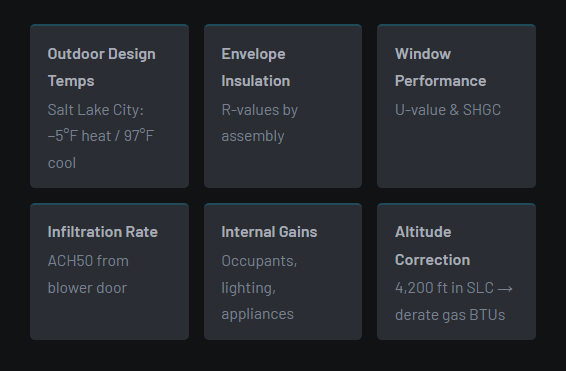
Manual J is the ACCA-standard method for calculating a building’s heating and cooling loads based on its specific characteristics — not generic assumptions. Every input matters: Utah design temperatures (−5°F heating design; 97°F cooling design for Salt Lake City), insulation levels, window U-values and SHGC, infiltration rate, orientation, and internal gains from occupants and appliances all factor into the final equipment sizing recommendation.
The Manual J Standard Example
OUR HVAC SERVICES
RainFire Builders handles the complete HVAC scope — from Manual J calculation and system selection through ductwork fabrication, equipment installation, ventilation, and smart thermostat commissioning.

The RAINFIRE HVAC PROCESS
HVAC is the most building-science-intensive trade in residential construction — and the one where the largest performance gap exists between systems designed from a calculation and systems installed from habit.
Every project begins with a room-by-room Manual J heating and cooling load calculation based on the actual building plans, insulation specifications, window performance values, Utah design temperatures (−5°F heating design temperature for Salt Lake City; 97°F dry-bulb/65°F wet-bulb cooling design), and altitude correction factor. The output determines the BTU capacity required for each room, the total system capacity, and the supply airflow needed at each register. This document is completed before any equipment is specified or ordered.
Manual D uses the Manual J airflow requirements to size every duct in the distribution system — trunk lines, branch ducts, and supply and return registers. Duct sizing must balance total external static pressure against the air handler’s blower curve to deliver the specified CFM to each room without excessive velocity noise or inadequate airflow at distant registers. In Utah, duct routing through unconditioned attics is avoided where possible — attic temperatures exceed 140°F in summer, and uninsulated ducts in that environment lose 25–40% of their conditioned air energy before it reaches the register. Where attic runs are unavoidable, ducts are sealed with mastic and insulated to R-8 minimum.
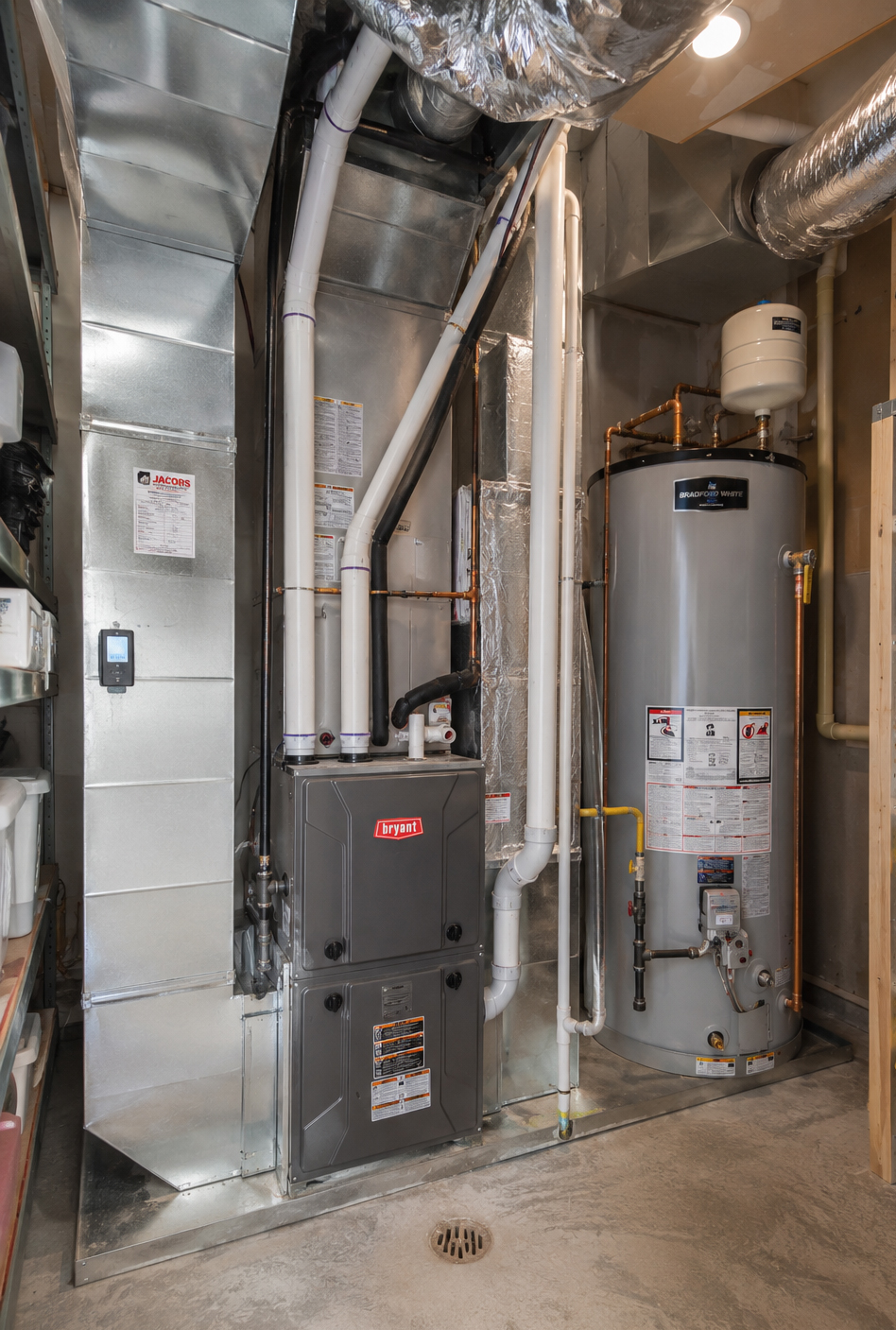
Ductwork is fabricated and installed before drywall — supply trunks, branch ducts, and return air chases are sized per the duct design and routed to register locations. Return air pathways are designed to be sufficient for every operating zone — an undersized return is one of the most common HVAC defects in production construction, causing excessive negative pressure in rooms with closed doors. Gas line connections to the furnace location are roughed in simultaneously with the plumbing gas rough-in. Flue vent routing from high-efficiency furnaces (typically 2-pipe PVC) is established during rough-in.
After drywall and before finish work, the air handler/furnace and outdoor condenser unit are installed and connected. Gas lines are pressure-tested. Refrigerant lines are run and pressure-tested before charging. ERV or HRV ventilation unit is installed and ducted to the exterior and to the air handler. Electrical connections are made to the air handler, condenser, and thermostat location. Condensate drain is routed to a proper drain or exterior location. The rough-in mechanical inspection is called and passed before any finish work covers equipment access panels.
After the system is energized, RainFire Builders commissions every component: refrigerant charge is verified by superheat and subcooling measurement (not by rule of thumb); furnace heat exchanger is inspected for cracks; supply airflow is measured at each register with an anemometer and balanced within 10% of the Manual J design CFM; total external static pressure is measured and confirmed within the air handler’s rated operating range; the ERV/HRV is set to the correct ventilation rate per ASHRAE 62.2; and the smart thermostat is programmed with occupied and unoccupied schedules. The system is handed over with a commissioning report documenting measured performance at every point.
UTAH’S UNIQUE AIR CHALLENGE
Air Quality & HVAC Filtration
Utah has two distinct air quality crisis seasons — winter temperature inversions that trap vehicle and industrial emissions in the valley, and summer wildfire smoke events that push PM2.5 into hazardous ranges. Your HVAC system’s filtration is your first line of defense for both.
RainFire Builders integrates filtration specification, ERV ventilation, and humidification into every HVAC design for Utah homes — treating indoor air quality as part of the system design, not an aftermarket add-on.
Winter Inversions on the Wasatch Front
Caused by cold dense air trapped under a warm air layer against the Wasatch Range — can push fine particulate matter (PM2.5) to unhealthy levels for days or weeks at a time, particularly in Salt Lake, Utah, and Davis Counties. During inversions, a well-air-sealed home with MERV 13 or higher filtration provides meaningfully better indoor air than the outdoor ambient.
Wildfire Smoke
Increasingly common from July through September — introduces ultrafine particles and gaseous pollutants (formaldehyde, acrolein, and others) that standard fiberglass filters do not capture. MERV 13 captures PM2.5 particles. HEPA filtration (in whole-home bypass configurations) provides the highest filtration level without overpressuring standard HVAC systems.
Utah’s Dry Winters
Create a secondary air quality issue: extremely low indoor humidity from both the cold outdoor air and the heating system. Whole-home humidification — either bypass or steam — maintains relative humidity in the 35–50% range recommended by ASHRAE, which reduces the survival time of airborne viruses and bacteria, reduces static electricity, and protects all wood elements in the home.
