
EVERY PROJECT RUNS ON PROCESS
A project built on a handshake and a vague scope will accumulate surprises. A project built on detailed estimates, written schedules, open job costing, documented change orders, managed inspections, and a quality assurance program runs on information — and finishes the way it started, on time and on budget.

The Build Is the Easy Part. Managing It Is the Job.
Anyone with a contractor’s license can frame a wall. The part that makes or breaks a construction project — that determines whether a client ends construction with the result they expected or a list of things that went wrong — is the project management layer that operates around, above, and below the physical work. Estimates that include everything. Schedules that reflect reality. Cost tracking that happens in real time, not at the end. Change orders that document every dollar before work proceeds. Inspections that are passed before the next phase starts. Quality assurance that catches problems while they are still inexpensive to fix.
RainFire Builders manages every project through six formal disciplines — the same process on a $12,000 deck as on a $2.4 million custom home. The scale changes; the discipline does not. These aren’t extras for premium clients. They are the minimum standard for every project we take on, because the consequences of not having them fall on the client, not the contractor.
Projects with Written Estimates & Change Orders
Formal Project Management Disciplines
Interior Trades – One Schedule
Verbal Quotes or Handshake Scope Changes
Estimate
Written scope. Line-item costs. No verbal quotes. Every inclusion and exclusion is stated clearly before any contract is signed.
Schedule
Dated production plan. Trade sequencing confirmed. Updated weekly to reflect current progress and projection — not the original plan.
Job Cost
Real-time tracking of every dollar spent and committed. Monthly reports. No end-of-project surprises — clients know the financial position at any point.
Change Orders
Every scope change is in writing before work proceeds. Cost and schedule impact stated. Signed by both parties. Log maintained throughout the project.
Inspections
Every permit inspection is managed, scheduled, and passed before the next phase begins. Documentation filed for every passed inspection.
Quality Assurance
Phase sign-off before each trade hands off. Project manager milestone reviews. Client punch list completed before final payment.
INDUSTRY STANDARD VS. RAINFIRE STANDARD
What “Professional” Actually Looks Like
The residential construction industry has no uniform professional standard for project management. A contractor can be licensed, bonded, and insured and still manage every project through verbal agreements, mental schedules, and invoice-by-feel billing. Most clients don’t know the difference until something goes wrong — at which point the absence of documentation becomes the problem.
RainFire Builders applies a management standard borrowed from commercial construction to every residential project we take on. Written estimates with defined scope. Dated schedules with named phases. Job cost tracking against those estimates. Change orders that require signatures before work proceeds. Inspection scheduling and documentation. Phase-by-phase quality verification. Not because clients demand it — most don’t know to ask for it. Because it produces better outcomes, fewer surprises, and a project record that means something when the project is done.
The comparison below is not flattering to the residential construction industry as a whole. It is an accurate description of what most homeowners experience versus what a managed project looks like. You deserve the latter on every project, regardless of size.
Typical Industry Practice
Estimates
Verbal or range quotes. “Around $X, depending.” Inclusions not specified in writing.
Scheduling
Mental schedule. “We’ll get there next week.” No documented sequence or end-date commitment.
Job Costing
Financial tracking internal only, if at all. Client learns about overruns at invoice time.
Change Orders
Verbal agreements. “Yeah, we can add that.” Amount negotiated or revealed at final invoice.
Inspections
Inspections are called as required by the permit. Corrections handled as they come up. Client not informed.
Quality Assurance
Quality managed by individual trade crews. No formal review between phases. Defects found at punch list — expensive to fix.
RAINFIRE BUILDERS STANDARD
Written, line-item estimates. Every material and labor item listed. Every exclusion is stated. No surprises in the contract.
Written production schedule with phase dates. Updated weekly. The client has the current projection, not just the original plan.
Monthly job cost reports are shared with the client. Budget vs. actual by cost code. Real-time visibility — no end-of-project shock.
Written change orders only. Cost and schedule impact are stated before work proceeds. Signature required. Running log maintained.
All inspections scheduled and tracked. Corrections resolved before the next phase. Client receives inspection pass documentation.
Phase sign-off before handoff. Project manager milestone reviews. Problems caught while the wall is open, not after the drywall is hung.
OUR PROJECT PROCESSES
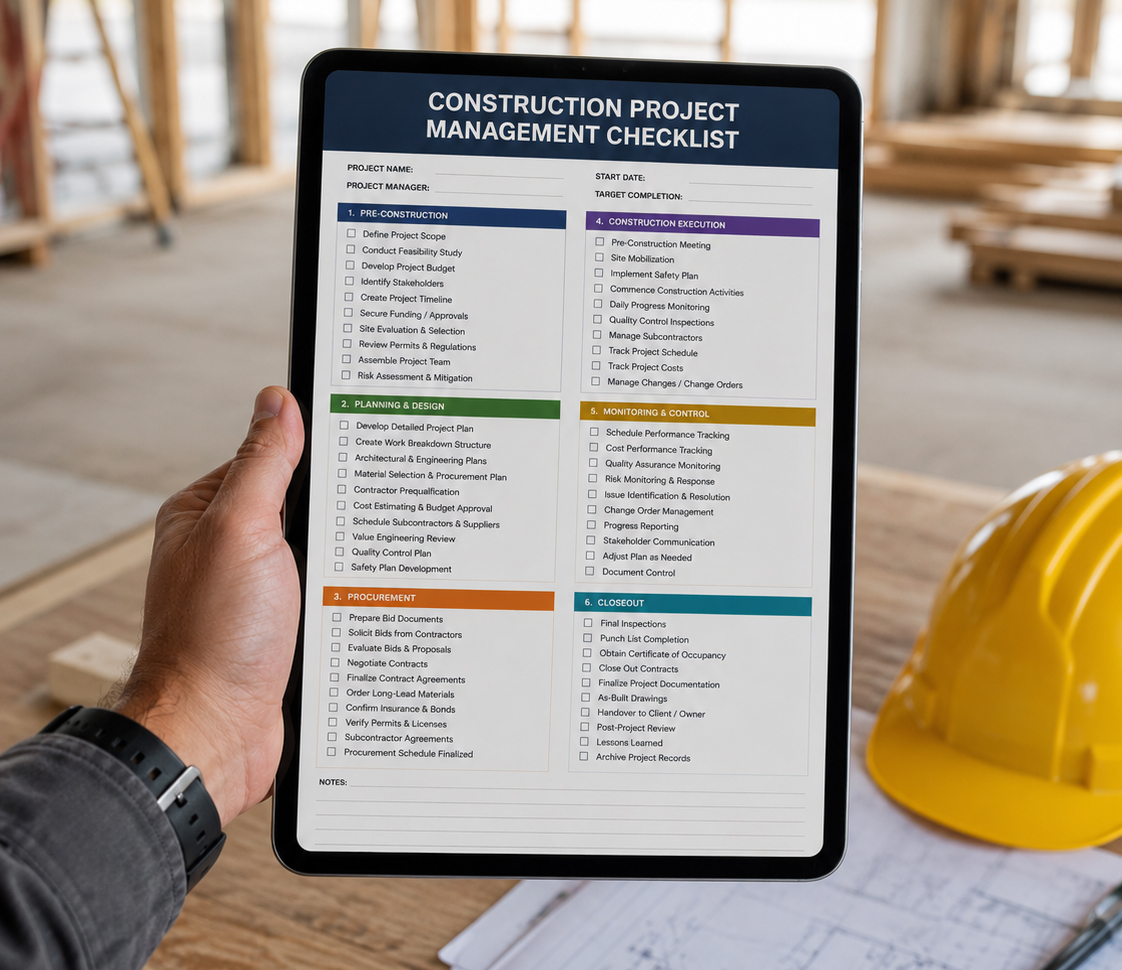
PROJECT MANAGEMENT DEEP DIVES
How We Manage
Every Project
Each of the six project management disciplines operates as a formal system — not an informal best effort. Here is what each one means in practice on a RainFire Builders project, and what you should expect from your contractor on any project you undertake.
Estimates
An estimate is not a guess with a number attached. A RainFire Builders estimate is a written document that breaks every cost into its components — labor by trade and hour, materials by specification and quantity, subcontractor scopes by defined deliverable, permit fees, and a clearly stated contingency. Every item that is included is listed. Every item that is excluded is stated. The scope of work that accompanies the estimate defines what the project is, so both parties are agreeing to the same thing before any contract is signed. This is the document that prevents end-of-project disputes about what was included and what wasn’t.
- Written scope of work accompanying every estimate
- Labor costs broken out by trade and phase
- Materials specified by the manufacturer, model, and quantity
- Permit fees and soils report costs itemized separately
- Exclusions listed explicitly — no implied scope
- Contingency line item stated and explained
- Pre-construction services agreement for complex projects
Written. Line-Item. No Surprises.
Scheduling
A schedule is not a rough timeline communicated verbally at a project kickoff meeting. A RainFire Builders production schedule is a written document that sequences every phase of work, identifies the trade responsible for each phase, states the planned duration of each phase, and sets a projected completion date. The schedule is updated weekly and shared with the client — reflecting the current state of the project, not the original plan that was prepared before work began. When phases run ahead or behind, the downstream schedule is updated immediately. Trade sequencing on RainFire Builders projects benefits materially from in-house self-performance of all ten interior trades — there are no unknown subcontractor availability windows creating unexplained gaps in the sequence.
- Written production schedule with phase start and end dates
- Trade sequencing with named crews, not unnamed subcontractors
- Weekly schedule updates shared with the client
- Critical path identification for weather-sensitive and lead-time items
- Material delivery dates coordinated into the schedule
- Inspection hold points built into the sequence
- Schedule impact is documented on every change order
Dated. Sequenced. Updated Every Week.
Job Costing
Job costing is the discipline of tracking every dollar spent on a project against the approved estimate, in real time, so the project’s financial position is known continuously rather than revealed at invoice time. Open-book job costing means the client has access to that tracking — they can see what has been spent to date, what has been committed for future work, what is pending, and what the current projection-to-complete is. RainFire Builders provides monthly job cost reports on projects over a defined threshold, showing budget versus actual for every cost code. This transparency allows both parties to make informed decisions about scope changes while there is still time and budget to respond to them — and eliminates the construction industry’s most common client complaint: “I had no idea it was going to cost this much.”
- Monthly job cost reports: budget vs. actual by cost code
- Committed cost tracking — what’s spent and what’s contracted
- Projection-to-complete updated with every change order
- Labor cost tracking against estimate by trade phase
- Material cost tracking against specification and quantity
- Contingency usage is transparent and explained
- Final job cost reconciliation at project close
Open Book. Monthly Reports. No End-of-Project Shock.
Change Orders
A change order is a written document that describes a scope modification to the original contract — whether the change was initiated by the client, discovered as a field condition, or required by the building department. Every RainFire Builders change order identifies the scope being added, removed, or modified; the cost impact with a breakdown of labor and materials; the schedule impact in calendar days; and the reason the change is occurring. Work on the changed scope does not begin until the change order is signed by both parties. This is not bureaucratic formality — it is the discipline that prevents the most common and most damaging failure mode in construction project management: the accumulated verbal agreement that turns a $150,000 project into a $210,000 one without the client ever consciously authorizing the difference.
- Written change orders for every scope modification
- Cost impact breakdown by labor and material
- Schedule impact in calendar days stated on every CO
- Reason for change documented (client request, field condition, code)
- No work on the changed scope before CO is signed
- The change order log is maintained and shared monthly
- Running contract value is updated with every executed CO
Written Before Work. Signed by Both Parties.
Inspections
Building department inspections are the legally required checkpoints that confirm construction meets the permitted drawings and applicable codes before the work is covered. On a typical Utah residential project, this means: footing inspection before concrete placement; underground rough-in inspections for plumbing and electrical; framing inspection before insulation; MEP rough-in inspections (plumbing, electrical, HVAC) before insulation and drywall; insulation inspection; and final inspections for each trade culminating in a final building inspection and certificate of occupancy. RainFire Builders manages all inspection scheduling, responds to any inspection corrections before proceeding to the next phase, and provides clients with documentation of every passed inspection. An uninspected construction project leaves the homeowner with no verified record that the work meets code — a significant liability at resale and for insurance.
- Complete inspection scheduling and tracking for all permit types
- Footing and foundation inspection before every concrete pour
- MEP rough-in inspections: plumbing, electrical, and HVAC
- Framing and insulation inspection management
- Inspection corrections are resolved before the next phase proceeds
- Certificate of occupancy obtained and filed for every project
- The client receives documentation of all passed inspections
Every Phase. Every Pass. Everything Documented.
Quality Assurance
Quality assurance is the systematic verification that work meets the project’s specified standards before the construction sequence makes correction expensive. On a RainFire Builders project, QA operates at three levels: trade-level self-inspection by each crew supervisor at phase completion, before the next trade begins; project manager review at each major milestone — foundation, framing, MEP rough-in, insulation, drywall, and finishes — with a phase sign-off checklist completed and filed; and a final punch list review conducted with the client before project closeout, with all items resolved before final payment is processed. Beyond inspection frequency, quality assurance at RainFire Builders begins at specification — specifying the correct Utah mix design for concrete, the correct IECC climate zone for window U-factor, and the correct ACI 318 reinforcing for a Seismic Design Category D foundation eliminates entire categories of quality failures before any crew member arrives on site.
- Phase sign-off checklist completed before each trade handoff
- Project manager milestone reviews at 6 defined checkpoints
- Specification-level QA: correct mix design, correct IECC zone, correct seismic reinforcing
- Photographic documentation at each QA milestone
- Client punch list review before project closeout
- All punch list items resolved before final payment
- Written workmanship warranty covering the complete scope
Phase Sign-Off Before Every Handoff.
FROM FIRST CALL TO FINAL CERTIFICATE
The Project Journey at RainFire Builders
Every project we take on moves through the same gates — in the same sequence, with the same documentation standards, regardless of project size. Here is what that sequence looks like from the client’s perspective.
Free Project Assessment & Site Visit
PHASE 01 – FIRST CONTACT
Every project starts with a conversation — about what you want to build, what constraints exist, what the timeline looks like, and whether the project is a fit for RainFire Builders’ scope and expertise. This is followed by a site visit where we assess the actual conditions: topography, access, existing structure, soil type (for foundation and concrete work), municipal requirements, and any HOA or WUI zone conditions. No charge for the site visit and initial assessment.
Written Estimate with Full Scope Documentation
PHASE 02 – ESTIMATE & CONTRACT
The written estimate with line-item detail is delivered within the committed timeframe — 3–5 business days for straightforward scopes, 7–14 days for complex multi-trade projects. The estimate is accompanied by a written scope of work that defines inclusions and exclusions. If the estimate is accepted, a construction contract formalizes the scope, price, payment schedule, change order protocol, and warranty terms. No work begins until the contract is signed and the first payment milestone is received.
Permits, Materials, Schedule, and Trade Coordination
PHASE 03 – PRE-CONSTRUCTION
Pre-construction is the phase between signing the contract and swinging the first hammer — and it is where the project’s success is largely determined. Permit applications are submitted with complete drawings. Material lead times are assessed, and long-lead items are ordered. The production schedule is finalized with trade start dates. Any utility locates, soil reports, or HOA approvals required before work begins are completed. The project doesn’t start construction until it is fully prepared to proceed without preventable interruption.
Built in Sequence, Inspected at Every Phase
PHASE 04 – CONSTRUCTION
Construction proceeds per the schedule — with phase sign-off at each trade handoff, inspections called and passed before covered work proceeds, weekly client updates, and change orders executed in writing for every scope modification. Monthly job cost reports keep the financial picture current. The project manager is on-site at key milestones and available for client visits at any time. The daily standard on a RainFire Builders project: every trade does their job well, the QA process catches what doesn’t meet standard, and the client is never surprised by what they find when they show up.
Punch List Closed. Certificate Filed. Warranty Delivered.
PHASE 05 – CLOSEOUT & WARRANTY
Project closeout begins with the joint punch list walk. Every item is documented and resolved before the final payment is requested. The certificate of occupancy is obtained and delivered to the client along with the complete inspection documentation package, manufacturer warranties, product registration confirmations, and the written workmanship warranty. A 12-month follow-up is scheduled to identify any post-occupancy issues while they are still fresh and clearly attributable to the construction scope. The relationship doesn’t end when the last check clears.
EXPERIENCE AS IT IS VITAL
The Whole Building Process is in the Right Hands
COMMON QUESTIONS
How Project Management Actually Works
The questions clients most commonly ask about how a professionally managed construction project should operate — answered honestly.
RainFire Builders provides written estimates with line-item detail for every scope — labor by trade, materials by specification, subcontractor allowances, permit fees, and a clearly stated contingency. We do not provide range estimates or verbal quotes. Every estimate is tied to a written scope of work so both parties know exactly what is included and what is not. Pre-construction estimates are provided at no charge for projects within our service area and scope range. For complex projects (custom homes, large additions, full remodels), we offer a paid pre-construction services agreement that produces detailed cost plans, schedules, and constructability reviews before any contract is signed.
Every RainFire Builders project begins with a written production schedule — a sequenced, dated plan showing every phase of work, the trade responsible for each phase, and the durations assumed. Schedules are updated weekly and shared with the client, reflecting current progress and projections rather than the original plan. Trade sequencing benefits from in-house self-performance of all ten interior trades — there are no unknown subcontractor availability windows creating unexplained schedule gaps. The schedule is a commitment, not a suggestion, and every change order documents its impact on the project end date before work proceeds.
Job costing is tracking every dollar spent on a project against the estimate, in real time. Open-book job costing means the client has access to that tracking — spent to date, committed for future work, and current projection-to-complete. RainFire Builders provides monthly job cost reports on projects above a defined threshold, showing budget versus actual for every cost code. This transparency eliminates end-of-project surprises and allows informed decisions about scope changes while there is still time and budget flexibility to respond to them. It is the most effective tool for preventing the most common client complaint in construction: “I had no idea it was going to cost this much.”
Every scope change — whether client-initiated, field-discovered, or code-required — is documented as a written change order before work proceeds. The change order identifies the modified scope, the cost impact with a labor and material breakdown, the schedule impact in calendar days, and the reason for the change. Work on the changed scope does not begin until the change order is signed by both parties. The change order log is included in the monthly project documentation. Verbal agreements to add scope are not honored on RainFire Builders projects — this protects the client from accumulating undocumented costs and protects both parties from disputes at project closeout.
RainFire Builders manages all required permit inspections on every project — from footing inspection before concrete placement through the final certificate of occupancy. Required inspections for a typical Utah residential project include: footing and foundation before concrete; underground plumbing and electrical rough-in; framing before insulation; MEP rough-in (plumbing, electrical, HVAC) before insulation and drywall; insulation before drywall; and final inspections for each trade culminating in the final building inspection. All inspections are scheduled and tracked by the project manager. Clients receive documentation of every passed inspection at project closeout.
QA operates at three levels: trade supervisor self-inspection at phase completion before the next trade begins; project manager milestone reviews at six defined checkpoints (foundation, framing, MEP rough-in, insulation, drywall, finishes) with sign-off checklists completed and filed; and a final punch list review with the client before closeout, with all items resolved before final payment. Specification-level QA — using the correct Utah concrete mix design, the correct IECC climate zone for windows, the correct seismic reinforcing for the local SDC — eliminates entire categories of quality failures before any crew member arrives on site.
Straightforward, defined-scope projects: 3–5 business days after the site visit. Complex multi-trade projects (custom home, full remodel, large addition): 7–14 business days. We do not rush estimates — an estimate produced in 24 hours almost certainly omits items that will show up as change orders after work begins. A complete, detailed estimate delivered in 10 business days protects the client from scope surprises and protects the project from underbid distress. We tell you upfront how long the estimate will take and deliver by that date.
Budget overruns fall into two categories: scope changes (client-initiated, field-discovered conditions, or code-required work) and estimating errors (items omitted or incorrectly priced in the original estimate). Scope changes are documented as change orders — every dollar of added scope is written and signed before work proceeds. Estimating errors are RainFire Builders’ responsibility and are absorbed, not billed to the client. This distinction is defined in the contract, the project’s cost history is tracked transparently in monthly job cost reports, and the client always knows the current authorized contract value and the reason for any change from the original.
The RainFire Standard
WHY PROJECT MANAGEMENT IS OUR DIFFERENTIATOR
The trades are our craft. The management is our commitment. Here is what that means in practice on every project we take on.
No Verbal Quotes
Every cost commitment is written, itemized, and tied to a defined scope. Verbal quotes protect contractors — written estimates protect clients. We provide the latter, every time, as a condition of starting any project conversation.
One Team, All Trades
Self-performing all ten interior trades means one schedule, one accountability, and no coordination gaps. The framing crew, the electrician, the HVAC installer, and the tile setter are all on the same team with the same project manager.
Transparent Financials
Monthly job cost reports are shared with every client. Budget versus actual by cost code. The change order log is current at all times. The client is never the last to know the project’s financial position.
QA Before Cover-Up
Phase sign-off before every trade handoff catches problems while correction is still inexpensive. The industry norm is to find quality issues at punch list — after the wall is closed and the paint is dry. We found them before.
A Project Built On Process Is A Project Built Right.
Ready to Start a Project That Runs the Way It Should?
Most construction clients don’t know what to expect because most contractors haven’t shown them. A written estimate with a defined scope. A schedule that gets updated every week. An open job cost report that shows you exactly where your money is going. A change order that requires a signature before any extra work proceeds. Inspections passed and documented. Quality verified before the wall closes. This is not a premium tier — it is how every RainFire Builders project runs. Start a conversation and see what it feels like when construction goes the way it should.
Call us now at (385) 336-7246 or request an estimate online. We’ll start on your property’s project and your future with care.
We Make It Happen –
Request a Quote
Schedule your in-person consultation. Let’s get your project started
