INTERIOR PAINTING
With RAINFIRE BUILDERS
GET A FREE PAINTING ESTIMATE
LEARN MORE BELOW
Paint is the most visible finish in any room — and the one most damaged by everything that happened before it. Flashed joints, sheen inconsistency, brush marks in trim, and peeling at the ceiling line are all painting problems with roots in surface prep, primer selection, and sequencing. RainFire Builders treats paint as a system, not a step — and the results speak for themselves on every wall we finish.
PAINTED FOR UTAH’S ENVIRONMENT
What Does Utah’s Climate Mean for Paint?
Utah’s unique climate creates conditions that affect interior painting in ways that painters from other regions may not anticipate. Very low humidity in winter (often 10–20% indoors without humidification) causes latex paint to dry faster at the surface — which can create lap marks when sections are not maintained wet-to-wet and can affect inter-coat adhesion if recoat windows are not respected.
Temperature extremes matter too. Paint applied in spaces below 50°F will not cure correctly, resulting in soft, tacky films that peel prematurely. In new construction, this means temporary heat must be running and reaching temperature before painting begins in the fall and winter months — a requirement RainFire Builders enforces regardless of schedule pressure.
Utah’s wildfire smoke seasons and winter temperature inversions create significant indoor air quality concerns. Low-VOC and zero-VOC paint options are not just an environmental preference — in Utah, they are a practical choice for client health during and after the painting process. RainFire Builders specifies low-VOC products as the default on all residential projects.

Humidity Monitoring
RainFire Builders monitors indoor relative humidity on painting days. Very dry conditions change how we maintain wet edges, sequence coats, and schedule recoat times to prevent lap marks and adhesion failures.
50°F Minimum — Non-Negotiable
Paint applied below 50°F will not cure correctly. We verify space temperature — and the forecast for the next 48 hours — before beginning any painting work in cooler seasons.
Low-VOC Default
Utah’s air quality challenges — winter inversions and wildfire smoke — make indoor air quality especially relevant. Low-VOC and zero-VOC paints are specified as our residential default at no significant cost premium.
UV & Fading Considerations
Utah’s high-altitude sun is intense. Rooms with large south- or west-facing windows benefit from paint products with UV-resistant formulations to reduce color fading — we specify these where relevant.
OUR INTERIOR PAINTING SERVICES
RainFire Builders handles the full interior painting scope — from raw drywall through final touch-up — as a single coordinated package sequenced correctly with every other interior trade.

The RAINFIRE PAINTING PROCESS
Paint is applied last and judged first. Our process works backward from that reality — every step is designed to protect the final result, not to move faster through the schedule.
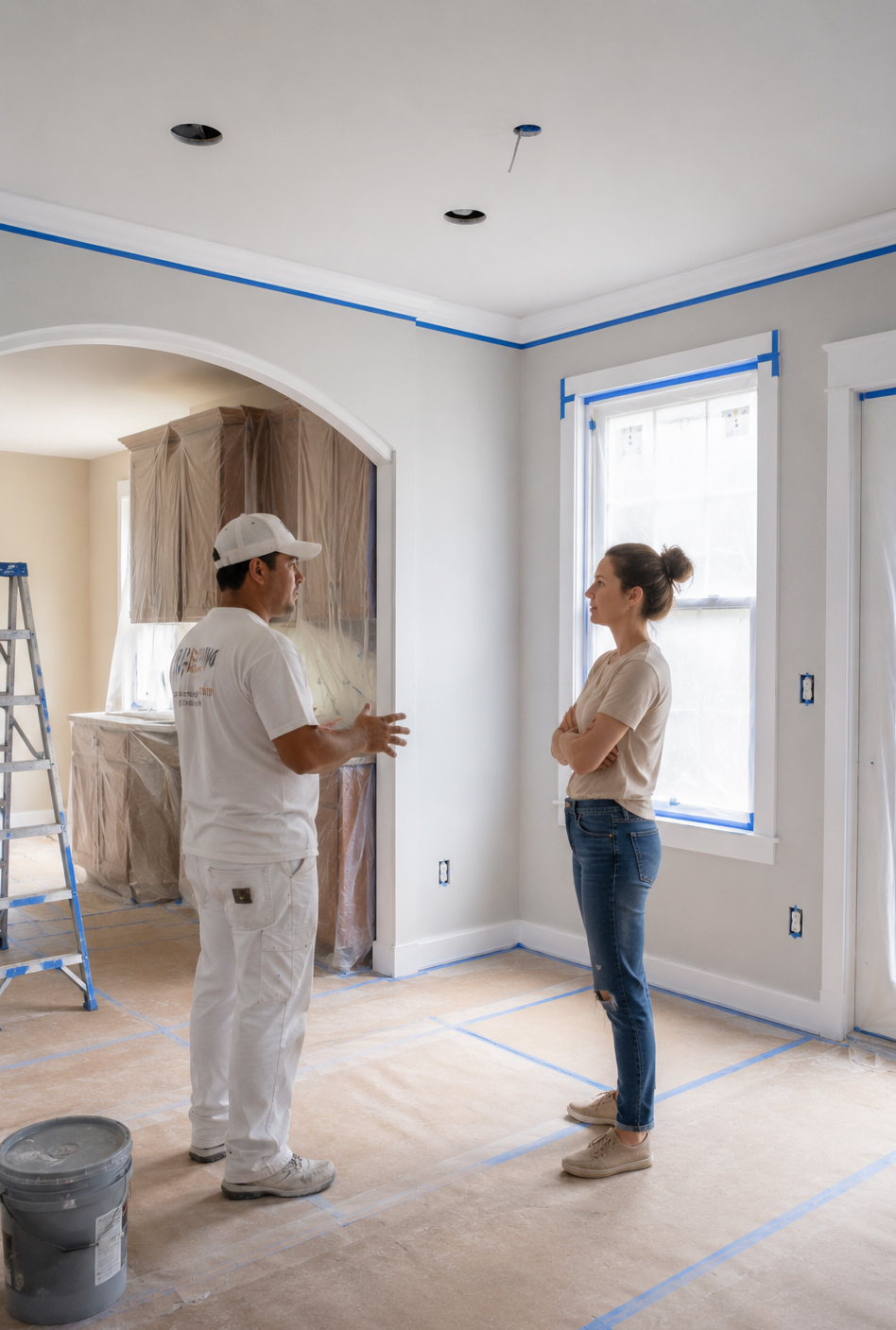
Before any painting begins, RainFire Builders produces a written paint schedule — every room, every surface, every product, every sheen, and the primer type. This schedule is reviewed with the client and confirmed in writing. It eliminates the ambiguity that leads to wrong sheen in the wrong room, missed accent walls, and scope disputes at the end of the project. Color selections are confirmed with memo samples on the actual wall surface under the home’s real lighting before full commitment.
All drywall repairs and skim patches are sanded smooth and feathered before any primer is applied. Existing painted surfaces are cleaned with TSP substitute and sanded where needed to break gloss and improve adhesion. Nail holes, dents, and caulk gaps are filled. Window and door casings are caulked at the wall before painting. All trim and millwork surfaces are lightly sanded for tooth. In remodels, surfaces with water stains, smoke damage, or marker are treated with shellac-based stain blocker before any latex primer or paint is applied — not after the stain bleeds through two coats of finish.
New drywall receives a dedicated PVA (polyvinyl acetate) drywall primer — the only product that seals both the paper face and joint compound areas uniformly, preventing the flashing that results from differential absorption. Trim receives a dedicated wood primer or bonding primer depending on the substrate. Spot priming is applied anywhere repairs were made to existing painted surfaces. Primer is always a discrete step — never substituted by applying extra coats of finish paint or paint-and-primer products on new drywall.
Ceilings are painted before walls. Cut lines at the crown, recessed lights, and ceiling fans are cut in first, then rolled with a consistent nap roller matched to the texture level of the surface. Walls are cut in at the ceiling line, trim, and corners with a clean, crisp line — then rolled from floor to ceiling in the same overlapping W-pattern to avoid lap lines. Utah’s dry air accelerates dry time, which requires maintaining a wet edge throughout each section to prevent visible lap marks at roller transitions.
After the first coat is fully dry (minimum 4 hours for latex; longer in very dry conditions), a second coat is applied to all walls and ceilings. Trim receives two finish coats with a light sand between coats for a smooth, brush-mark-free result. Doors are painted separately — off their hinges where possible for spray application. Final inspection is conducted under raking light before the project is handed over. Touch-up list is completed before final payment. RainFire Builders does not consider a painting project done until the client has walked through it and signed off.
