Concrete and Masonry2026-06-06T11:05:34+00:00

Exterior Construction – Concrete & Masonry

Concrete That Outlasts Utah’s 
100 Freeze-Thaw Cycles

Utah’s Wasatch Front endures more than 100 freeze-thaw cycles per year. Standard 3,000 PSI non-air-entrained concrete — the specification used in warmer markets — scales, spalls, and cracks within 5–10 years under that kind of cycling. The difference between concrete that lasts 30 years and concrete that fails in 10 is a mix design decision made before the first truck arrives. RainFire Builders specifies air-entrained 4,000 PSI concrete for all Utah exterior applications — and builds every slab, wall, and masonry system with the subbase, reinforcement, and control joints that make the mix design’s promise hold.

GET A FREE CONCRETE ASSESSMENT

EXPLORE OUR SERVICES

OUR CONCRETE & MASONRY SERVICES

  • Concrete Flatwork

  • Stamped & Decorative Concrete

  • Concrete Driveways

  • Retaining Walls

  • Concrete Steps & Entryways

  • Brick & CMU Block Masonry

  • Natural & Cultured Stone

  • Exposed Aggregate Concrete

  • Outdoor Fireplaces & Fire Features

  • Concrete Repair & Restoration

100%

Licensed & Insured

7+

Counties Served

15+

Years in Utah

500+

Projects Delivered

PERFORMANCE FUNDAMENTALS

Why Mix Specification is the Most
Important Concrete Decision You Make

Every concrete project begins with a specification that most homeowners never see — the mix design. Compressive strength (PSI), air content, water-cement ratio, aggregate type, and cement type are the parameters that determine how the concrete will perform in Utah’s specific outdoor environment. A correctly specified mix on a correctly prepared subbase will outlast the house. An under-specified mix on an inadequate subbase will fail visibly within one decade in Utah’s climate.

Air entrainment is the critical Utah specification. During mixing, an air-entraining admixture creates a network of microscopic, uniformly distributed air voids — typically 5–7% of the concrete volume. When water in the concrete’s capillary pores freezes, these voids provide space for ice expansion without generating internal pressure sufficient to crack the concrete matrix. The Salt Lake valley experiences more than 100 freeze-thaw cycles per year; ACI 318 classifies this as exposure class F2 (moderate freeze-thaw) and requires air-entrained concrete for all exterior applications. Non-air-entrained concrete in this environment develops surface scaling within 5–10 years as freeze-thaw stress repeatedly damages the concrete surface.

Water-cement ratio is the second key parameter. More water makes concrete easier to place but dramatically increases permeability — and permeable concrete allows more water infiltration into the pore structure, which amplifies freeze-thaw damage. A water-cement ratio of 0.45 or below is the correct target for Utah exterior concrete; ratios above 0.50 produce noticeably less durable concrete in Utah’s environment. Never add water to a concrete truck to improve workability in Utah — the short-term ease is paid for in years of service life.

Masonry — brick, CMU block, and stone — has its own set of Utah-specific performance considerations. Proper mortar joint tooling creates a compacted, water-repellent surface at every joint that resists moisture infiltration. Weep holes at the base of masonry cavities allow any water that penetrates the outer wythe to drain to the exterior. And because Utah’s hard water (200–400 ppm) deposits calcium carbonate at the surface as migrating water evaporates, efflorescence management through proper drainage is as much a part of good masonry construction as the mortar specification itself.

FINISH SURFACE

Broom finish, stamped texture, exposed aggregate, or trowel finish applied to the fresh concrete surface. The finish quality and texture affect both appearance and slip resistance. Tooled control joints placed at ACI 360-recommended spacing (2–3× slab thickness in feet) guide crack location to the joints.

CONCRETE SLAB – 4,000 PSI AIR-ENTRAINED

4-inch minimum residential (5–6″ for vehicle-heavy areas), minimum 4,000 PSI compressive strength, 5–7% air entrainment per ACI 318 F2 exposure class, w/c ratio ≤ 0.45. Reinforced with #3 or #4 rebar at 18″ O.C. each way, or fiber-reinforced concrete for residential flatwork. Cured per ACI 308 for a minimum of 7 days.

VAPOR BARRIER (INTERIOR SLABS)

10-mil polyethylene vapor barrier (ASTM E1745 Class A) under interior slabs — including basement slabs and garage floors — to prevent soil moisture vapor migration into the slab. Critical in Utah’s clay-dominant soils. Not always required under exterior flatwork with positive drainage.

COMPACTED AGGREGATE BASE

4–6 inches of class II aggregate (3/4″ minus crushed stone), compacted to 95% modified Proctor density. The base layer provides drainage, distributes loads, and prevents differential settlement — the primary cause of concrete slab cracking in Utah. Over-excavation to remove expansive clay and replacement with non-expansive fill is required on sites with high-plasticity soils.

GEOTEXTILE FABRIC

Non-woven geotextile fabric between the subgrade and aggregate base on sites with fine-grained or expansive soils. Prevents subgrade fines from migrating up into the aggregate layer (pumping), maintaining the drainage and load-distribution performance of the base over time.

PREPARED SUBGRADE

Native soil or engineered fill, graded for positive drainage (minimum 1–2% slope away from structures), scarified and recompacted. On sites with Lake Bonneville expansive clay soils, imported non-expansive fill may replace the top 12–24 inches of native soil to eliminate the differential movement that causes slab cracking.

OUR SCOPE OF WORK

OUR CONCRETE &
MASONRY SERVICES

Every concrete placement and masonry installation is managed from subbase preparation through final sealer — with freeze-thaw-specified mix design, proper control joint layout, and Utah-specific reinforcing details on every project.
Recruitment Executive Search

Driveways, patios, walkways, and utility pads — the complete flatwork scope for Utah residential and commercial projects. Subgrade preparation with expansive soil assessment, 4–6 inch compacted aggregate base, air-entrained 4,000 PSI concrete placement with reinforcing, control joint layout per ACI 360 recommendations, broom or brushed finish, and penetrating sealer application. Proper positive drainage grade away from all structures is confirmed before forming. Formed concrete edges and transitions to existing surfaces were detailed to prevent edge cracking.

Stamped concrete in stone, slate, flagstone, cobblestone, brick, and wood-plank patterns — with integral color, dry-shake accent color, and solvent or water-based acrylic sealer to enhance color and protect the surface. Utah stamped concrete requires the same 4,000 PSI air-entrained base mix as standard flatwork — the decoration is in the surface treatment, not a different product. Sealer reapplication every 2–3 years is required to maintain color vibrancy and surface protection in Utah’s UV environment. Also available: acid-stained and polished concrete for covered outdoor applications.

Recruitment Executive Search

New driveway construction and full replacement for Wasatch Front residential and commercial properties. 4-inch minimum for passenger vehicle applications, 5–6 inches for RV, boat, and truck traffic areas. Expansion joint between the new driveway and the existing garage slab and public sidewalk. Proper grade to drain away from the garage floor and foundation. Thickened edges prevent spalling at driveway margins. De-icing salt-resistant specification (ACI F3 exposure) available for driveways in areas where sodium or calcium chloride applications will be used in winter.

Poured concrete, CMU block, and segmental retaining wall systems for grade change management on Wasatch Front residential and commercial sites. Walls up to 4 feet are built to IRC R404 prescriptive standards with frost-depth footings; walls over 4 feet receive licensed structural engineering for soil pressure, SDC D seismic loads, and ASCE 7-22 compliance. Drainage aggregate backfill and perforated drain tile behind the wall relieve hydrostatic pressure — the most common cause of retaining wall failure in Utah. All permitted retaining walls include a footing inspection before concrete placement.

Recruitment Executive Search

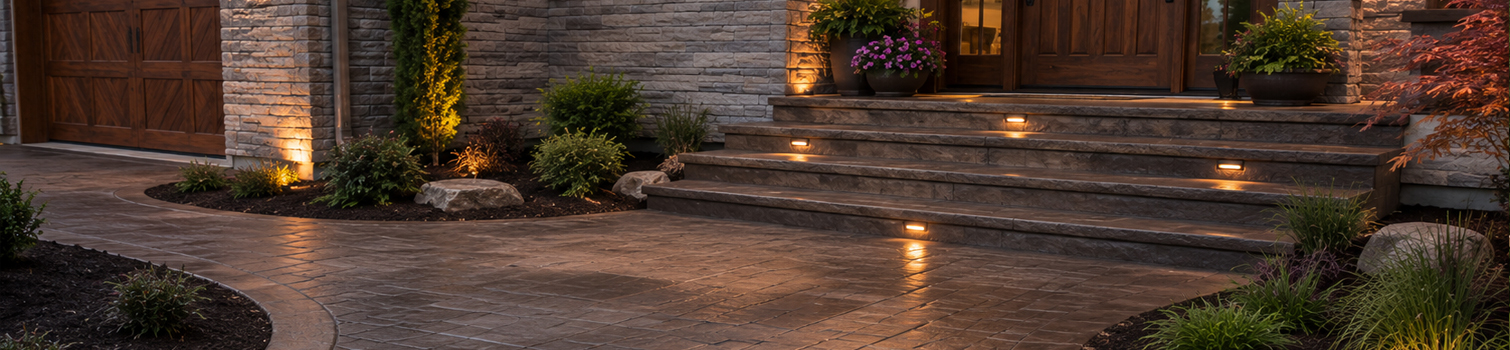
Exterior stair construction in poured concrete — front entry steps, garage approach steps, patio step transitions, and landscape step systems. All exterior concrete steps in Utah require frost-depth footings (30–36″ depending on location) to prevent the frost heave that tilts and cracks improperly founded steps within a few winters. Riser and tread dimensions designed to IRC R311 stair requirements: 4-inch minimum riser, 11-inch minimum tread, maximum 3/8-inch variation in riser or tread dimension. Integral handrail post anchor pockets for railing attachment are included on steps 30 inches or more above grade.

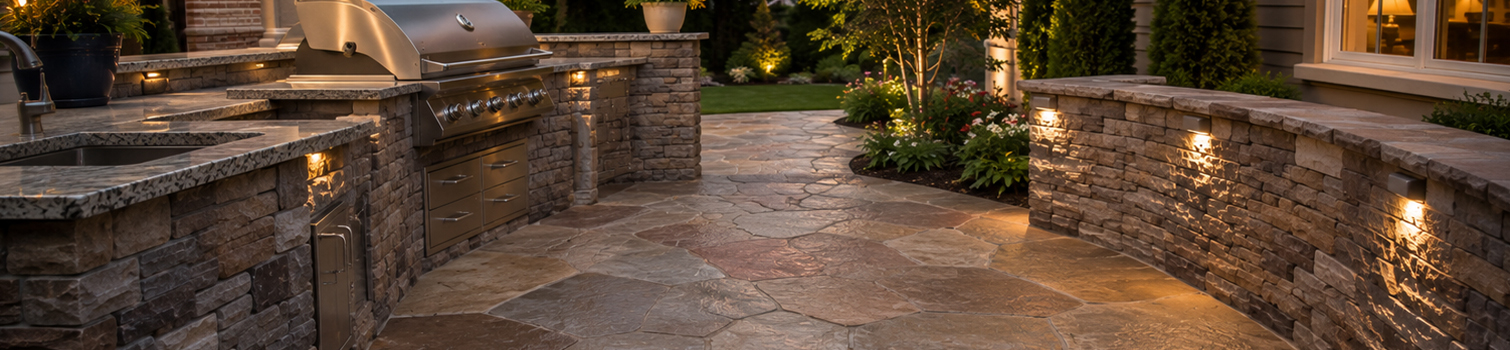
Structural and decorative masonry — brick veneer, CMU block walls, natural stone accent walls, cultured stone installation, and outdoor fireplace masonry. Mortar specified per ASTM C270 Type S for below-grade and high-freeze-thaw exposure. Tooled mortar joints (concave or V-joint) create a denser, water-repellent surface than flush or raked joints — the Utah-appropriate finish specification. Weep holes at 24-inch spacing at the base of cavity walls for drainage. Efflorescence control through penetrating silane/siloxane sealers applied after masonry has fully cured.

HOW WE WORK

The RainFire Concrete & Masonry Process

The decisions that determine concrete longevity are made before the first truck arrives — in the mix specification, the subbase preparation, and the reinforcing layout. Our process builds in those decisions at every stage.

About Avada Recruitment
Built for Utah’s Conditions

Why Utah Concrete & Masonry Demands Utah-Specific Specification

The most common concrete failure on the Wasatch Front is not bad concrete — it is correct concrete for the wrong climate. A 3,000 PSI non-air-entrained mix is an acceptable specification in Phoenix, Dallas, or Orlando. In Utah, where the same driveway endures more than 100 temperature crossings of 32°F every year, it produces a slab that begins scaling at the surface within 5 years and is visibly deteriorating at 10. The air-entrained 4,000 PSI mix costs approximately 15–20% more from the batch plant and is the entire difference between a 10-year concrete surface and a 30-year concrete surface. Every RainFire Builders exterior concrete placement uses the correct Utah mix.

Subbase preparation is the second non-negotiable. Concrete cannot perform better than the subgrade it sits on. Utah’s high-plasticity Lake Bonneville clay deposits in the valley-floor communities move measurably with seasonal moisture cycling — and a perfect concrete slab placed over moving expansive soil will crack, heave, and become uneven on the same schedule as the soil beneath it. Identifying expansive clay before placement and replacing it with non-expansive engineered fill is the correct response — it adds cost but produces a result that doesn’t require replacement in 10 years.

Retaining walls are a common need on Wasatch Front lots — the valley-floor communities transition rapidly into foothill topography, and grade changes of 4–12 feet are common in Sandy, Draper, Cottonwood Heights, and Murray. Every retaining wall over 4 feet of unbalanced fill requires a licensed structural engineer in Utah, and most Wasatch Front municipalities require engineered drawings and a permit for any retaining wall — regardless of height — on a hillside lot. RainFire Builders coordinates structural engineering on every engineered retaining wall scope and manages the permit process through final inspection.

Air-Entrained 4,000 PSI — Every Pour

Every RainFire Builders exterior concrete placement uses 4,000 PSI minimum compressive strength with 5–7% air entrainment per ACI 318 exposure class F2. We do not place standard 3,000 PSI non-air-entrained concrete on Wasatch Front exterior applications. The specification difference is the difference between a 10-year and 30-year surface in Utah’s climate.

Expansive Clay Subbase Management

High-plasticity Lake Bonneville clay subgrade is common throughout the Wasatch Front valley floor. RainFire Builders assesses subgrade soil type on every flatwork project and specifies non-expansive engineered fill replacement on sites with documented high-plasticity soils — the preparation that prevents differential settlement cracking regardless of concrete quality.

Retaining Wall Engineering

Retaining walls over 4 feet of unbalanced fill require a licensed structural engineer in Utah — plus seismic design for SDC D. RainFire Builders coordinates engineering on every qualifying wall and manages the permit process through final inspection. Frost-depth footings (30–36″) are installed on all retaining wall systems regardless of height.

Hard Water Sealer & Masonry Guidance

At 200–400 ppm, Wasatch Front hard water deposits calcium scale on concrete and masonry surfaces — and the scale accumulates in drainage channels and weep holes that need to function. RainFire Builders applies penetrating silane/siloxane sealers on all exterior concrete and specifies breathable sealers on masonry — and leaves every client with a written maintenance guide for Utah-specific first-season and annual care.

UTAH-SPECIFIC CONDITIONS

Six Conditions That Make Utah Concrete & Masonry Unique

Utah’s climate and geology create a combination of concrete and masonry performance challenges that are more severe than those in most U.S. markets. Any contractor applying national-average specifications without adapting them to Utah’s actual conditions is specifying for failure — the failure just takes 5–10 years to become visible.

Freeze-thaw cycling is the dominant performance driver for Utah exterior concrete. The Wasatch Front valley floor experiences more than 100 freeze-thaw cycles annually — temperatures above freezing during the day and below at night, particularly in the shoulder seasons (March–April and October–November). ACI 318 classifies this exposure as Class F2 (moderate freeze-thaw severity) and requires air-entrained concrete with a maximum water-cement ratio of 0.45 for all exterior applications. ACI’s Class F3 (severe) designation applies to areas subject to deicing salt exposure, which adds salt-specific requirements to the freeze-thaw specification.

Expansive soils from Lake Bonneville clay deposits affect the subbase performance under concrete flatwork across much of the Wasatch Front. High-plasticity clay (plasticity index > 15) in the subgrade beneath a concrete slab causes differential vertical movement as the soil cycles between wet expansion and dry contraction — producing longitudinal cracking in slabs that tracks the wetting pattern of irrigation or roof drainage. Removing the top 12–24 inches of expansive clay subgrade and replacing it with non-expansive engineered fill is the correct response on affected sites — an additional cost that is a fraction of the cost of cracking and replacing the slab within the first decade.

De-icing salts are applied to Utah driveways and walkways during the long winter season, and they accelerate concrete surface scaling beyond the freeze-thaw effect alone. Sodium chloride (rock salt) and calcium chloride both create chemical and physical stress at the concrete surface as they depress the freezing point of absorbed water. ACI 318 exposure class F3 requirements — which include higher air content and lower water-cement ratio than F2 — are appropriate for concrete surfaces that will regularly receive de-icing chemicals. The first winter after placement is the period of greatest salt vulnerability; sand is the recommended traction agent for new concrete during the first 12 months after placement.


100+ FREEZE-THAW CYCLES PER YEAR

SLC valley: 100+ annual freeze-thaw cycles. ACI 318 exposure class F2 applies — requires air-entrained concrete at 5–7% air content and w/c ≤ 0.45. Standard 3,000 PSI non-air-entrained concrete scales and spalls within 5–10 years under this cycling. Correct specification is 4,000 PSI air-entrained — the spec that separates contractors who build for Utah from those who don’t.

DE-ICING SALT EXPOSURE – ACI CLASS F3

Driveways and walkways receiving sodium chloride or calcium chloride de-icers require ACI 318 Class F3 specifications: 4,500 PSI minimum, 6–7% air, w/c ≤ 0.40. Never apply de-icing salts to concrete during the first winter (minimum 12 months) after placement — fresh concrete is more vulnerable to salt-induced scaling. Sand is the appropriate traction agent during the first season.

EXPANSIVE LAKE BONNEVILLE CLAY SUBGRADE

High-plasticity (PI > 15) montmorillonite clay under concrete flatwork moves with moisture cycling — producing differential settlement and longitudinal cracking. Remove and replace expansive clay within 12–24 inches of subgrade with non-expansive engineered fill where soils report indicates plasticity index over 15. Geotextile fabric between subgrade and aggregate base prevents clay migration into the base course.

HARD WATER EFFLORESCENCE – 200 TO 400 PPM

Wasatch Front water hardness of 200–400 ppm deposits calcium carbonate on masonry and concrete surfaces as moisture migrates through and evaporates. Efflorescence is primarily aesthetic but indicates moisture movement through the structure. Managed through proper drainage (weep holes in masonry cavity walls), penetrating sealers on concrete, and breathable silane/siloxane sealers on masonry that reduce water infiltration while allowing vapor to escape.

SDC D – ENGINEERED RETAINING WALLS

Most Wasatch Front communities are in Seismic Design Category D per ASCE 7-22. Retaining walls over 4 feet of unbalanced fill per IRC R404 require structural engineering — including seismic design for SDC D lateral forces in addition to static soil pressure. Post-and-panel, poured concrete, and CMU block retaining walls all require engineered design and a permit for heights over 4 feet. Frost-depth footings (30–36″) are required on all retaining wall systems.

SULFATE EXPOSURE – GREAT SALT LAKE MARGIN

Near the Great Salt Lake and western Salt Lake County communities, saline groundwater contains sulfate concentrations that attack standard Portland cement concrete over time — degrading paste matrix and weakening structural concrete. Type V sulfate-resistant cement is required per ACI 318 Table 19.3.2 for sites with W2 (moderate) or W3 (severe) water exposure to sulfates. Communities near the GSL margin should have groundwater tested before concrete is specified.

COMMON QUESTIONS

CONCRETE & MASONRY FAQs

Specific, honest answers for Utah homeowners — written for Wasatch Front conditions, not national averages that don’t account for 100 freeze-thaw cycles a year.

How thick should a concrete driveway be in Utah?2026-06-06T10:38:44+00:00

4-inch minimum for standard passenger vehicle traffic, 5–6 inches for areas with RV, truck, or heavy vehicle use. This is thicker than the 3.5-inch minimum some contractors use — Utah’s 100+ annual freeze-thaw cycles make thinner slabs significantly more susceptible to cracking and surface scaling, particularly when combined with de-icing salt use. Subbase preparation matters equally: 4–6 inches of compacted class II aggregate over a stable, non-expansive subgrade with a proper positive drainage grade away from the structure prevents the differential settlement that is the most common driveway failure mode on the Wasatch Front. RainFire Builders specifies a 4-inch minimum for residential driveways and 5–6 inches for heavy vehicle areas, on a properly compacted aggregate base with confirmed drainage grade before any forming begins.

What concrete mix is best for Utah’s freeze-thaw climate?2026-06-06T10:39:28+00:00

For all Utah exterior concrete applications: minimum 4,000 PSI compressive strength, air entrainment of 5–7% per ACI 318 exposure class F2, and water-cement ratio of 0.45 or below. Air entrainment is the most critical parameter — it creates microscopic voids that relieve freeze-thaw expansion stress inside the concrete, preventing the surface scaling that destroys under-specified exterior concrete in Utah within 5–10 years. Standard 3,000 PSI non-air-entrained concrete is NOT appropriate for any Utah exterior application and will fail prematurely under Wasatch Front freeze-thaw conditions. For surfaces receiving de-icing salts, specify ACI 318 Class F3 requirements: 4,500 PSI minimum, 6–7% air, w/c ≤ 0.40. Near the Great Salt Lake margin, Type V sulfate-resistant cement is required per ACI 318 Table 19.3.2 due to elevated sulfate concentrations in the groundwater.

What causes concrete to crack and how do you prevent it in Utah?2026-06-06T10:40:13+00:00

Concrete always cracks — the goal is controlling where and how. Utah-specific causes include: shrinkage cracking as the slab cures (controlled by proper w/c ratio, proper ACI 308 curing, and control joint placement per ACI 360 at maximum 2–3 times slab thickness in feet); freeze-thaw cracking from water in existing cracks expanding on freezing (prevented by air-entrained mix and penetrating sealer); settlement cracking from differential subbase movement (prevented by proper compacted aggregate base and removal of expansive clay); and reactive cracking from alkali-silica reactivity (ASR) in certain Utah aggregates. Control joints — saw-cut to one-quarter of slab depth within 4–24 hours of placement, or tooled during finishing — are the primary crack management tool. A 4-inch slab should have control joints no more than 8–12 feet apart in both directions. RainFire Builders lays out every control joint location on the forms before placement begins.

How much does a concrete driveway cost in Utah?2026-06-06T10:40:54+00:00

Standard broom-finish driveway installed (2025–2026 Wasatch Front market): $10–$16 per square foot including demolition of existing surface, subbase preparation, 4-inch air-entrained 4,000 PSI concrete, control joints, and penetrating sealer. A typical 2-car driveway at 500–700 sq ft runs $5,000–$11,000. Stamped concrete: $16–$28 per sq ft. Exposed aggregate: $12–$18. Colored (integral) concrete: $13–$20. Contractors quoting significantly less are typically using 3,000 PSI non-air-entrained concrete — saving $0.50–$1.00 per sq ft on materials but producing a surface that requires replacement in 10–15 years. The 20-year lifecycle cost heavily favors properly specified concrete. RainFire Builders provides itemized quotes that clearly identify the mix specification so every homeowner can compare apples to apples.

What is stamped concrete and how does it hold up in Utah?2026-06-06T10:41:34+00:00

Stamped concrete is poured concrete pressed with rubber stamp patterns while still workable, creating textures resembling stone, slate, brick, or cobblestone. Integral color is mixed throughout the concrete; accent color (dry shake or stain) applied to the surface before stamping creates depth and variation. Stamped concrete holds up well in Utah when correctly specified: 4,000 PSI air-entrained base mix (same as any Utah exterior concrete), proper curing, and penetrating acrylic sealer application after curing — reapplied every 2–3 years as the UV-exposed film degrades. Without regular resealing in Utah’s high-UV, high-freeze-thaw environment, stamped concrete develops surface scaling and color fading within 3–5 years. With proper specification and maintenance, stamped driveways and patios maintain good appearance for 20–30 years and consistently rank as homeowners’ favorite exterior investment in terms of visual impact per dollar.

When do retaining walls in Utah require a structural engineer?2026-06-06T10:43:19+00:00

IRC Section R404 requires engineered design for any retaining wall with more than 4 feet of unbalanced backfill (bottom of footing to top of retained soil). On the Wasatch Front — where most communities are in Seismic Design Category D per ASCE 7-22 — walls over 4 feet also need seismic design for lateral forces in addition to static soil pressure. In practice, most significant landscape retaining walls in Sandy, Draper, Cottonwood Heights, and other foothill communities require engineering. Walls under 4 feet can be built to IRC prescriptive standards — but even for smaller walls, frost-depth footings (30–36″) are required, and drainage aggregate and drain tile behind the wall must be provided to prevent hydrostatic pressure buildup from Utah’s snowmelt and spring rains. RainFire Builders coordinates structural engineering on all qualifying walls and manages the permit process through final inspection.

How long before I can drive on new concrete in Utah?2026-06-06T10:44:26+00:00

Foot traffic: minimum 24–48 hours after placement in mild Utah conditions (above 50°F). Vehicle traffic: minimum 7 days — ideally 10–14 days in shoulder-season temperatures below 50°F overnight. In cold-weather applications (below 40°F overnight), the cure period is extended, and new concrete must be protected from freezing during curing with insulated blankets or a heated enclosure. Concrete reaches its design 28-day compressive strength at 28 days — vehicle traffic before 7–10 days risks surface marking and reduced long-term performance. Never apply de-icing chemicals to concrete during the first winter (12 months) after placement — the concrete’s pore structure is still developing and is more susceptible to salt-induced scaling. Sand is the appropriate traction treatment for new concrete during the first season.

What is the best concrete sealer for Utah’s climate?2026-06-06T10:45:23+00:00

For Utah exterior concrete flatwork (driveways, walkways, patio slabs), penetrating silane/siloxane sealers provide the best long-term protection. They bond chemically with the concrete matrix, reduce water absorption without creating a surface film that can peel or delaminate under Utah’s freeze-thaw cycling and UV, and are appropriate for surfaces where tire marks from a film-forming sealer would be objectionable. For stamped and decorative concrete, solvent-based or water-based acrylic sealers enhance color and provide the characteristic sheen — these require reapplication every 2–3 years as the film degrades under UV. For brick, block, and stone masonry, breathable silane/siloxane sealers are the correct specification — they prevent water infiltration while allowing moisture vapor to escape from the masonry body, preventing the trapped-moisture scaling that occurs with film-forming sealers on masonry. All sealer applications should follow the manufacturer-specified cure period — applying sealer before full cure traps bleed water and causes delamination.

The RainFire Difference

WHY CHOOSE RAINFIRE BUILDERS FOR CONCRETE & MASONRY?

Correct Utah Mix — Every Pour

We specify 4,000 PSI air-entrained concrete with 5–7% air content and w/c ≤ 0.45 on every exterior placement. We do not place standard 3,000 PSI non-air-entrained concrete in Utah’s outdoor environment — and every quote we provide clearly identifies the mix specification so homeowners can compare honestly.

Subbase Done Right

We assess subgrade soil type before specifying subbase depth, identify expansive clay where present, and specify non-expansive fill replacement when needed. Concrete placed on a properly prepared base doesn’t crack from settlement. The subbase investment is the protection for every dollar spent on the concrete above it.

ACI 360 Control Joints

Control joint locations are laid out on the forms before placement begins — not improvised during the pour. Every RainFire Builders flatwork project receives joints at ACI 360-recommended spacing, at re-entrant corners, and at all transitions to existing structures. Joints placed correctly guide cracking where it won’t be noticed.

Sealer + First-Winter Instructions

Penetrating sealer is applied at 28 days on every completed concrete scope — not offered as an upsell. Every client receives written first-winter care instructions covering de-icing salt avoidance, traction sand use, snow clearing practices, and spring joint inspection. The sealer and the instructions protect the investment we both made.

CLICK HERE to see the rest of the EXTERIOR SERVICES

CONTINUE BUILDING:

RELATED INTERIOR SERVICES

Decks & Patios

Concrete patios, power patios, and composite decks are designed and built as a single coordinated outdoor living scope – deck framing tied to the concrete patio edge, matching grade transitions, and a single permit for the complete project.  |  Explore More About Decks & Patios

Stone Veneer & Siding

Manufactured stone and natural thin stone veneer installations are a masonry scope that intersects with exterior siding – drainage plans, flashing, and scratch coat work is coordinated between masonry and siding crews on every RainFire Builders project.  |  Explore Siding & Cladding

Foundations

Foundation concrete and exterior flatwork share the same critical mix design requirements – and the foundation drain tile and site drainage system directly affect the performance of adjacent concrete flatwork. Designed together by default on full builds.  |  Explore Foundations

Retaining Walls

Engineered retaining walls for grade change management on Wasatch Front hillside lots – poured concrete, CMU/block, and segmental systems with front-depth footings and SDC D seismic design on walls over 4 feet.  |  Explore Concrete & Masonry

Outdoor Fireplaces & Fire Pits

Masonry outdoor fireplaces, prefabricated insert installations, and built-in fire pit systems – the masonry scope that turns a patio or deck into a year-round gathering space in Utah’s long outdoor living seasons.  |   Explore Concrete & Masonry

All Exterior Services

Return to the full exterior services overview – roofing, siding, foundation, windows, decks, and concrete – all managed under one licensed general contractor.  |  Go Back to the Beginning


4,000 PSI AIR-ENTRAINED, ACI 360 JOINTS, SEALED AT 28 DAYS.

Concrete That’s Still Standing When Your Grandkids Move In.

The difference between a concrete driveway that looks like new at 25 years and one that needs replacement at 10 is not craftsmanship. It’s specification — a mix design decision made before the first truck arrives. RainFire Builders specifies correctly for Utah’s 100 freeze-thaw cycles, properly prepares the subbase, lays out control joints before placement, and seals every finished surface at 28 days. Free on-site estimates across the Wasatch Front — we’ll assess your subgrade, specify the right mix for your application and de-icing exposure, and give you a complete scope and price with the mix specification shown on every line.

Call us now at (385) 336-7246 or request an estimate online. We’ll start on your property’s project and your future with care.

We Make It Happen – 

Request a Quote

Schedule your in-person consultation. Let’s get your project started

Go to Top