
Flooring2026-05-29T20:20:02+00:00
INTERIOR CONSTRUCTION – FLOORING

FLOORING INSTALLATION
With RAINFIRE BUILDERS
About Avada Recruitment Agency

GET A FREE FLOORING ESTIMATE

LEARN MORE BELOW

Every step you take in your home lands on a floor — and every floor is a decision about durability, comfort, and character. RainFire Builders installs all major flooring systems with one non-negotiable starting point: the subfloor gets prepared correctly, the moisture gets tested, and the right product gets chosen for the conditions it will live in. Because flooring that fails isn’t a flooring problem — it’s an installation problem.

FLOORING SYSTEMS WE INSTALL:
  • Solid hardwood — nail-down & glue-down

  • Engineered hardwood — all methods

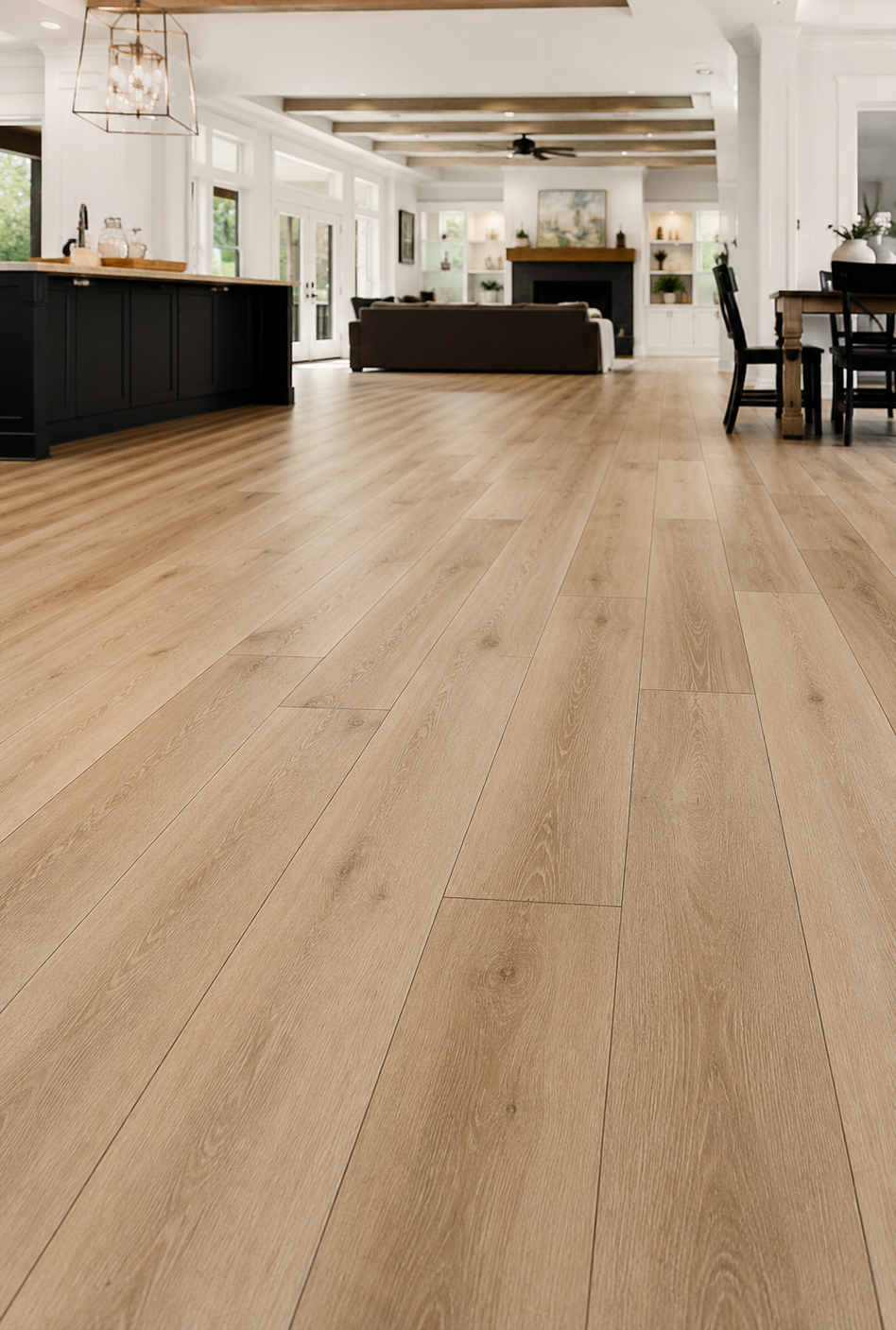
  • Luxury vinyl plank & LVT

  • Large-format porcelain & stone tile

  • Carpet — bedroom to whole-home

  • Polished & stained concrete

  • Subfloor leveling & moisture mitigation

  • Radiant heat rough-in & compatibility

SURFACES THAT PERFORM

FLOORING THAT’S BUILT TO LAST

Flooring is one of the highest-impact decisions in any interior build or remodel — and one of the most technically demanding to install correctly. The visible product accounts for only half the equation. Below every great floor is a well-prepared subfloor: flat within tolerance, dry within spec, and structurally sound enough to carry the load of the chosen finish material for decades.

Subfloor flatness, moisture content, and deflection are the three variables that determine whether a floor performs as it should or fails within years. RainFire Builders tests and documents all three before installation begins — not after a problem surfaces.

Whether you’re selecting flooring for a new custom home in Draper, finishing a basement in Sandy, or renovating a kitchen in Park City, the right product depends on the specific conditions of your project: below-grade or above, over concrete or wood joists, with radiant heat or without, and the humidity levels your home maintains through Utah’s dramatic seasonal swings.

RainFire Builders walks every client through product selection as part of the estimate process — matching the right flooring to the right location, the right subfloor, and the right budget.

Solid Hardwood

3/4″ milled from a single species — can be sanded and refinished multiple times. Best over wood subfloors above grade in climate-controlled Utah homes.

Engineered Hardwood

Real wood veneer over cross-ply core. More stable than solid in Utah’s low-humidity climate. Compatible with slab-on-grade and many radiant heat systems.

Luxury Vinyl Plank & LVT

100% waterproof, dimensionally stable, and highly durable. The leading choice for Utah basements, kitchens, and families with pets and heavy traffic.

Porcelain & Natural Stone Tile

Large-format through mosaic — kitchens, baths, mudrooms, and outdoor transitions. Requires the flattest subfloor of any flooring category.

Carpet

Bedroom suites, bonus rooms, and finished basements. Acoustic comfort, thermal insulation, and soft underfoot feel — still the right choice in the right rooms.

Polished & Stained Concrete

Mechanically polished or dye-stained concrete for modern, industrial, and commercial interiors. Durable, low-maintenance, and unique to every pour.

SCOPE OF WORK

OUR INTERIOR FRAMING SERVICES

From single-room remodels to full new-construction builds, RainFire Builders provides the complete range of interior framing services for residential and commercial projects across Utah.

Complete interior wall and ceiling framing for custom homes, production builds, and spec homes — coordinated from foundation stage through rough-in inspections.

Interior layout changes, room additions, basement finishes, and second-story additions — including demolition of existing walls and structural modification with beam installation.

Engineered beam placement, temporary shoring, and clean structural transitions to open up floor plans without compromising structural integrity. Always permitted and inspected.

Steel stud framing for office build-outs, retail spaces, and medical facilities — including demising walls, interior offices, and code-compliant corridor layouts.

Dropped ceilings, tray and coffered ceiling frameworks, HVAC and plumbing chase soffits, and vaulted ceiling structures — all framed plumb and level.

Interior stair stringers, landings, and platform framing for both open and closed stair designs — built to IRC tread depth and riser height requirements.

Recruitment Features
HOW WE WORK

The RAINFIRE FLOORING PROCESS

Most flooring failures trace back to steps that were skipped before the first plank was laid. Our process ensures every variable is addressed before installation begins — not discovered after it ends.

BUILT FOR UTAH’S CONDITIONS

Flooring Decisions: Utah’s Climate Demands

Utah presents one of the most demanding climates for interior flooring in the western U.S. The combination of very dry winters (indoor relative humidity can drop below 15% without humidification), hot summers, and dramatic temperature swings between seasons creates conditions that stress every wood-based flooring product.

Gapping is the most common complaint in Utah wood flooring — and it is almost always preventable. Gaps between planks form when wood loses moisture to dry winter air and contracts. A whole-home humidification system maintaining 35–50% RH eliminates the problem entirely. RainFire Builders recommends and coordinates humidification with our HVAC team on every solid hardwood project.

Utah’s high-altitude communities — Park City, Heber City, and mountain canyon homes — see more extreme temperature swings and lower average humidity year-round. These locations are where engineered hardwood or LVP is almost always the right choice over solid wood, regardless of budget. We will tell you this honestly rather than install what you want and come back to fix problems.


MOISTURE TESTING ON EVERY JOB

RainFire Builders tests both subfloor and incoming flooring moisture content before every wood installation — documented in the project record. It is not optional or skipped in busy weeks.

HUMIDITY-AWARE PRODUCT SELECTION

For projects without whole-home humidification, RainFire Builders steers clients toward engineered or LVP products that perform reliably in 15–30% RH — Utah’s typical winter interior humidity range.

RADIANT HEAT COORDINATION

We review radiant heat system specs against flooring manufacturer requirements and coordinate maximum surface temperature limits with our HVAC team before committing to a product.

ALTITUDE & MOUNTAIN COMMUNITIES

Park City, Heber, and Midway homes face more extreme conditions than the valley. RainFire Builders adjusts product specifications and acclimation protocols for higher-elevation projects.

COMMON QUESTIONS

FLOORING FAQs

Honest answers to the questions Utah homeowners ask most about flooring — before and after they’ve made an expensive mistake.

What is the best flooring for Utah’s climate and dry winters?2026-05-29T07:05:03+00:00

Utah’s low winter humidity — often 10–30% indoors without humidification — creates real challenges for wood flooring. Engineered hardwood and luxury vinyl plank (LVP) handle Utah’s humidity fluctuations far better than solid hardwood because their multi-layer construction resists expansion and contraction. Solid hardwood can work in Utah, but it requires careful acclimation, verified subfloor moisture levels, and a whole-home humidification system that maintains 35–50% RH to prevent seasonal gapping. RainFire Builders performs moisture testing before every wood installation — no exceptions.

What is the difference between solid hardwood and engineered hardwood flooring?2026-05-29T07:05:49+00:00

Solid hardwood is milled from a single piece of wood — typically 3/4″ thick — and can be sanded and refinished multiple times over its lifetime. It is moisture-sensitive and is not recommended for below-grade (basement) or over-slab installations. Engineered hardwood has a real hardwood veneer layer bonded over multiple layers of cross-ply plywood or HDF core. The cross-ply construction resists expansion and contraction, making engineered wood more stable in Utah’s dry climate and suitable for over-radiant-heat and above-slab installations. Both products look identical once installed — only the subfloor and environmental performance differ.

Is LVP (luxury vinyl plank) a good flooring choice for Utah homes?2026-05-29T07:07:04+00:00

Yes — LVP is one of the most practical flooring choices for residential construction in Utah. It is 100% waterproof, dimensionally stable through Utah’s humidity swings, durable under heavy traffic, and available in realistic wood and stone visuals. LVP is ideal for Utah basements, mudrooms, kitchens, and anywhere moisture is a concern. Wear layer thickness matters significantly — specify 12 mil minimum for residential, 20 mil for commercial or high-traffic areas. RainFire Builders installs commercial-grade LVP products and will not recommend or install budget products that fail within a few years.

What subfloor preparation is required before installing new flooring?2026-05-29T07:07:53+00:00

Subfloor preparation requirements vary by product: wood flooring needs the subfloor flat within 3/16″ over 10 ft and moisture content below 12% (or within 4% of the flooring MC). Large-format tile requires flatness within 1/8″ over 10 ft with no deflection. LVP requires 3/16″ over 10 ft with all high spots and low spots corrected. RainFire Builders performs a full subfloor assessment — flatness measurement, moisture testing, and structural evaluation — before any flooring installation begins and documents findings before work proceeds.

How much does flooring installation cost in Utah?2026-05-29T07:08:55+00:00

Installed flooring costs in Utah vary significantly by material: carpet runs $3–$7/sq ft; LVP $4–$8/sq ft; engineered hardwood $6–$12/sq ft; solid hardwood $8–$15/sq ft; porcelain tile $8–$18/sq ft (larger format commands higher labor costs); natural stone $12–$25+/sq ft. These ranges include standard subfloor preparation. Significant leveling, moisture mitigation, old flooring removal, and radiant heat rough-in are quoted separately. RainFire Builders provides itemized estimates broken down by material, labor, and subfloor prep so you understand every line item.

Can hardwood or LVP flooring be installed over radiant heat?2026-05-29T07:09:46+00:00

Many engineered hardwood products are approved for use over radiant heat with a maximum surface temperature of 80–85°F. Solid hardwood is generally not recommended over radiant heat due to excessive seasonal movement. LVP products vary — some are rated for radiant; others are not, and exceeding temperature limits causes warping and joint separation. Porcelain tile is the most radiant-heat-compatible flooring available. RainFire Builders reviews manufacturer specifications for every product installed over a radiant system and coordinates with our HVAC team to confirm the system is set up within flooring tolerances.

What is a floating floor installation versus glue-down or nail-down?2026-05-29T07:10:32+00:00

Nail-down uses a pneumatic cleat nailer to fasten each board through its tongue into a wood subfloor — the traditional method for solid hardwood. Glue-down uses full-spread adhesive to bond flooring directly to concrete or wood — common for engineered hardwood and LVT over slab. Floating locks boards together at joints without fastening to the subfloor — the standard method for LVP and many engineered products. Each method has specific subfloor requirements, acoustic characteristics, and appropriate applications. RainFire Builders selects the correct method based on the product, subfloor type, and installation conditions — not installer preference.

How long does hardwood flooring need to acclimate before installation in Utah?2026-05-29T07:11:18+00:00

Solid hardwood should acclimate on-site in the installation environment for a minimum of 3–5 days — and in some Utah winter conditions up to 7–10 days — with HVAC running at normal occupied temperature and humidity. Engineered hardwood typically requires 48–72 hours. Acclimation allows wood to reach equilibrium moisture content with its surroundings, reducing gapping, cupping, and buckling risk after installation. RainFire Builders builds acclimation time into every wood flooring project schedule. Rushing this step is one of the leading causes of flooring warranty voidance and is never something we do to meet a faster delivery date.

The RainFire Difference

WHY CHOOSE RAINFIRE BUILDERS FOR FLOORING?

Test Before You Install

Moisture meters and flatness gauges come to every job site. We do not eyeball subfloor conditions or assume everything is fine — we measure it, document it, and address any issues before a single plank goes down.

Honest Product Guidance

We will tell you when the flooring you want is the wrong choice for the conditions you have. That conversation is less comfortable than just installing it — and far less expensive than replacing it in three years.

Trade-Coordinated Scheduling

Because RainFire Builders self-performs all interior trades, flooring goes in at the right point in the sequence — after paint, before base shoe and trim. Never rushed, never in the wrong order.

Manufacturer-Compliant Methods

Every installation follows the product manufacturer’s written installation guidelines. When a warranty claim is needed, RainFire Builders’ documentation — moisture readings, acclimation records, method compliance — protects you.

CONTINUE BUILDING:

RELATED INTERIOR SERVICES

Framing

Subfloor flatness and structural deflection both depend on solid framing underneath  |  Explore Framing

Drywall & Plaster

Drywall and painting are completed before flooring – sequence protects your investment  |  Explore Drywall & Plaster

Painting

Interior painting is always scheduled before flooring installation to protect finished surfaces  |  Explore Painting

Cabinetry & Countertop

Kitchen cabinets are installed over the subfloor before flooring, with flooring tucked under toe kicks  |  Explore Cabinetry & Countertops

HVAC

Radiant heat rough-in and whole-home humidity control directly affect flooring performance  |  Explore HVAC

Trim & Millwork

Baseboard and base shoe installation follow flooring – covering expansion gaps cleanly  |  Explore Trim & Millwork


FLOORING THAT HOLDS UP TO UTAH LIFE

The right floor for the right conditions, installed correctly from the subfloor up. RainFire Builders handles the whole equation — product selection, subfloor prep, moisture testing, and expert installation — so your floors look great and stay that way.

Call us now at (385) 336-7246 or request an estimate online. We’ll start on your property’s project and your future with care.

We Make It Happen – 

Request a Quote

Schedule your in-person consultation. Let’s get your project started

Go to Top