Siding and Cladding2026-06-07T02:34:39+00:00

Exterior Construction – Siding & Cladding

The Wall Your Home Wears 
Every Single Day

Siding is simultaneously your home’s primary moisture management system, fire resistance layer, thermal contributor, and the aesthetic statement that defines every first impression. In Utah’s environment — high-altitude UV that fades materials faster than sea-level ratings predict, WUI fire zones across the Wasatch Front foothills, freeze-thaw cycling that exploits every improper flashing detail — the choice of cladding material and installation quality determines whether your walls perform for decades or fail at their hidden seams within ten years.

GET A FREE SIDING ASSESSMENT

EXPLORE OUR SERVICES

OUR SIDING SERVICES

  • Fiber Cement – James Hardie

  • Vinyl Siding Installation

  • LP SmartSide Engineered Wood

  • Cedar & Natural Wood Siding

  • Stone Veneer & Manufactured Stone

  • Stucco & EIFS Systems

  • WUI Fire-Rated Cladding

  • Housewrap & Drainage Plane

  • Soffit, Fascia & Trim

  • Full Re-Siding Projects

100%

Licensed & Insured

7+

Counties Served

15+

Years in Utah

500+

Projects Delivered

MORE THAN AESTHETICS

What Siding Actually Does –
And Where It Fails

Most homeowners think of siding as the material they see. Contractors who install it correctly think of siding as the outer surface of a wall assembly — a system that includes a weather-resistant barrier, a drainage plane, and flashing at every transition — and which must be designed so that any water that breaches the primary cladding surface has a managed path out of the wall, not into it.

The majority of siding failures in Utah are not material failures. They are installation failures. Vinyl siding was installed directly over existing siding without addressing the substrate condition underneath. Fiber cement is installed without a maintained painted surface, allowing moisture absorption into the cement board that causes delamination. Stucco applied over a compromised housewrap that allows bulk water infiltration at every crack. Stone veneer installed without a weep screed at the base that allows water behind the veneer to accumulate, migrate into the sheathing, and decay structural framing — sometimes for years before it becomes visible.

RainFire Builders approaches every siding project as a wall assembly scope — assessing the housewrap, sheathing, and substrate condition before specifying material and installing every flashing detail, transition, and trim junction with the water management focus that protects the building for the full life of the cladding.

CLADDING – SIDING SURFACE

The visible, weather-facing material — fiber cement, vinyl, wood, stone, or stucco. It must be maintained and sealed against Utah’s UV and freeze-thaw environment.

DRAINAGE PLAN – AIR GAP

A 3/8–3/4″ gap between the cladding and the housewrap, created by furring strips or a drainage mat. Allows any bulk moisture behind the cladding to drain out at the weep screed rather than accumulate.

HOUSEWRAP – WRB

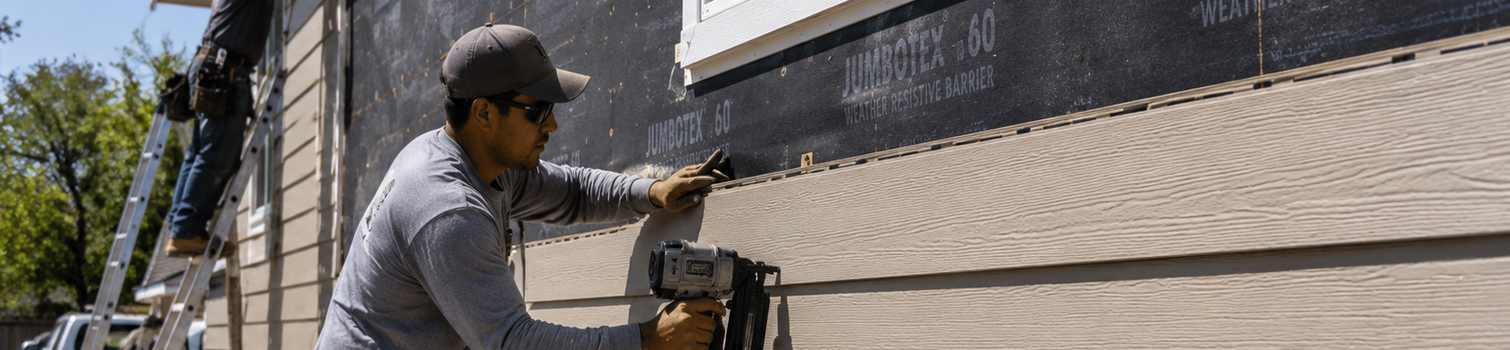
Weather-resistant barrier (Tyvek, Typar, or similar) — lapped shingle-fashion from bottom to top to prevent bulk water entry while allowing vapor diffusion. The most critical hidden layer.

STRUCTURAL SHEATHING

OSB or plywood nailed to the framing. Provides racking resistance and the nail base for siding. Moisture-compromised sheathing must be replaced before cladding reinstallation — not covered over.

CAVITY INSULATION

Batt, blown, or spray foam between framing members. Siding replacement creates the opportunity to improve cavity insulation where the existing layer is inadequate or damaged.

Interior Finish (Drywall)

The interior face. When wall assembly moisture management fails, the damage path leads here — and is often only discovered when drywall staining, mold, or structural softness forces the issue.

OUR SCOPE OF WORK

OUR SIDING &
CLADDING SERVICES

RainFire Builders manages every siding scope, from single-material reside to complete multi-material exterior cladding replacement and new-construction envelope installation.
Recruitment Executive Search

Complete James Hardie installation — HardiePlank lap siding, HardieShingle, HardiePanel, and HardieTrim. ColorPlus pre-finished and field-primed systems. Full warranty compliance with HardieZone specifications for Utah’s Climate Zones 5 and 6 environments.

Insulated and standard vinyl siding for non-WUI residential applications — Dutch lap, clapboard, shake, and vertical profiles. Proper starter strip and J-channel detailing that accommodates Utah’s thermal expansion range without buckling on south-facing exposures.

Recruitment Executive Search

LP SmartSide lap, panel, and trim systems — factory-primed and ready for field-applied finish paint. Engineered strand composite with borate treatment for rot and insect resistance—WUI-eligible fire rating for Wasatch Front foothill applications.

Full-elevation and accent stone veneer installation — natural thin stone and manufactured stone systems including Eldorado Stone, ProVia, and comparable. Proper drainage plane, metal lath, scratch coat, and continuous weep screed at the base — the flashing details that prevent stone veneer moisture failure.

Recruitment Executive Search

Traditional 3-coat Portland cement stucco over metal lath, and modern drainage EIFS systems with foam insulation board and reinforced base coat. Expansion joint layout designed for Utah’s thermal cycling. Stucco repair and re-coat on existing stucco homes, including matching texture and integral color.

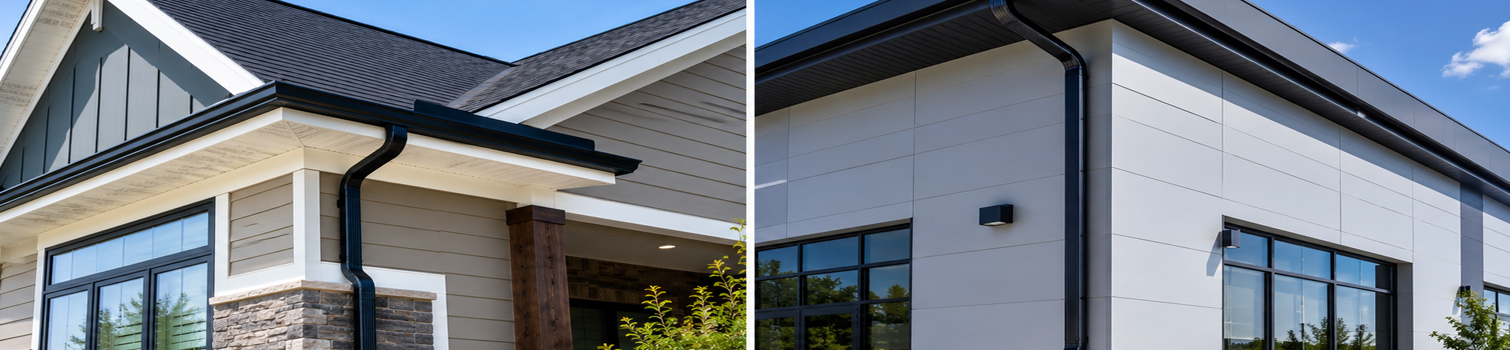
Aluminum and fiber cement soffit and fascia replacement, corner boards, window and door trim surrounds, belly bands, frieze boards, and complete trim accessory systems. The trim and transition details that define the visual quality of a completed exterior — and where installation shortcuts produce the earliest failures.

HOW WE WORK

The RainFire Siding Process

A siding replacement is not simply removing old material and nailing up new. The wall assembly underneath — housewrap, sheathing, insulation, and every concealed flashing detail — determines whether the new cladding performs for its full expected life or begins failing at its hidden transitions within a decade.

About Avada Recruitment
Utah Siding Considerations

Siding Designed For Utah’s Specific Challenges

High-altitude UV is the most underestimated siding challenge on the Wasatch Front. At 4,200 feet, UV intensity is approximately 25% higher than at sea level. For painted surfaces — fiber cement, LP SmartSide, and wood — this means paint film oxidation and color fade happen measurably faster than manufacturer repainting intervals suggest. Field-painted fiber cement in Utah should be assessed for repainting at 8–10 years rather than the 10–15 years often cited for lower-elevation markets. ColorPlus factory-applied finish on James Hardie products outperforms field paint significantly — the factory application quality and UV-stabilized coating formula is meaningfully better than most field-applied topcoats.

Utah’s freeze-thaw cycling exploits every joint, caulk line, and flashing gap that isn’t sealed correctly. Water infiltrating behind siding in October can cause sheathing moisture damage and mold growth through the winter before it becomes visible from inside the home in spring. The solution is correct installation technique — not a specific material — though fiber cement and stone veneer are more forgiving of minor moisture exposure than wood or engineered wood products when moisture does infiltrate.

Wildland fire risk is the context that makes siding selection a safety decision, not just an aesthetic one. Any homeowner with a foothill-adjacent property should verify their WUI designation before specifying siding — and should choose fiber cement, stucco, or stone as the default for any property where wildfire is a plausible risk, regardless of whether it is formally required.

+25% UV at 4,200 Feet

Paint on fiber cement and wood siding degrades 20–30% faster in Utah than sea-level repainting intervals suggest. South and west exposures fade fastest — ColorPlus factory finish is the most UV-durable painted surface available.

WUI Zones — Wasatch Front Foothills

Draper, Sandy, Cottonwood Heights, Herriman, South Jordan, and foothill communities throughout Salt Lake, Utah, and Davis Counties include WUI-designated parcels where fire-rated cladding is required or strongly recommended. RainFire Builders verifies your parcel’s WUI status on every project.

Freeze-Thaw & Caulk Joints

Paintable exterior caulk in Utah must flex through a 100°F+ annual temperature range — from −5°F winter nights to 100°F+ summer wall surface temperatures on south exposures. Low-quality caulk cracks within 2–3 Utah winters; siliconized acrylic or hybrid polyurethane caulks are the minimum specification at all siding joints.

Hard Water — 200–400 ppm

Utah’s hard water leaves mineral deposits on siding surfaces from irrigation overspray and rain splash — visible as white calcite staining, particularly on darker-colored cladding. Not a structural concern, but a maintenance consideration for homeowner cleaning expectations on irrigation-exposed elevations.

WILDLAND URBAN INTERFACE

Utah’s WUI Zones – Why Your Siding Choice Is a Fire Decision

A significant portion of the Wasatch Front’s most desirable residential areas — the foothills of Draper, Sandy, Cottonwood Heights, Herriman, South Jordan, and communities throughout Salt Lake, Utah, and Davis Counties — are designated Wildland Urban Interface zones where wildfire risk is a documented and regulated hazard.

In WUI zones, your siding is not just an aesthetic material — it is a fire exposure component that may be required by ordinance, HOA policy, or insurance carrier to achieve a specific fire resistance rating. Vinyl siding, which melts and contributes fuel in a fire event, is typically prohibited or strongly discouraged in designated fire hazard zones. Untreated wood siding without fire-retardant treatment carries similar restrictions.

RainFire Builders verifies the WUI classification and applicable fire cladding requirements for every Utah siding project before a material recommendation is made. We are experienced with the documentation requirements for WUI-compliant installations and familiar with the HOA design review processes in the affected communities across the Wasatch Front.

Not sure if your property is in a WUI zone? RainFire Builders checks your parcel’s designation as a standard part of every siding assessment — at no charge. The answer changes which materials are available and appropriate for your specific location.


FIBER CEMENT (JAMES HARDIE)

Non-combustible mineral composition. Class 1/A fire resistance — the highest rating available. The default WUI-compliant choice across the Wasatch Front. Explicitly approved for installation in Utah WUI-designated zones without additional documentation.

STUCCO – 3-COAT PORTLAND CEMENT

Portland cement-based plaster is inherently non-combustible. Class 1/A rated. Common on Southwestern-style Utah homes and excellent in WUI applications — the mineral mass provides thermal protection in addition to fire resistance.

STONE VENEER – NATURAL & MANUFACTURED

Masonry materials are non-combustible — Class 1/A by composition. Used as primary or accent cladding in WUI zones. Manufactured stone veneer achieves the same fire rating as natural stone at a lower installed cost.

LP SMARTSIDE – ENGINEERED WOOD

LP SmartSide achieves a Class 1 fire rating through factory-applied borate treatment. WUI eligibility varies by municipality and HOA — some accept Class 1, others require Class 1/A non-combustible. Verify local requirements before specifying.

VINYL SIDING – PVC

Vinyl is a thermoplastic — it melts, deforms, and can contribute fuel load in a fire event. No meaningful fire resistance rating. Typically prohibited or strongly discouraged in Utah WUI-designated zones. Should not be specified in fire hazard areas regardless of code requirement.

NATURAL CEDAR / WOOD – UNTREATED

Untreated wood siding is combustible with no fire resistance rating. Not appropriate for WUI-designated zones without fire-retardant treatment (FRT) applied to achieve a minimum Class 1 rating — which adds high cost and complexity to installation and maintenance.

COMMON QUESTIONS

SIDING & CLADDING FAQs

Honest, specific answers to Utah homeowners’ most common siding and cladding questions.

What siding holds up best in Utah’s climate?2026-06-05T20:10:04+00:00

Fiber cement siding — specifically James Hardie products — is the top performer for most Utah residential applications. It offers a 30–50-year service life, Class 1/A fire rating for WUI zones, excellent resistance to hail and Utah’s high-altitude UV, and a factory-applied ColorPlus finish that outperforms field painting in UV retention. LP SmartSide engineered wood is an excellent second choice with similar impact resistance and WUI eligibility at a somewhat lower cost. Vinyl is adequate for non-WUI properties where budget is the priority, but UV-fades 20–30% faster in Utah’s altitude environment than manufacturer specs predict. Natural cedar is beautiful but demands consistent maintenance in Utah’s climate.

What is fiber cement siding and why is it recommended for Utah?2026-06-05T20:11:27+00:00

Fiber cement is a composite of Portland cement, sand, and cellulose fibers pressed into boards, panels, or shingles that mimic wood or smooth profiles. It is the leading Utah choice for four reasons specific to our conditions: fire resistance (Class 1/A — WUI compliant across the Wasatch Front foothills); hail resistance (absorbs impact without cracking, unlike vinyl); UV stability (ColorPlus factory finish outperforms field paint at Utah’s altitude); and moisture resistance (doesn’t absorb moisture when the painted surface is maintained). James Hardie’s ColorPlus factory finish specifically uses UV-stabilized coatings that far outlast typical field-applied paints in high-altitude applications.

What is a WUI zone and why does it matter for siding in Utah?2026-06-05T20:12:35+00:00

WUI (Wildland Urban Interface) zones are designated areas where residential development meets undeveloped wildland vegetation — creating documented wildfire exposure risk. Significant portions of Draper, Sandy, Cottonwood Heights, Herriman, and foothill communities throughout the Wasatch Front carry WUI designations. In these zones, fire-resistant cladding is often required by local ordinance or HOA policy. Vinyl siding is not WUI-appropriate — it melts and contributes fuel load. Untreated wood requires fire-retardant treatment to achieve WUI compliance. Fiber cement, stucco, and stone veneer are Class 1/A non-combustible and WUI-compliant. RainFire Builders verifies WUI classification before recommending any siding material.

Does vinyl siding fade faster in Utah than in other states?2026-06-05T20:13:58+00:00

Yes — measurably. At 4,200 feet elevation, UV radiation is approximately 25% more intense than at sea level. Vinyl siding’s UV stabilizers degrade under sustained UV exposure; at Utah’s altitude, this happens 20–30% faster than at sea level. Most vinyl shows noticeable color fade on south and west exposures within 8–12 years in Utah, versus 12–18 years in lower-elevation markets. Premium vinyl with higher UV stabilizer content performs better but still doesn’t match fiber cement’s color retention at altitude. If UV-stable color is a priority for a south or west-facing wall, fiber cement with ColorPlus finish is the correct specification.

How long does siding last in Utah?2026-06-05T20:15:08+00:00

Utah siding lifespan by material: vinyl 20–30 years; fiber cement 30–50 years with repainting every 10–15 years; LP SmartSide 20–35 years; natural cedar 15–25 years with consistent annual maintenance; stone veneer 30–50+ years; stucco 20–40 years with annual crack sealing. The primary accelerants of premature siding failure in Utah are UV degradation without repainting (fiber cement and wood), freeze-thaw moisture infiltration through failed caulk joints, and installation without a drainage plane that traps moisture behind the cladding. RainFire Builders addresses all three failure modes in every installation specification.

What causes siding to fail prematurely in Utah?2026-06-05T20:15:53+00:00

Four primary causes: inadequate moisture management (no drainage plane behind siding traps moisture with no exit path, causing sheathing rot and mold — the most common hidden failure); improper flashing at windows, doors, and transitions (the most common water infiltration entry point — visible as staining at window corners); UV degradation without maintenance (fiber cement and wood left unpainted absorb moisture and decay); and WUI non-compliance (vinyl in fire zones creates liability beyond material performance). RainFire Builders addresses all four: drainage plane as standard, metal flashing at all transitions, ColorPlus or site-applied top coat at installation, and WUI material verification before any material is selected.

How much does siding replacement cost in Utah?2026-06-05T20:16:39+00:00

For a typical 2,000 sq ft Utah home (approximately 1,400–1,600 net sq ft of wall area): vinyl siding $9,000–$18,000 installed; fiber cement (James Hardie) $18,000–$35,000; LP SmartSide $14,000–$26,000; natural cedar $20,000–$40,000; stone veneer accent (one or two elevations) $8,000–$20,000; stucco re-coat on existing stucco $6,000–$14,000; full stucco replacement to sheathing $25,000–$50,000. Variables: substrate condition (sheathing and housewrap replacement add $3,000–$10,000), window and door flashing scope, and structural discoveries during tear-off. RainFire Builders provides detailed itemized estimates after physical assessment.

What is the difference between traditional stucco and EIFS in Utah?2026-06-05T20:17:44+00:00

Traditional 3-coat stucco is Portland cement-based plaster over metal lath — hard, breathable, and durable with a 20–40 year service life when cracks are maintained. Excellent WUI performance. Annual crack sealing before Utah winters prevents freeze-thaw infiltration. EIFS (Exterior Insulation and Finish System) adds foam insulation board for improved thermal performance, using a reinforced base coat and synthetic finish coat over the foam. Modern drainage EIFS includes a drainage plane behind the foam to manage moisture — a critical improvement over first-generation EIFS that caused widespread moisture problems. Both perform well in Utah when properly installed; the choice is aesthetic and energy performance driven. RainFire Builders installs both systems and specifies drainage EIFS as the standard for new EIFS applications.

The RainFire Difference

WHY CHOOSE RAINFIRE BUILDERS FOR SIDING & CLADDING?

WUI Expertise Built In

We verify every parcel’s WUI classification before a material recommendation is made. Fiber cement, stucco, and stone veneer are our WUI-zone defaults — not options we offer on request. Utah’s fire risk is too real to treat as an afterthought.

Hidden Work Documented

Every housewrap installation, every sill pan flashing, every transition detail is photographed before cladding covers it. You receive a documented installation record that supports both manufacturer warranties and future insurance assessments.

Full Tear-Off Standard

We don’t install new siding over old. Full removal exposes the substrate condition, identifies moisture damage before it’s covered for another decade, and produces a cleaner, thinner wall profile with better long-term performance.

Exterior Trades Coordinated

RainFire Builders self-performs roofing, siding, and windows — so the window flashing is coordinated with the housewrap, and the new siding is never installed under a roof that needs replacement in three years. One team. No gaps between trades.

CLICK HERE to see the rest of the EXTERIOR SERVICES

CONTINUE BUILDING:

RELATED INTERIOR SERVICES

Roofing

Roofing and siding share critical step-flashing transitions. Both trades are sequenced together by RainFire – new siding is never installed under a roof needing replacement in three years.  |  Explore More About Roofing

Windows & Doors

Windows and door flashing are the most common siding moisture failure points. RainFire Builders coordinates new window installation within re-siding scopes – one flashing sequence done correctly  |  Explore Windows & Doors

Foundations

The siding-to-foundation transition – where cladding terminates above grade – is a common moisture infiltration point. Proper flashing and clearance above grade are addressed in every siding scope.  |  Explore Foundations

Concrete & Masonry

Masonry chimneys and foundation walls intersect with siding at critical flashing points. RainFire Builders coordinates masonry and cladding as a single moisture management scope.  |  Explore Concrete & Masonry

Insulation

A re-siding creates the access opportunity to inspect and improve cavity insulation – the work that is prohibitively expensive without the walls already being opened.  |  Explore About Insulation

All Exterior Services

Return to the full exterior services overview – roofing, siding, foundation, windows, decks, and concrete – all managed under one licensed general contractor.  |  Go Back to the Beginning


WUI-Compliant. Moisture Managed. Built to Last.

Your Walls Deserve More Than What’s Holding Them Together Right Now.

Whether your siding is fading, failing, or simply due for a replacement after fifteen Utah winters, RainFire Builders provides free on-site siding assessments — probing the substrate, checking the flashing, verifying WUI compliance, and giving you an honest picture of what needs to happen and what it will cost. No cover-overs. No cut corners. No materials specified before we know what’s behind the ones we’re replacing.

Call us now at (385) 336-7246 or request an estimate online. We’ll start on your property’s project and your future with care.

We Make It Happen – 

Request a Quote

Schedule your in-person consultation. Let’s get your project started

Go to Top