
CABINETRY &
COUNTERTOPS
GET A FREE CABINETRY ESTIMATE
LEARN MORE BELOW
The kitchen and bathrooms are the rooms that define a home’s daily experience — and the spaces that most directly determine its value. RainFire Builders handles cabinetry and countertops as a unified scope: layout planning, cabinet specification, precise installation, stone coordination, and templating are managed as one project from start to finished surface. No handoffs between disconnected contractors. No gaps in accountability.
THE HEART OF EVERY HOME
Cabinetry & Countertops Done Right
Kitchen and bathroom cabinetry is the most complex millwork scope in any home — combining precise spatial planning, manufactured component delivery, site-specific installation, and coordinated countertop fabrication into a single sequence where every trade dependency matters. A cabinet layout planned without accounting for appliance clearances, door swing conflicts, or countertop overhang tolerances creates problems that are expensive to fix after the fact.
Layout is where kitchens succeed or fail. The working triangle between the refrigerator, sink, and range. The drawer stack that clears the dishwasher door. The island overhang that accommodates seating without conflicting with adjacent base cabinet doors. RainFire Builders reviews every layout for function before a single cabinet is ordered — not after delivery day reveals a problem.
Countertop coordination is the second half of the scope and one of the most sequencing-sensitive operations in the entire interior build. Templating cannot happen until cabinets are installed and shimmed level. Fabrication takes time — from three days for quartz to ten or more for complex natural stone. RainFire Builders manages the cabinet-to-countertop timeline as a single coordinated scope so kitchens are operational on schedule.

Framed (Face-Frame)
A solid wood frame is attached to the front of the box. Traditional aesthetic. Door hinges mount to the frame. The frame partially obscures interior access but adds rigidity and a classic look favored in Craftsman and traditional Utah homes.
Frameless (European / Full-Access)
No face frame — the door covers the full box opening for maximum interior access and a clean, contemporary look. Requires more precision at installation because no frame conceals misalignment. Standard in modern and transitional kitchen designs.
Box Construction: Plywood vs. Particleboard
Plywood boxes hold screws better over time, resist moisture, and are significantly stronger than particleboard. RainFire Builders specifies plywood box construction as the standard on all kitchen and bath cabinetry — it is not a premium upgrade.
OUR CABINETRY & COUNTERTOP SERVICES
RainFire Builders manages the full cabinetry and countertop scope — from layout planning through cabinet installation, templating, countertop fabrication coordination, and final installation — as a single accountable project.

The RAINFIRE CABINETRY PROCESS
From the first layout review to the final countertop seam, RainFire Builders manages every step of the cabinetry and countertop scope — eliminating the gaps and delays that fragment this scope across multiple contractors.
Before ordering begins, RainFire Builders reviews the cabinet layout against the architectural plans, appliance specifications, and countertop selection. Door swings are checked for conflicts. Drawer stacks are confirmed to clear dishwasher doors and other appliances. Countertop overhang is verified for bar seating clearance. Filler locations are identified and sized. Tall cabinet runs are checked for ceiling crown height feasibility. Any issues found at this stage are resolved in 30 minutes of planning — not in a day of on-site rework.
Before any cabinet is hung, all walls are checked for plumb and flat. Studs are located and marked. The highest point of the floor is found — cabinets are set level from that point, shimmed as needed, with filler strips cut to close any gap between the cabinet bottom and the floor. Wall cabinets are hung on a ledger board, screwed into studs, and pulled into alignment before final tightening. All cabinets are shimmed level front-to-back and side-to-side — not simply pushed against the wall and secured. Scribe moldings are cut and fitted to irregular walls at all exposed edges.
After all cabinet boxes are set, every door is hung and adjusted for consistent reveal — the visible gap between door and frame or adjacent door should be uniform across the entire run. Drawer fronts are aligned on a common baseline. Soft-close hinges are adjusted for closing force and angle. All drawer slides are checked for smooth travel and full extension. Decorative hardware is installed with a template jig for consistent placement across all pieces. The goal is a kitchen where doors and drawers align perfectly and close silently — because these are the details the client will see every day for decades.
Once all cabinets are installed, shimmed level, and finalized, RainFire Builders coordinates with the stone fabricator to schedule templating. The templater creates a precise digital or physical template of every countertop surface — capturing all angles, backsplash heights, sink cutout locations, and edge profiles. This template drives fabrication. Templating cannot occur before cabinets are level and final — any subsequent cabinet adjustment after templating results in a countertop that does not fit. RainFire Builders does not allow countertop templating until cabinet installation is fully complete.
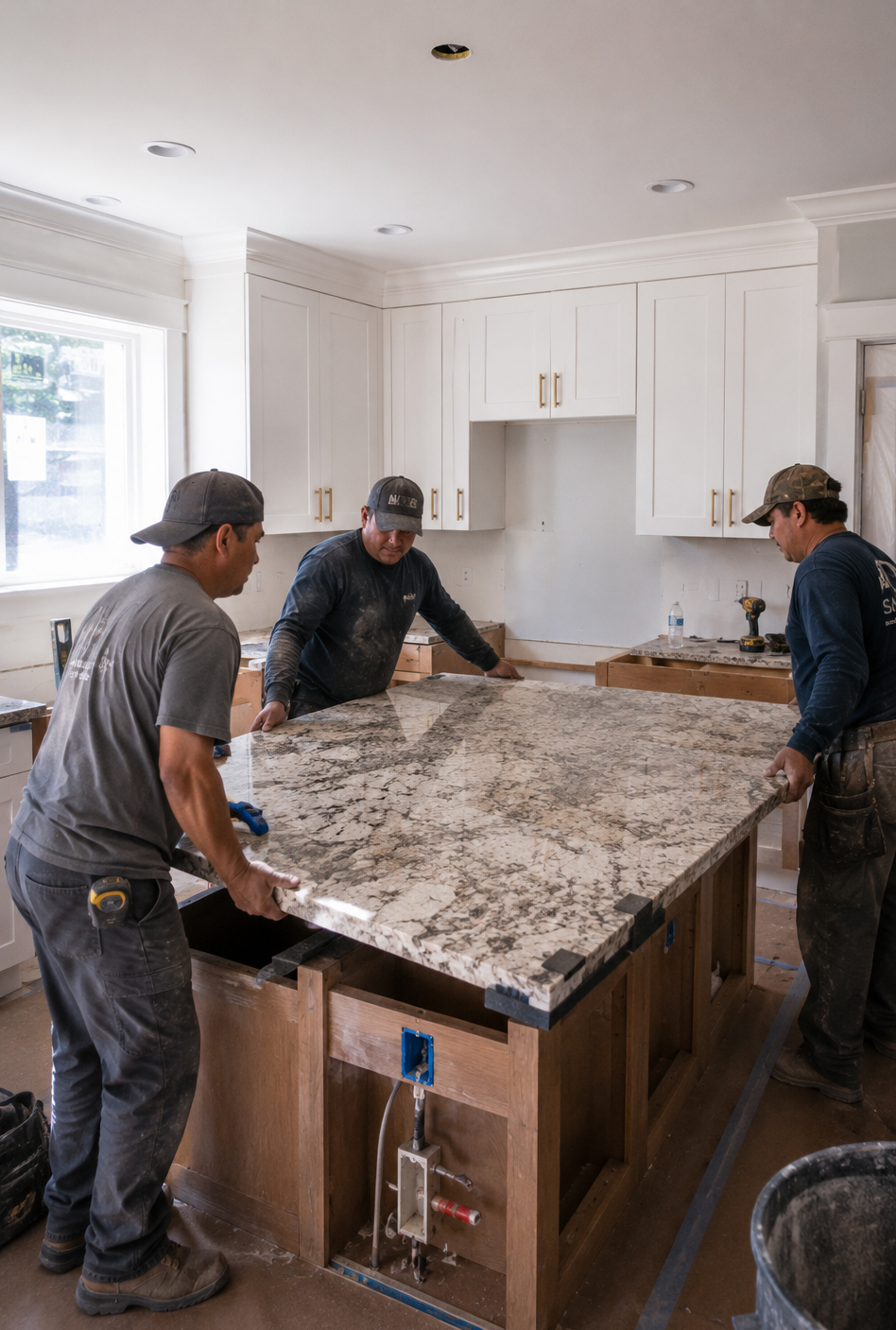
Stone countertops are installed by the fabricator’s team with RainFire Builders on site to manage delivery access, protect finished floors and cabinetry, and confirm that each piece lands correctly. After countertops are set, RainFire Builders installs the undermount sink and confirms fit, caulks the backsplash joint between the countertop and tile, and reinstalls all hardware and accessories removed during installation. Final inspection confirms even overhangs, tight backsplash joints, and consistent seam alignment before the kitchen is considered complete.
