Foundations2026-06-05T18:28:54+00:00

Exterior Construction – Foundation Systems

Everything Else Rests 
On This Decision

The foundation is the only building system that cannot be inspected, accessed, or corrected after the structure above it is complete — except at extraordinary cost. In Utah, where the Wasatch Fault runs beneath one of the densest residential corridors in the West, where prehistoric Lake Bonneville clay soils swell and shrink with moisture cycles, and where frost depths extend well below grade, foundation design is the most consequential structural choice in any build.

GET A FREE FOUNDATION ASSESSMENT

EXPLORE OUR SERVICES

OUR FOUNDATION SERVICES

  • New Construction Foundations

  • Full Basement Excavation

  • Crawl Space Foundations

  • Slab-on-Grade Construction

  • Waterproofing & Drain Tile

  • Seismic Retrofitting

  • Retaining Walls

  • Foundation Repair & Stabilization

  • Site Drainage & Grading

  • Site Preparation & Excavation

100%

Licensed & Insured

7+

Counties Served

15+

Years in Utah

500+

Projects Delivered

SITE-SPECIFIC RISK

Utah’s Five Foundation Hazards
Designed for Directly

No other metropolitan area in the western United States combines the range of foundation hazards present on the Wasatch Front in a single market. Identifying which hazards apply to a specific parcel — before design begins — is the critical work that separates a foundation built to last a century from one that begins showing distress within a decade.

Seismic Design Category D applies to virtually all of Salt Lake, Utah, Davis, and Weber Counties per ASCE 7-22 — driven by the documented hazard of the Wasatch Fault system, which geologists classify as one of the most hazardous faults in the country. The USGS estimates a significant probability of an M6.75+ earthquake on the central Wasatch Fault in the next 50 years. SDC D foundation requirements — heavier rebar, tighter spacing, special connection detailing — substantially exceed standard residential minimums, and RainFire Builders applies them on every Wasatch Front project regardless of permit minimum requirements.

Lake Bonneville’s expansive soils cover much of the valley floor from northern Utah County through Davis County. The montmorillonite clay in these prehistoric lake bed deposits swells when wet and shrinks when dry. On sites with high-plasticity clay in the active soil zone, seasonal moisture cycling can move soil — and the structure above it — by measurable amounts every year. Engineering costs to address this at construction are modest. Remediation costs after the fact are not.

Wasatch Fault – SDC D

Salt Lake, Utah, Davis, Weber Counties: SDC D per ASCE 7-22. Requires ACI 318 seismic reinforcing — larger rebar, tighter spacing, special lap and hook details at corners, openings, and connections. Anchor bolts designed for seismic uplift and shear. Special inspection of reinforcing placement is required on many projects.

Expansive Lake Bonneville Clay

Montmorillonite clay is prevalent in Bonneville Lake bed deposits throughout the valley floor. Sites with a plasticity index (PI) > 15 in the active zone require engineering measures: deeper footings, non-expansive fill replacement under slabs, or pier-and-grade-beam systems. Soils report required to quantify.

Frost Depth: 30 to 48 Inches

IRC-required footing depth below frost line: 30″ SLC valley; 36″ foothill communities (Draper, Sandy, Cottonwood Heights); 36–42″ Wasatch Back (Park City, Heber); 42–48″ mountain communities above 6,000 ft. Missed most often on garage and addition slabs, producing frost heave.

High Water Table – West SLC

West Valley City, West Jordan, Taylorsville, Jordan River corridor: groundwater is often within 8–15 feet of grade. Requires dewatering during excavation, waterproofing rated for positive hydrostatic pressure, and permanent sump systems. Near the Great Salt Lake margin: Type V sulfate-resistant cement is required.

Elevated Radon – EPA Zones 1 & 2

Significant portions of the Wasatch Front — particularly foothill communities near the Wasatch Range — fall within EPA Radon Zone 1 (average screening > 4 pCi/L). Sub-slab depressurization rough-in at construction costs under $300 eliminates the need for core drilling if post-occupancy testing indicates active mitigation is needed.

Hillside & Slope Stability

Foothill communities in Salt Lake, Utah, and Davis Counties: slopes require stepped footings, grade beams, retaining walls, and hillside anchoring. Slope stability analysis required in most jurisdictions for sites exceeding 15–20% grade. Geotechnical engineer field review is required during excavation on hillside sites.

OUR FOUNDATIONS SERVICES

UTAH’S FOUNDATION TYPES –
ONE GENERAL CONTRACTOR

Every foundation scope is managed from soils report coordination through excavation, forming, concrete placement, waterproofing, drainage, and final inspection — with licensed structural engineering and full permit management on every project.
Recruitment Executive Search

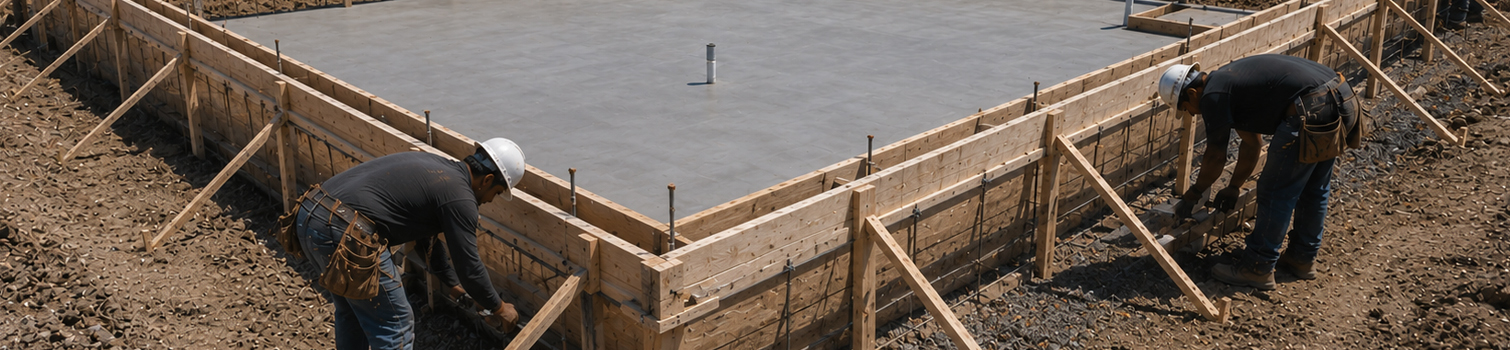
Complete new construction foundation scopes for custom homes, spec homes, ADUs, and commercial buildings. Soils report coordination, structural engineering, excavation, footing and wall forming, concrete placement, waterproofing, drain tile, backfill, and slab. Every foundation is designed to meet SDC D seismic requirements, local frost depth, and site-specific bearing capacity. Wasatch Front projects include all Utah code compliance — ASCE 7-22, ACI 318, and local municipality amendments.

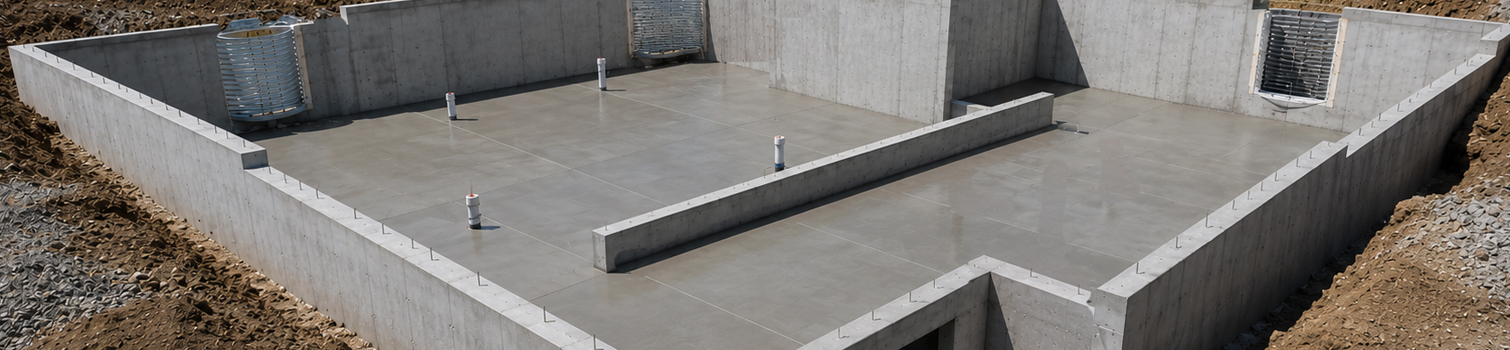
Full basement foundation scopes — excavation to depth, perimeter footing forming and pour, 8–10″ poured concrete wall forming and pour with ACI 318 SDC D reinforcing, interior column footings, basement slab subbase and vapor barrier, and complete exterior waterproofing. 8–10-foot finished wall height options. Radon rough-in provision available. Every pour vibrated internally for void-free consolidation — the most common source of long-term foundation wall leaks.

Recruitment Executive Search

Crawl space foundations for sites where full basement depth is cost-prohibitive or where soil or water table conditions require it. Perimeter footings below frost depth, stem walls to crawl space height, moisture barrier design, and SDC D seismic anchor bolting. Crawl space encapsulation design available — spray foam or closed-cell insulation at rim joist, continuous ground vapor barrier, and conditioned air supply — for improved moisture management, energy performance, and radon control.

Slab-on-grade foundations for garages, ADUs, additions, and commercial spaces — with properly designed thickened perimeter footings to frost depth, interior reinforcing per structural engineering, 4″ clean gravel base, 10-mil vapor barrier, and control joint layout per ACI 360. On expansive soil sites, non-expansive engineered fill replacement under the slab or grade beams per the soil report recommendations. Every garage slab includes an adequate anchor bolt layout for future shear wall or hold-down requirements.

Recruitment Executive Search

Complete exterior foundation waterproofing systems — fluid-applied or sheet-applied membrane over the below-grade wall face, dimple-mat drainage board, 4″ perforated drain tile in a gravel bed at footing level, daylighted outlet or sump pit with submersible pump, and window well drains for egress openings. Every waterproofing installation is photographed before backfill — the only layer that cannot be inspected again. Also available: interior drain tile and sump systems for existing basements experiencing water infiltration.

Seismic retrofitting for existing homes that predate current SDC D anchor bolt and cripple wall requirements — adding hold-downs, anchor bolts, and sheathed cripple wall panels to bring the structure closer to current seismic standards. Foundation repair for cracked or laterally deflecting walls — carbon fiber strap systems, steel I-beam bracing, or epoxy crack injection depending on the mode of failure. Structural engineering assessment before any repair recommendation; no repair is proposed without first identifying the cause.

HOW WE WORK

The RainFire Foundation Process

The foundation phase is the one place in construction where there is no coming back. Our process applies the same discipline to what goes underground that we bring to everything above grade — because that discipline is worth more here than anywhere else.

About Avada Recruitment
engineered for Utah’s ground

Foundation design for Utah’s specific conditions

The Wasatch Fault defines foundation design on the Wasatch Front. The Utah Seismic Safety Commission identifies the Wasatch Front as one of the most seismically exposed urban areas in the United States. A M7.0+ rupture of the central Wasatch Fault — which last ruptured approximately 550–600 years ago — would be among the most damaging natural disasters in U.S. history given the density of development directly above the fault trace. ASCE 7-22 Seismic Design Category D requirements for concrete reinforcing, connection detailing, and anchor bolt design reflect this reality. RainFire Builders applies SDC D standards on every Wasatch Front foundation, regardless of project scale or minimum permit requirements in the local jurisdiction.

Lake Bonneville sediment underlies much of the Wasatch Front valley floor. These prehistoric lake-bed deposits are rich in montmorillonite — the same clay mineral selected for industrial applications due to its extraordinary capacity to absorb and release water. Soil plasticity index (PI) values of 20–40 are common in these deposits, indicating high expansion potential. The engineering response is straightforward when identified in advance; the remediation cost, when not identified, is substantial.

Radon is an underappreciated foundation design variable in Utah’s mountain front communities. Uranium-bearing granite in the Wasatch Range contributes to elevated radon soil gas concentrations throughout the foothill zones — areas that include some of the most sought-after residential sites in Salt Lake, Utah, and Davis Counties. Sub-slab rough-in at construction is a modest cost that eliminates a significant later expense and health risk.

SEISMIC DESIGN CATEGORY D

Most Wasatch Front counties are classified SDC D per ASCE 7-22 — the second-highest seismic design level. Requires ACI 318 special seismic provisions: larger rebar, tighter spacing, special lap and hook details at all critical joints, and anchor bolts designed for seismic uplift and shear. RainFire Builders designs every Wasatch Front foundation to SDC D — not to the local minimum permit standard.

Frost Depth: 30 to 48 Inches

Utah frost penetration ranges from 30″ at the SLC valley floor to 48″+ in mountain communities above 6,000 ft. Every RainFire Builders foundation is designed to the local frost depth — including garage and addition slabs, where thickened and insulated perimeter footings per IECC R402.2.9 are required to prevent frost heave damage.

Lake Bonneville Expansive Clays

Montmorillonite clay in prehistoric Lake Bonneville lake bed deposits underlies much of the Wasatch Front from northern Utah County through Davis County. High-plasticity index (PI > 15) soils in the active zone create differential movement risk that requires engineering intervention in foundation design. A soils report is the minimum due diligence on any Wasatch Front site.

Radon – EPA Zones 1 & 2

Portions of the Wasatch Front fall within EPA Radon Zone 1 (average screening > 4 pCi/L), particularly in foothill communities near the Wasatch Range. EPA recommends passive sub-slab depressurization rough-in on all Zone 1 new construction — a 3″ PVC pipe and T-fitting in the sub-slab gravel that costs under $300 and eliminates core drilling if active mitigation is needed post-occupancy.

FIRST PRINCIPLES

What a Foundation Does – And Where It Fails

A foundation performs four simultaneous functions: it transfers structural loads into the bearing soil below; it resists lateral forces from soil pressure and seismic ground motion; it acts as a barrier against moisture, gases, and organisms from the soil; and it defines the dimensional stability that every finish element depends on across decades of use.

Most foundation failures are not sudden events. They are the slow accumulation of decisions made before the first shovel was moved: insufficient reinforcing for the local seismic environment, inadequate waterproofing, drainage designed to hold water against the wall, and foundations built over expansive clay soils without engineering intervention.

In Utah’s specific environment — Seismic Design Category D throughout most of the Wasatch Front, Lake Bonneville expansive clay soils across the valley floor, frost depths of 30–48 inches, and snowmelt-driven spring groundwater loading that pressures every below-grade surface for weeks each year — these decisions have consequences that compound silently for years before they become visible.

RainFire Builders treats every foundation scope as a structural engineering coordination project from the first day of site investigation. The foundation is the only element of the building that cannot be replaced.


FINISH GRADE & BACKFILL

Structural fill — never native expansive clay — compacted against the wall after waterproofing. Positive slope away from the structure: 6″ drop in the first 10′ per IRC R401.3. Surface drainage is the cheapest waterproofing you can do.

WATERPROOFING MEMBRANE

Fluid-applied polyurethane or sheet-applied membrane over the exterior wall face — the primary barrier to bulk water entry. Not damp-proofing (which only resists soil moisture vapor). Required in every Utah basement that expects to stay dry under snowmelt loading.

DRAINAGE BOARD & DRAIN TILE

Dimple-mat drainage board over the membrane channels water to the perimeter drain tile — 4″ perforated pipe in a gravel bed at footing level. Daylighted or connected to a sump pit. Photographed before cover — the layer that can never be inspected again.

POURED CONCRETE FOUNDATION WALL

8–10″ poured concrete with reinforcing per structural engineer — #4 or #5 rebar at 12″ or 8″ O.C. per ACI 318 SDC D requirements. Transfers all floor, roof, and wall loads to the footing. Vibrated internally during pour to eliminate voids.

SPREAD FOOTING

Wider than the wall above, the footing distributes concentrated load over a larger bearing area. Must bear below frost depth (30″ minimum in SLC valley, 36–48″ in mountain communities) on soil rated to the engineer’s minimum bearing capacity specification.

GRAVEL BASE & VAPOR BARRIER

4″ minimum clean aggregate over subgrade, with a 10-mil polyethylene vapor barrier (ASTM E1745 Class A preferred) under the slab. Critical in Utah’s clay-dominant soils, where soil moisture vapor migrates through concrete. Sub-slab radon vent pipe rough-in is recommended in EPA Zone 1 areas.

INTERIOR BASEMENT SLAB

4″ minimum concrete with WWM or #3 rebar. Control joints at engineered locations to manage shrinkage cracking. Where radon rough-in is installed, the vent pipe stub-out is accessible from the interior for future active mitigation system connection without core drilling.

COMMON QUESTIONS

FOUNDATION FAQs

Specific, honest answers to Utah homeowners’ most common foundation questions — engineered for actual Wasatch Front conditions, not national averages.

What type of foundation is best for a Utah home?2026-06-05T06:09:02+00:00

For most Wasatch Front valley homes, a full basement is the most common and usually the most cost-effective choice — providing 900–1,500+ sq ft of usable space at a modest cost premium over a crawl space, with excellent seismic performance from the massive concrete walls. Footings for any foundation type must reach frost depth regardless, so extending to full basement depth has relatively low marginal cost. Crawl spaces are appropriate where a high water table or shallow rock makes full excavation prohibitive. Slabs work for garages, ADUs, and additions — but require frost-protection edge insulation or thickened footings that many contractors miss. The right choice depends on site soils, topography, water table, and the homeowner’s goals for below-grade space. RainFire Builders presents all three options with Utah-specific cost and performance data before any foundation design is specified.

How deep does a foundation need to be in Utah?2026-06-05T06:09:32+00:00

Footings must bear below the local frost depth: 30″ minimum at the SLC valley floor; 36″ in foothill communities (Draper, Sandy, Cottonwood Heights); 36–42″ in Wasatch Back communities (Park City, Heber City, Midway); and 42–48″ or more in mountain communities above 6,000 feet. These are minimums to the bottom of the footing — if poor soil bearing capacity requires going deeper to competent bearing strata, or if basement depth exceeds frost depth, the structure drives the excavation. On slab-on-grade applications, the perimeter footing must still reach frost depth even though the interior slab is near grade — a detail consistently missed by contractors unfamiliar with Utah frost requirements, producing heave damage that distorts door openings and cracks slabs within the first few winters.

What is Seismic Design Category D and how does it affect Utah foundation design?2026-06-05T06:10:01+00:00

Seismic Design Category (SDC) is defined in ASCE 7-22. Most of Salt Lake, Utah, Davis, and Weber Counties are SDC D — the second-highest level — reflecting the significant ground motion hazard of the Wasatch Fault. SDC D requires: concrete reinforcing per ACI 318 Chapter 18 seismic provisions (heavier rebar, tighter spacing, special lap splice and hook details at all critical sections); anchor bolts designed for seismic uplift and lateral shear forces rather than gravity loads alone; continuous hold-down hardware at shear wall locations; and special inspection of reinforcing placement on qualifying structures. These requirements substantially exceed standard residential construction minimums in many jurisdictions. RainFire Builders designs every Wasatch Front foundation to SDC D — whether or not the local permit office would require it for a given project type.

What are expansive soils and how do they affect Utah foundations?2026-06-05T06:10:31+00:00

Expansive soils contain clay minerals — particularly montmorillonite — that swell when wet and shrink when dry, generating volume change forces that can crack and move foundations. Montmorillonite-rich soils are common throughout the Wasatch Front valley floor in prehistoric Lake Bonneville lake bed deposits. Sites with plasticity index (PI) over 15 in the active soil zone (typically the top 6–8 feet) need engineering intervention: deeper footings to stable bearing soil below the active clay layer, non-expansive engineered fill under slabs to replace problem material, or pier-and-grade-beam systems that span the active zone. The cost to address expansive soils at construction is modest. The cost to repair differential settlement damage to a structure built over unengineered expansive soils is not. A soil report is the only way to identify and quantify the risk on a specific parcel.

How much does a new construction foundation cost in Utah?2026-06-05T06:10:58+00:00

Wasatch Front market costs (2025–2026) for standard residential sites: slab-on-grade — $18,000–$35,000; crawl space — $22,000–$45,000; full basement (8–9 ft walls) — $35,000–$80,000. These ranges cover normal soil conditions, standard structural engineering fees, excavation, forming, concrete, and basic waterproofing. Rock or caliche hardpan requiring blasting or hydraulic breaking adds $10,000–$40,000+, depending on volume. High-water-table sites requiring dewatering add $5,000–$20,000. Expansive soil sites requiring engineered fill replacement add $8,000–$25,000. Full exterior waterproofing with drain tile and a sump pump adds $8,000–$18,000 — recommended on all Utah basement foundations and worth it. RainFire Builders provides itemized estimates after a soils report review and site walk.

Does every Utah basement need waterproofing?2026-06-05T06:11:28+00:00

Yes — every Utah basement foundation should have full exterior waterproofing, not just damp-proofing. Utah’s annual snowmelt cycle pushes substantial water against foundation walls for weeks each spring. Clay soils hold water against the wall surface long after rainfall or snowmelt events. A complete waterproofing system includes: exterior membrane on the wall face, drainage board, perimeter drain tile in gravel at the footing level, and a daylight outlet or sump pump. The cost of construction is $8,000–$18,000. The cost to excavate and retrofit it after the structure is complete — and after moisture damage has compromised interior finishes — is $30,000–$80,000 for a full basement perimeter. RainFire Builders installs full exterior waterproofing on every Utah basement it builds, regardless of what appears to be the current water table condition at the time of construction.

What are the warning signs of foundation failure in a Utah home?2026-06-05T06:12:03+00:00

Key indicators include: horizontal cracks in basement walls (lateral soil or hydrostatic pressure — structurally evaluate these); stair-step cracks in brick or CMU walls (differential settlement); diagonal cracks from corners of windows and doors (differential settlement or seismic movement); doors or windows that stick, bind, or no longer latch (foundation movement distorting the frame); separation between foundation wall and sill plate; floors that slope visibly or feel springy; water infiltration through the wall or slab; and efflorescence — white mineral deposits from water migrating through the concrete. Not all cracks indicate structural failure. Hairline shrinkage cracks in poured concrete walls are normal. Any crack wider than 1/4 inch, growing, or showing horizontal displacement requires structural engineering assessment before repair, because the repair must address the cause, not just the symptom.

What is a soils report and when is it required?2026-06-05T06:12:46+00:00

A soils report — formally a geotechnical investigation report — is produced by a licensed geotechnical engineer from soil borings or test pits, laboratory testing, and engineering analysis. It provides soil bearing capacity, expansion potential, groundwater depth, and specific foundation design recommendations for the parcel. Most Utah municipalities require soil reports for new construction on sloped sites, known problem soil areas, and commercial projects. Structural engineers require them on most Wasatch Front residential projects due to the known prevalence of expansive soil. A soils report costs $2,000–$5,000 and produces the data that drives foundation design decisions worth $35,000–$80,000. RainFire Builders coordinates soil reports on every project where site-specific conditions are unknown — meaning almost every new construction project on the Wasatch Front.

The RainFire Difference

WHY CHOOSE RAINFIRE BUILDERS FOR FOUNDATION WORK?

SDC D on Every Project

We do not design down from Seismic Design Category D for Wasatch Front projects regardless of scale. Every foundation we pour meets ACI 318 seismic reinforcing requirements — the Wasatch Fault doesn’t make exceptions for smaller buildings.

Soils-First Design

We coordinate geotechnical investigation before specifying a foundation system on any site where soil conditions are unknown. On the Wasatch Front, that means virtually every project. The soils report is the document that drives every significant foundation decision — not assumptions about what’s typically under the neighborhood.

Every Hidden Layer Documented

Every rebar cage, waterproofing installation, and drain tile run is photographed before cover. You receive a complete package: soils report, structural drawings, inspection records, product data sheets, and photographs. The foundation warranty is backed by records, not just a handshake.

Foundation to Finish, One Team

RainFire Builders manages the foundation through framing and interior finish as a single coordinated scope. The anchor bolt layout the foundation crew sets is the layout the framing crew builds to — no disconnects, no coordination gaps between underground and above-grade teams.

CLICK HERE to see the rest of the EXTERIOR SERVICES

CONTINUE BUILDING:

RELATED INTERIOR SERVICES

Framing

Structural framing begins at the foundation anchor bolts and sill plate – the most seismically critical connection in the structure. Designed and installed as a single coordinated scope with the foundation that supports it.

Siding & Cladding

The transition between the below-grade foundation wall and above-grade cladding system is one of the most common moisture infiltration failure points in Utah residential construction – managed as a single scope

Retaining Walls

Hillside sites and walk-out basements frequently require engineered retaining walls – designed for lateral soil pressure, seismic forces, and drainage, and integrated with the foundation system structurally.

Basement Finishing

The new construction foundation is the first investment. The finished basement that converts it to livable space is the second – and RainFire Builders manages both phases, whether at once or when the budget timeline allows.

Insulation

Below-grade insulation – interior rigid foam on basement walls, under-slab insulation for heated slabs, and crawl space rim joist – is the thermal envelope element that begins at the foundation and must be coordinated with it.

All Exterior Services

Return to the full exterior services overview – roofing, siding, foundation, windows, decks, and concrete – all managed under one licensed general contractor from ground to ridge.


Engineered for Utah’s Ground. Built for the Long Run

The Foundation Decision Cannot Be Undone. Make It Right.

Every other building element can be accessed and corrected. The foundation cannot. If it is under-reinforced for the Wasatch Fault, built over unengineered expansive clay, or inadequately waterproofed against Utah’s spring moisture loading, the consequences compound silently for years. RainFire Builders provides free on-site foundation assessments — for new construction, additions, and existing homes showing signs of distress. Soils-first. Seismically designed. Every hidden layer photographed. No shortcuts underground.

Call us now at (385) 336-7246 or request an estimate online. We’ll start on your property’s project and your future with care.

We Make It Happen – 

Request a Quote

Schedule your in-person consultation. Let’s get your project started

Go to Top