Drywall and Plaster2026-05-29T06:29:28+00:00
INTERIOR CONSTRUCTION – DRYWALL & PLASTER

DRYWALL & PLASTER
With RAINFIRE BUILDERS
About Avada Recruitment Agency

GET A FREE DRYWALL ESTIMATE

LEARN MORE BELOW

The wall surface is what every person in the room sees, touches, and judges. A poorly finished wall tells the whole story – visible seams, flashed joints, and uneven texture that no amount of paint can cover. RainFire Builders finishes walls and ceilings to the standard that paint, tile, and light demand, on every project, every time.

WHAT WE DELIVER
  • Drywall hanging – residential & commercial

  • Tape, bed & finish — Level 1 through Level 5

  • Smooth, orange peel & knockdown textures

  • Moisture-resistant & fire-rated assemblies

  • Veneer & three-coat plaster systems

  • Curved walls & archway boarding

  • Repair, patch & texture matching

  • Exterior soffit & ceiling board

FROM BOARD TO BEAUTIFUL

What is Drywall & Plaster?

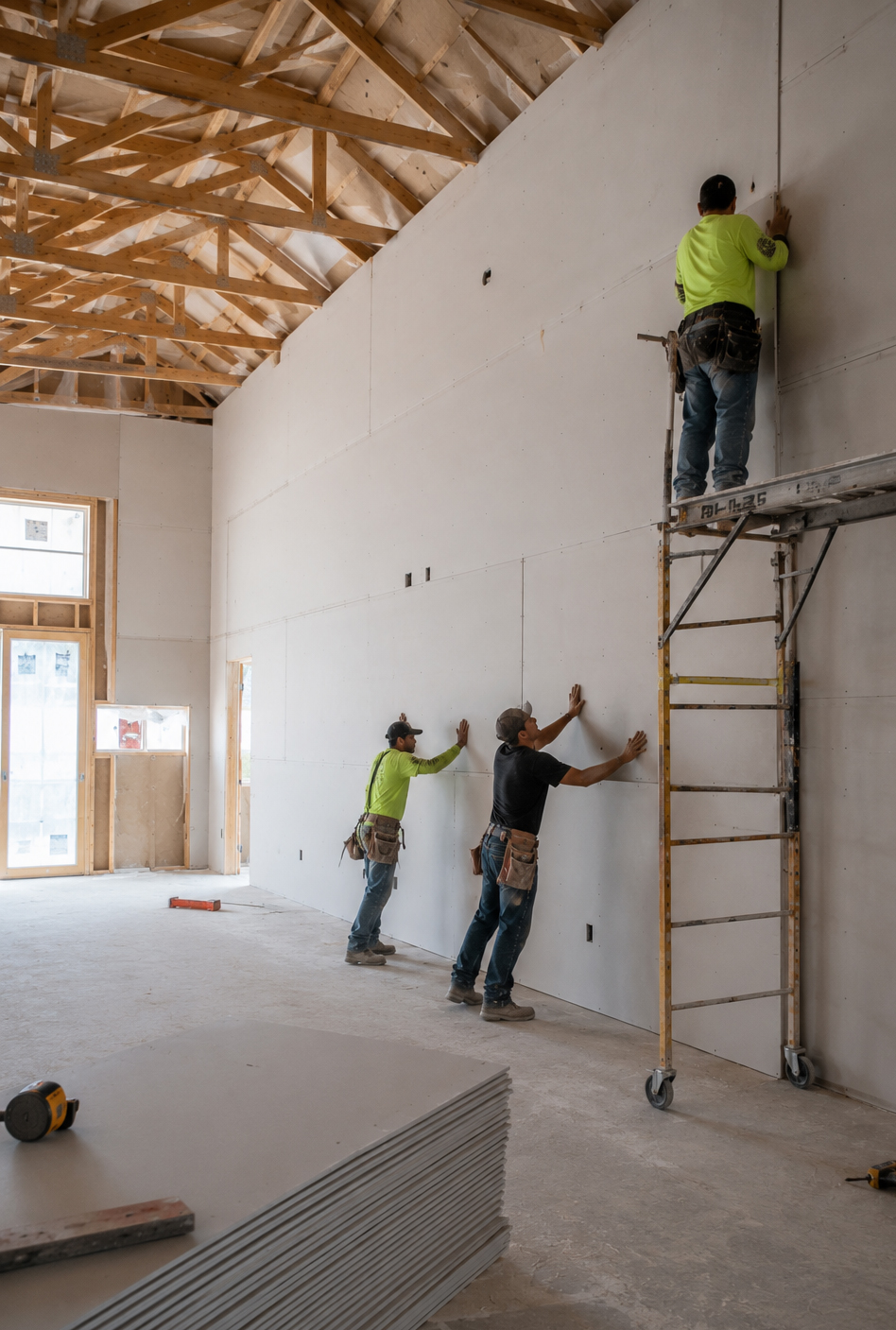
Drywall — also called gypsum board, wallboard, or by the trade name Sheetrock — is a manufactured panel product consisting of a gypsum mineral core pressed between two layers of paper facing. It is the dominant interior wall and ceiling material in North American construction because it installs quickly, finishes smoothly, and offers reliable fire-resistance and sound performance.

Finishing drywall is a separate and equally critical skill. Hanging the board is the beginning — then comes taping, applying multiple coats of joint compound, feathering each coat wider than the last, sanding between coats, and ultimately achieving a surface that is invisible under paint. The quality of a wall is decided by the finisher, not the painter.

Plaster systems — veneer plaster over blueboard, or traditional three-coat plaster over metal lath — produce harder, denser wall surfaces than standard drywall. They resist dents and dings, provide superior sound attenuation, and carry a refined, high-end aesthetic that remains the choice of discerning custom home clients across Utah’s luxury market.

Standard Gypsum Board

The workhorse of interior construction. 1/2″ is used for most wall applications; 5/8″ is standard for ceilings and where an added fire rating is needed. Available in 9′, 10′, and 12′ lengths for high-wall and cathedral applications.

Moisture-Resistant Board

Fiberglass-faced or moisture-resistant gypsum panels for bathrooms, laundry rooms, and any space subject to humidity. Cement board (HardieBacker, DuRock) is specified directly behind tile in wet areas.

Type X Fire-Rated Board

5/8″ Type X gypsum board is required in garage-to-living-space assemblies, shaft walls, stairwells, and commercial occupancies per Utah building and fire codes.

Blueboard / Veneer Plaster Substrate

A specially coated gypsum board designed to bond with finish plaster coats. The foundation of veneer plaster systems that produce a harder, denser, crack-resistant surface than standard taped drywall.

SCOPE OF WORK

OUR DRYWALL & PLASTER SERVICES

Whether you need a simple patch repair or a full new-construction finish-out for a custom Utah home, RainFire Builders brings the right crew, the right tools, and the right standard to every project.

Complete drywall scope for new homes and commercial build-outs — board delivery, layout, hanging, taping, multi-coat finishing, and sanding ready for paint.

Drywall for room additions, basement finishes, kitchen and bathroom remodels — including demo of existing board, new installation, and blending with adjacent existing walls.

Premium full-surface skim coat applied to the entire wall and ceiling for luxury custom homes, open-plan spaces, and any project where flat or low-sheen paint will be used.

Spray and hand-applied textures — smooth, orange peel, knockdown, and skip trowel — are applied consistently to match room aesthetics or existing adjacent surfaces.

Veneer plaster over blueboard for luxury residential projects. Hard, dense, crack-resistant walls and ceilings with a surface quality that standard drywall finishing cannot replicate.

Professional drywall repair for water damage, impact holes, and restoration projects — including texture matching to blend seamlessly with existing surfaces.

Recruitment Features
HOW WE WORK

The RAINFIRE DRYWALL PROCESS

Great drywall finishing is a multi-day, multi-coat process. Skipping coats or rushing drying time — as less experienced crews do — produces walls that telegraph every imperfection under the first coat of paint. We don’t skip steps.

INDUSTRY STANDARD FINISH GRADES

Understanding Drywall Finish Levels

The Gypsum Association and major paint manufacturers define six finish levels (0–5) for drywall surfaces. Specifying the correct level for each room is one of the most commonly overlooked decisions in residential construction — and one of the most consequential when paint goes on the wall.


NO FINISH

Board hung with no taping or finishing. Appropriate for temporary construction only — never for any finished or paintable surface.

TAPE IN JOINTS

Joint tape embedded in compound, face paper covered. Used in attics, crawl spaces, and concealed mechanical areas — anywhere the surface is never seen.

ONE COAT OVER TAPE

One coat of compound over tape and fasteners. Standard substrate for tile in wet areas — no further finishing needed where tile will cover the board.

TWO COATS, SANDED

Two coats over tape and fasteners, lightly sanded. Used under heavy texture or thick wall coverings. Not appropriate for smooth or thin-coat finishes.

THREE COATS, FULLY SANDED

The industry standard for most painted walls and ceilings — three coats over all joints and fasteners, each coat feathered wider, fully sanded. Appropriate for flat, eggshell, or semi-gloss paint in standard lighting conditions.

FULL SKIM COAT – ENTIRE SURFACE

A thin skim coat of joint compound or finish plaster is applied over the entire wall surface — not just joints — creating a completely uniform canvas. Required for flat paints, strong sidelighting, open-plan rooms, and all luxury custom home applications where surface uniformity is non-negotiable.


RainFire Builders defaults to Level 4 on all standard work and Level 5 in luxury custom homes, open-plan living spaces, and any area where flat or eggshell paints will be applied.

COMMON QUESTIONS

DRYWALL & PLASTER FAQs

Straight answers about drywall, plaster, finishes, and everything in between.

Is it better to repair drywall or replace it entirely?2026-05-29T06:09:37+00:00

Small holes under 6 inches and isolated hairline cracks are almost always best repaired with a proper patch. Large sections with water damage, active mold staining, or significant structural impact are better replaced — cut out the damaged board and install new material. For restoration projects with widespread damage across multiple walls, a full re-board and refinish often costs less than attempting panel-by-panel repairs and produces a far more uniform result. RainFire Builders will give you an honest assessment of what makes sense for your specific situation rather than defaulting to the more expensive option.

Can wall texture be matched during a drywall repair?2026-05-29T06:08:57+00:00

Yes — with the right skills and equipment. Orange peel and knockdown textures can be closely matched with spray equipment and correct pressure settings. Skip trowel is more challenging because it depends on individual hand motion and pressure. Smooth and Level 5 walls require the most care — a feathered skim coat repair must be sanded meticulously and primed before paint to be invisible. RainFire Builders’ finish team has extensive texture-matching experience across all common Utah residential textures, and will blend repairs rather than re-texture entire rooms when matching is achievable.

What is a Level 5 drywall finish and when is it worth the extra cost?2026-05-29T06:07:01+00:00

A Level 5 finish applies a thin skim coat of joint compound over the entire wall and ceiling surface — not just at joints and fasteners — creating a completely uniform canvas. It is the only drywall finish that reliably hides surface variation under flat paint, in rooms with strong sidelighting, or under low-sheen eggshell in open-plan spaces. In Utah’s luxury custom home market, Level 5 is increasingly the standard in main living areas, primary suites, and anywhere trim and millwork quality calls for an equally polished wall surface. The premium over Level 4 is typically 15–30% of the total drywall cost — and it shows.

How long does drywall finishing take to dry between coats?2026-05-29T06:06:22+00:00

Standard all-purpose joint compound requires a minimum of 24 hours between coats at 65–75°F and 40–60% relative humidity. In Utah’s very dry winter air (often 10–25% indoor humidity), compound can skin over quickly but may crack beneath the surface if it dries too fast — particularly in thin applications. Our crews monitor indoor conditions and use lightweight or setting-type compounds where appropriate to maintain finish quality regardless of season. Rushing the drying process is one of the most common causes of cracking and popping seams.

What type of drywall should be used in bathrooms and kitchens?2026-05-29T06:05:44+00:00

Standard drywall is not appropriate in wet or high-humidity areas. Bathrooms and kitchens require moisture-resistant board — either fiberglass-faced gypsum (DensArmor or similar) for areas with humidity but no direct water, or cement board (HardieBacker, Durock) directly behind tubs, showers, and tile surround installations. Purple board (moisture- and mold-resistant gypsum) works well in laundry rooms and bathrooms without direct water exposure. RainFire Builders specifies the correct substrate for every location — not a one-size-fits-all product across the whole house.

How much does drywall installation cost in Utah?2026-05-29T06:04:56+00:00

Drywall installation (hanging, taping, and finishing to Level 4) in Utah typically ranges from $2.50 to $5.00 per square foot of wall and ceiling surface, depending on board type, room complexity, ceiling height, and finish level. Level 5 skim coat adds $0.50 to $1.50 per square foot. Specialty boards — moisture-resistant, fire-rated, or impact-resistant — carry higher material costs. RainFire Builders provides itemized estimates broken down by hanging, taping, and finishing phases so you see exactly what you’re paying for.

What is the difference between drywall and plaster?2026-05-29T06:04:17+00:00

Drywall is a manufactured panel — a gypsum core between paper — installed in sheets and finished with joint compound. Traditional plaster is a wet-applied material (lime, gypsum, or cement-based) built up in multiple coats over lath or an existing substrate. Veneer plaster is a hybrid system: standard blueboard panels serve as the substrate, and a thin, hard plaster finish coat is applied over the entire surface. Plaster systems are harder, denser, and more crack-resistant than drywall and carry a higher upfront cost — worth it in luxury applications.

What are the drywall finish levels and which one do I need?2026-05-29T05:54:47+00:00

Drywall finish levels run from Level 0 (no finish — temporary only) to Level 5 (full skim coat over the entire surface). Level 1 is for attics and hidden spaces. Level 2 is the tile substrate standard. Level 3 is for heavy texture or thick wall coverings. Level 4 is the minimum for standard painted walls and ceilings. Level 5 is required wherever flat paint, enamel sheens, or critical sidelighting will reveal surface variation — the standard in high-end Utah custom homes. RainFire Builders defaults to Level 4 for standard work and Level 5 in all premium residential projects.

The RainFire Difference

WHY CHOOSE RAINFIRE BUILDERS FOR DRYWALL & PLASTER?

Raking Light Standard

We inspect every finished surface under raking (angled) light — the same conditions that reveal every flaw after paint. Problems found at this stage cost 10 minutes to fix. Found after painting, they cost everyone.

Utah Climate Aware

Utah’s low winter humidity (10–25%) affects how joint compound dries and cures. Our crews actively manage drying conditions — not just the schedule — to prevent cracking and surface checking before the next coat.

Sequenced with Every Trade

Because RainFire Builders self-performs all interior trades, our drywall crews never board over unfinished rough-in work, blocked backing, or uninspected assemblies — a common and costly mistake with fragmented subcontracting.

Finish Grade, Every Time

We do not offer “budget drywall” as a product category. Every project receives the correct finish level for its paint and lighting conditions — specified in writing before work begins, delivered without argument when complete.

SURFACE CHARACTER:

INTERIOR WALL TEXTURE GUIDE

SMOOTH / LEVEL 5

No texture at all — a perfectly flat, skim-coated surface that is the gold standard for luxury, modern, and contemporary interiors.

BEST FOR: LUXURY CUSTOM HOMES, MODERN DESIGN, FLAT PAINT

ORANGE PEEL

A light, evenly distributed spray texture that resembles the skin of an orange. The most common texture in Utah residential construction hides minor surface variation and applies quickly.

BEST FOR: PRODUCTION HOMES, FAMILY LIVING AREAS, STANDARD FINISH

KNOCKDOWN

A splatter of compound applied by spray or roller, then “knocked down” flat with a trowel before drying. Creates a mottled, high-end appearance with more depth than orange peel.

BEST FOR: TRANSITIONAL HOMES, DINING ROOMS, ACCENT WALLS

SKIP TROWEL

A hand-applied texture created with a curved trowel in irregular, overlapping passes — each applicator’s result is unique. A warmer, artisanal aesthetic prized in Tuscan and Mediterranean-influenced homes.

BEST FOR: WARM TRADITIONAL INTERIORS, PLASTER AESTHETIC

POPCORN / ACOUSTIC

A heavily stippled spray texture common on ceilings from the 1960s–1990s. No longer commonly specified for new work, RainFire Builders matches it for repair work and can remove and replace it.

BEST FOR  MATCHING EXISTING OLDER HOMES, CEILING REPAIR

VENEER PLASTER

A wet-applied thin plaster finish coat over blueboard substrate. Harder than any drywall finish, highly resistant to cracking and impact, with a subtle hand-troweled character unique to each room.

BEST FOR: LUXURY RESIDENTIAL, PERIOD RESTORATION, DURABILITY


CONTINUE BUILDING:

RELATED INTERIOR SERVICES

Framing

The wall skeleton that drywall is hung onto – plumb framing is essential for flat, straight walls  |  Explore Framing

Insulation

Batt, blown, and spray foam systems installed into the wall cavities that your framing creates  |  Explore Insulation

Electrical

Rough-in wiring runs through the framing before walls are closed – sequence matters  |  Explore Electrical

Indoor Plumbing

Supply and drain lines are routed through framed walls during rough-in – before drywall  |  Explore Indoor Plumbing

HVAC

Ductwork chases, mechanical closets, and equipment platforms are all built into framing  |  Explore HVAC

Trim & Millwork

Coffered ceilings, built-ins, and wainscoting all begin with precision framing underneath  |  Explore Trim & Millwork


Don’t Settle for Walls that Tell on Themselves

Imperfect drywall shows under the first coat of paint and never stops showing. RainFire Builders finishes every wall and ceiling to the standard it deserves — on time, on spec, and ready to paint without rework. Let’s talk about your project.

Call us now at (385) 336-7246 or request an estimate online. We’ll start on your property’s project and your future with care.

We Make It Happen – 

Request a Quote

Schedule your in-person consultation. Let’s get your project started

Go to Top