
Exterior Construction – Roofing
Roofing Built For
Utah’s Weather Reality
The Wasatch Front sits in one of the most demanding roofing environments in the western United States — a high-hail corridor, UV intensity 25% stronger than sea level, thermal cycling between −5°F winters and 100°F summers, and snow loads that defeat systems specified for milder climates. RainFire Builders installs every roofing system with Class 4 impact resistance as the standard, full-coverage ice and water shield, and the material specifications that survive Utah’s actual conditions — not the generic specifications that look fine on the bid sheet and fail in year seven.
OUR ROOFING SERVICES
Class 4 Impact-Resistant Shingles
Standing Seam & Metal Roofing Systems
Flat & Low-Slope Membrane Roofing
Concrete & Clay Tile Installation
Full-Coverage Ice & Water Shield
Roof Deck Inspection & Replacement
Ridge, Soffit & Attic Ventilation
Flashing At All Penetrations & Valleys
Emergency Roof Repair & Tarping
Gutters, Downspouts & Leaf Guards
Licensed & Insured

OUR ROOFING SERVICES –
RainFire Builders handles every roofing scope from complete replacement through emergency repair — as a single accountable project from assessment through final inspection and manufacturer warranty registration.
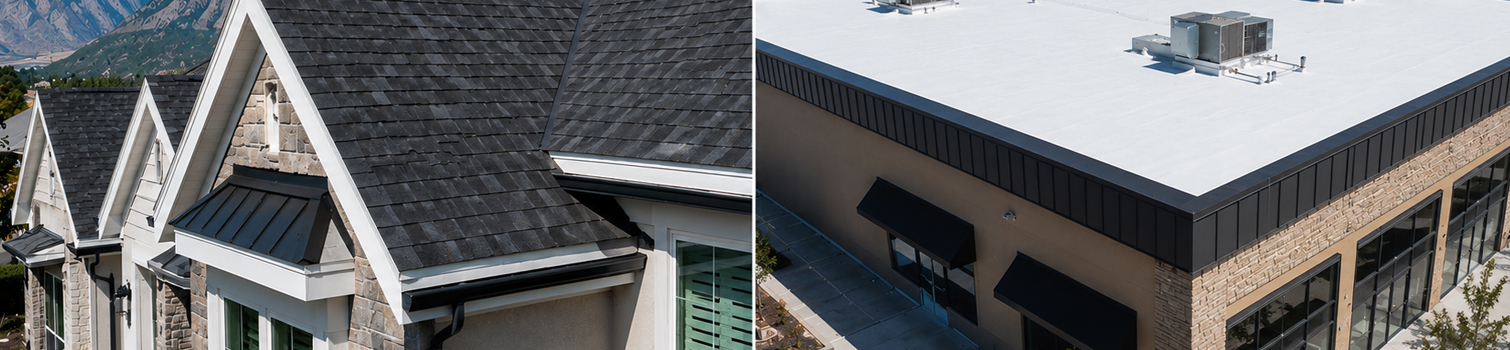
Complete tear-off and replacement for residential homes — deck inspection, full-coverage ice and water shield, synthetic underlayment, Class 4 impact-resistant shingles, and all flashing as an integrated scope. Permit managed, inspection coordinated.
Standing seam steel and aluminum roofing, metal shingles, and exposed fastener steel panel systems — the highest-durability roofing option for Utah’s hail, UV, and snow conditions. Ideal for luxury residential, mountain community, and commercial applications.
TPO, EPDM, and modified bitumen membrane systems for flat roofs and slopes under 2:12 — designed with Utah-specific drainage considerations, heat-welded seam detailing for thermal cycling, and freeze-resistant drain assembly specification.
Targeted repairs for missing shingles, failed flashing, storm damage, and active leaks — with same-day emergency tarping for active infiltration events. Honest scope assessment: repair when repair is right, replacement when it isn’t.
Skylight installation and replacement with properly flashed curb mounting, solar panel conduit stub-out and rail attachment blocking, and all roof penetrations — plumbing vents, HVAC flues, exhaust fans — flashed and waterproofed to current installation standards.
Seamless aluminum gutter systems, downspout placement for proper drainage away from the foundation, leaf guard systems, ridge vent installation, and soffit ventilation balanced to prevent ice dam formation — the drainage and ventilation scope that makes the roofing system complete.
HOW WE WORK
The RainFire Roofing Process
A roofing project done correctly has a specific sequence that most homeowners never see — and that separates a roof that performs for 30 years from one that starts failing at eight.
Full Roof Assessment
Before any material or price is discussed, RainFire Builders conducts a complete roof assessment — photographing every roof section from the ladder and the ridge, inspecting the attic below for signs of moisture infiltration, checking ventilation adequacy, measuring the roof for accurate square footage, and documenting the condition of all flashing, valleys, and penetrations. We identify deck damage, soft spots, and moisture-compromised sheathing before the tear-off reveals them. The assessment report drives the scope and the specification — never the other way around.
Material Selection & Permit
The material selection is made with the full information of the assessment: the hail history of the neighborhood, the insurance carrier’s discount schedule for Class 4 products, the existing roof’s ventilation design, and any structural considerations for heavier materials. Where a permit is required, RainFire Builders submits the application and tracks its issuance before any crew or material is scheduled. Materials are ordered and confirmed before demolition is scheduled — not assumed to be in stock the morning of tear-off.
Tear-Off & Deck Inspection
Complete tear-off of all existing layers is standard for Utah roofing — most Utah building departments prohibit more than two layers total, and roofing over an existing layer conceals the deck condition that determines whether the new roof is being installed on a sound substrate. After tear-off, every square foot of decking is walked and probed. Soft spots, delamination, and moisture-stained sheathing are replaced before any new material is installed. This is the step that separates a genuine roof replacement from a cover-up — and the step where most cut-rate contractors find ways to cut corners.
Installation — Layer by Layer
Drip edge installed before ice and water shield at eaves, after at rakes. Full-coverage self-adhering ice and water shield across the entire deck — not just the first three feet. Synthetic underlayment over the ice and water shield. Primary material installed to the manufacturer’s nailing pattern and exposure specifications using corrosion-resistant fasteners. All valleys, penetrations, chimneys, and wall junctions flashed in metal — not caulk. Ridge cap installed over a continuous ridge vent where applicable. Every step is photographed as it is completed, creating a documented installation record that supports both the manufacturer’s warranty and future claims assessment.
Final Inspection & Warranty Registration
Final walk-around inspection and interior attic check after material installation. Permit inspection coordinated where required. Manufacturer warranty registered in the homeowner’s name — not left for the homeowner to discover wasn’t done when they try to file a claim years later. Job site cleanup, including magnet sweep of all shingle nails from the yard and driveway. The completed project includes a written workmanship warranty, manufacturer warranty documentation, and the assessment photos that establish the installation baseline for future insurance and maintenance purposes.

Roofing Built for Utah’s Extremes
Utah presents a combination of roofing challenges rarely found together. The Wasatch Front’s documented hail corridor means that over a typical 30-year roof lifespan, most Salt Lake Valley homes will experience at least one hail event significant enough to affect roofing material integrity — making Class 4 impact resistance the most financially rational specification for virtually every residential replacement roof on the Wasatch Front.
Ice dams — the formation of ice dams at the eave when warm attic air melts snow that refreezes at the cold overhang — are the most common winter moisture infiltration mechanism in Utah homes. The solution is attic air sealing, adequate insulation (R-49 to R-60 in Climate Zone 5), and balanced ridge-soffit ventilation — plus full-coverage ice and water shield on the roof deck that provides backup protection when ice dam water backs up under shingles.
Utah’s altitude affects shingle chemistry. At 4,200 feet in Salt Lake City, UV radiation is approximately 25% more intense than at sea level. Shingle manufacturers’ granule formulations and warranty durations are based on sea-level UV exposure. In practice, Utah roofs reach the end of their useful life 3–5 years sooner than the same shingle in a lower-altitude market — which is one more reason Class 4 products with enhanced UV stabilization outperform standard architectural shingles on the Wasatch Front.
The Wasatch Front is a documented high-hail zone. Class 4 impact-resistant roofing is the standard RainFire Builders specifies on every residential replacement — not an upgrade option. The insurance savings alone typically justify the cost differential in 3–7 years.
The IRC requires ice and water shield only at the first 24 inches inside the exterior wall. RainFire Builders installs full-coverage ice and water shield across the entire roof deck — because Utah’s ice dam formation risk extends well beyond the standard code minimum.
At 4,200 feet, UV intensity is approximately 25% higher than at sea level — meaning shingle oxidation, granule adhesion loss, and sealant strip degradation happen measurably faster in Utah than manufacturer warranty durations reflect.
Ground snow loads in Park City and Heber Valley reach 80–120+ psf — requiring structural verification of roof framing capacity before any heavier roofing material (tile, thick metal) is specified. RainFire Builders coordinates structural review for all weight-sensitive roofing scopes in mountain communities.
THE FIRST LINE OF DEFENSE
What a Roof Actually Does – And How It Fails
A roof system is not a single layer of shingles. It is a layered assembly — structural decking, underlayment, ice and water protection, the primary surface material, flashing at every transition, and a ventilation system that manages the thermal and moisture conditions in the attic below. Every layer serves a function, and every layer must be correctly installed for the assembly to perform as designed.
Most Utah roof failures don’t announce themselves with dramatic leaks. They begin quietly: granule loss from hail impacts that exposes the asphalt mat to UV oxidation; a valley flashing joint that opens under thermal expansion; a sealant strip that loses adhesion in a cycle of cold winters and hot summers; an attic with inadequate ventilation that creates the temperature differential that drives ice dam formation. By the time water appears on a ceiling, the damage path typically extends through sheathing, framing, and insulation.
RainFire Builders approaches every roofing project — replacement or repair — with a complete assessment of all layers and a documented specification that addresses Utah’s specific failure modes. We don’t quote a material upgrade without explaining exactly what problem it solves. And we don’t close a project without photographing every flashing installation before it goes under cladding.
LAYER 1 – STRUCTURAL DECK
OSB or plywood sheathing over roof framing. Must be dry, flat, and structurally sound before any roofing material is installed. Soft spots, delamination, or staining indicate moisture damage that must be replaced, not covered.
LAYER 2 – ICE & WATER SHIELD
Self-adhering rubberized membrane that seals around fasteners and prevents water infiltration at eaves and valleys. Utah standard: full coverage. Not just the first three feet — the entire roof deck. Ice dam protection requires it.
LAYER 3 – SYNTHETIC UNDERLAYMENT
A secondary weather barrier below the primary surface that protects the deck if the primary material fails. Synthetic underlayment (non-woven polypropylene) outperforms traditional felt in UV resistance and tear strength.
LAYER 4 – PRIMARY SURFACE MATERIAL
Asphalt shingles, metal panels, tile, or membrane — the visible, weather-facing layer. Material selection drives 70% of the system’s long-term performance and the entire aesthetic impression.
LAYER 5 – FLASHING & VENTILATION
Metal flashing at every valley, penetration, chimney, and wall junction. Ridge and soffit ventilation balanced to maintain a cold, dry attic. The layers that most roofing shortcuts eliminate first — and the ones that cause the most failures.
COMMON QUESTIONS
ROOFING FAQs
Honest, specific answers to Utah homeowners’ most common roofing questions.
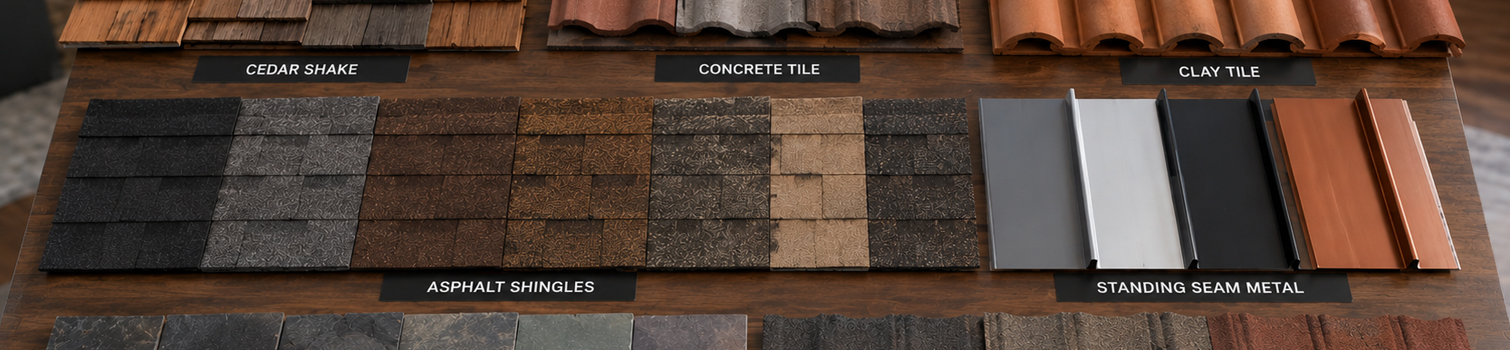
For most Utah residential homes, Class 4 impact-resistant asphalt shingles are the practical best choice — they provide the strongest available protection against Utah’s documented hail exposure, qualify for premium discounts of 15–30% with most Utah homeowners insurance carriers, and perform well against UV degradation and thermal cycling. Standing seam metal roofing is the highest-durability option (40–70-year lifespan, excellent hail performance) at 2–3× the upfront cost of shingles. Concrete and clay tile offer exceptional longevity but require structural engineering to confirm existing framing capacity for the added weight. RainFire Builders presents all material options with Utah-specific performance data on every roofing estimate.
Class 4 is the highest rating under UL 2218 — the standard for impact resistance of roofing materials. Testing involves dropping a 2-inch steel ball from 20 feet onto the sample; Class 4 means no cracking or splitting. In Utah, Class 4 matters because the Wasatch Front sits in a recognized high-hail corridor. Class 4 roofing substantially reduces hail damage probability, qualifies for 15–30% insurance premium discounts with most Utah carriers, and extends the functional roof life between replacements. RainFire Builders specifies Class 4 as the standard recommendation — not a premium upgrade — for every Wasatch Front residential roof replacement.
Utah’s high-altitude UV intensity and thermal cycling compress roofing lifespan compared to manufacturer ratings. Standard 3-tab shingles: 15–20 years. Architectural dimensional shingles: 20–28 years. Class 4 impact-resistant shingles: 25–35 years. Standing seam metal: 40–70+ years. Concrete/clay tile: 50+ years. Annual inspection to catch granule loss, flashing deterioration, and sealant failure before water infiltration begins is the most cost-effective roofing investment. A $200–$400 annual inspection avoids $2,000–$8,000 in water damage remediation that a missed small failure can produce.
Replacement indicators: widespread granule loss (bare spots on shingles or excessive granules in gutters); cupping or curling shingles across multiple sections; hail damage covering more than 30% of any roof section; a roof more than 20–25 years old; multiple leak locations; or visible daylight through the attic. Repair indicators: isolated missing or cracked shingles on a roof with 10+ years of remaining life; a single flashing failure on an otherwise sound roof; or one isolated leak source. RainFire Builders provides honest assessments — repair is recommended when repair is genuinely the right answer.
Ice dams form when heat escaping from the conditioned space warms the middle of the roof deck, melting snow that runs to the cold eave and refreezes. The cause is always inadequate attic insulation, inadequate attic ventilation, or air leakage paths from living space into the attic. The fix starts with attic air sealing and insulation to R-49 to R-60 (Utah Climate Zone 5) — not with heated cables or roof raking. On the roofing side, full-coverage ice and water shield provides backup protection at the most vulnerable areas. RainFire Builders always reviews attic ventilation and insulation as part of any roofing scope — because installing new shingles without addressing the ice dam mechanism is treating the symptom, not the problem.
For a typical 2,000 sq ft single-story Utah home (approximately 22–25 squares): standard architectural shingles run $9,000–$16,000 installed; Class 4 impact-resistant shingles add $1,000–$2,500 to the base cost; standing seam metal runs $22,000–$45,000; concrete tile runs $18,000–$35,000. Additional variables: deck replacement ($75–$120/sheet if needed); gutter replacement ($8–$15 per linear foot); permit fees ($200–$600 in most Utah jurisdictions); and skylight replacement if included. Class 4 insurance savings typically offset the Class 4 premium in 3–7 years — making the upgrade financially rational before accounting for extended roof life.
Like-for-like roof replacement (same material, same slope) typically does not require a permit in most Utah municipalities. However, structural roof modifications require permits; roofing over an existing layer requires permits in many jurisdictions (and most prohibit more than two total layers); solar panel installation requires electrical and structural permits; and skylight additions require permits. Some Utah cities require permits for all roofing work. RainFire Builders verifies permit requirements for each specific municipality before work begins and manages all permit applications when required. Unpermitted work that should have been permitted creates insurance complications and potential resale disclosure obligations.
3-tab shingles are a single-layer design with three cutouts along the lower edge — thin, flat profile, lower wind resistance (60–70 mph), shorter lifespan, and typically Class 1–2 impact resistance. They are rarely appropriate for Utah’s hail and wind environment and are not recommended by RainFire Builders for Wasatch Front roofs. Architectural shingles (dimensional or laminate) are multi-layer, heavier, thicker, and carry higher wind ratings (110–130 mph on premium products) — a meaningful improvement. Class 4 impact-resistant shingles are architectural shingles with additional polymer/rubber modification achieving the UL 2218 Class 4 rating. RainFire Builders specifies architectural shingles as the minimum for Utah residential roofing and Class 4 as the standard recommendation.
The RainFire Difference
WHY CHOOSE RAINFIRE BUILDERS FOR FOUNDATION WORK?
Class 4 Is Our Baseline
We don’t offer Class 4 as a premium upgrade. It’s the standard recommendation on every Wasatch Front residential roof — because Utah’s hail corridor makes it the only specification that makes financial and practical sense.
Every Layer Documented
Ice and water shield, underlayment, flashing installation — every hidden layer is photographed before it goes under the primary material. You receive a documented installation record that supports your manufacturer’s warranty and future insurance claims.
Warranty Registered For You
Every manufacturer’s warranty is registered in your name at project completion. Most Utah homeowners discover their warranties were never registered when they try to use them. This is a standard closeout step on every RainFire roofing project.
One Team for the Envelope
RainFire Builders self-performs roofing alongside siding, windows, and foundation work. When multiple exterior systems need work, we plan and sequence them together — so no trade undoes another’s work and no envelope gap is left open between projects.
CONTINUE BUILDING:
RELATED INTERIOR SERVICES
Windows & Doors
Windows and skylight flashing are part of the roofing scope – coordinating these trades ensures every opening is properly waterproofed as a unified system | Explore More Windows & Doors
Siding & Cladding
Roofing and siding are sequenced together – new siding is never installed under an end-of-life roof that will need replacement in three years | Explore More about Siding & Cladding
Foundation
Gutter systems that direct roof drainage away from the foundation protect the same structure that the foundation protects from below | Explore Foundations
Concrete & Masonry
Chimney masonry – caps, crown, and mortar joints – is part of the roofing system. Masonry failures above the rooflines cause roof leaks | Explore More Concrete & Masonry
Insulation
Attic insulation and air sealing are the structural solution to ice dam formation – the problem that begins at the roof but originates in the attic below | Explore More on Insulation
All Exterior Services
Return to the full exterior services overview – roofing, siding, foundation, windows, decks, and concrete, all under one contractor | Go Back to the Beginning
CLASS 4. FULL COVERAGE. WARRANTED
Your Roof Should Last as Long as Your Home. Let’s Make Sure It Will.
Whether you’re replacing an aging roof before the next hail season, dealing with a damage claim, or assessing a home purchase, RainFire Builders provides free on-site roof assessments with a documented findings report — honest, specific, and not contingent on you choosing replacement. We’ll tell you exactly what your roof needs, why, and what it will cost.
Call us now at (385) 336-7246 or request an estimate online. We’ll start on your property’s project and your future with care.
We Make It Happen –
Request a Quote
Schedule your in-person consultation. Let’s get your project started
