
Electrical2026-05-30T16:19:34+00:00
INTERIOR CONSTRUCTION – ELECTRICAL

ELECTRICAL
With RAINFIRE BUILDERS
About Avada Recruitment Agency

GET A FREE ELECTRICAL ESTIMATE

LEARN MORE BELOW

Modern home electrical is far more than wire and breakers. It is the nervous system of every room — powering lights that set the mood, outlets that keep life running, circuits that protect against fire, and smart systems that anticipate how you live. RainFire Builders’ licensed electricians design and install complete interior electrical systems with the panel sizing, circuit planning, and code precision that Utah homes demand.

WHAT WE INSTALL
  • Service panel sizing & installation

  • Full electrical rough-in — all circuits

  • Recessed & architectural lighting layout

  • AFCI & GFCI protection — NEC compliant

  • EV charger installation (Level 2)

  • Low-voltage — data, audio & smart home

  • Sub-panels & load center upgrades

  • Finish devices, fixtures & panel labeling

POWER, LIGHT & PROTECTION

Interior Electrical Systems Explained

Interior electrical begins at the service entrance — where utility power arrives at the building — and distributes through the main panel to branch circuits that serve every outlet, switch, and fixture in the home. The panel is the hub; the branch circuits are the arteries; the devices and fixtures are where electricity meets daily life.

Panel sizing is the most consequential early decision in any new electrical scope. An undersized panel constrains every future addition — an EV charger, a hot tub, a kitchen remodel — and requires expensive upgrades that a correctly sized panel at original installation would have avoided. RainFire Builders performs a load calculation before every panel specification to ensure the home is sized for how it will actually be used.

Circuit design determines whether your home can support modern loads without nuisance tripping, code violations, or fire risk. The 2020 NEC — Utah’s current adopted code — requires AFCI protection on virtually all living space circuits and GFCI protection in all wet locations. Understanding where these requirements apply, and why, is core to our electricians’ daily work.

Low-voltage systems — structured data cabling, whole-home audio, security, and smart home automation — must be pre-wired during rough-in alongside line-voltage wiring. Retrofitting low-voltage infrastructure after walls are closed costs three to five times what pre-wiring costs during construction. RainFire Builders plans and installs both systems in a single coordinated rough-in.

Phase 1 — Rough-In

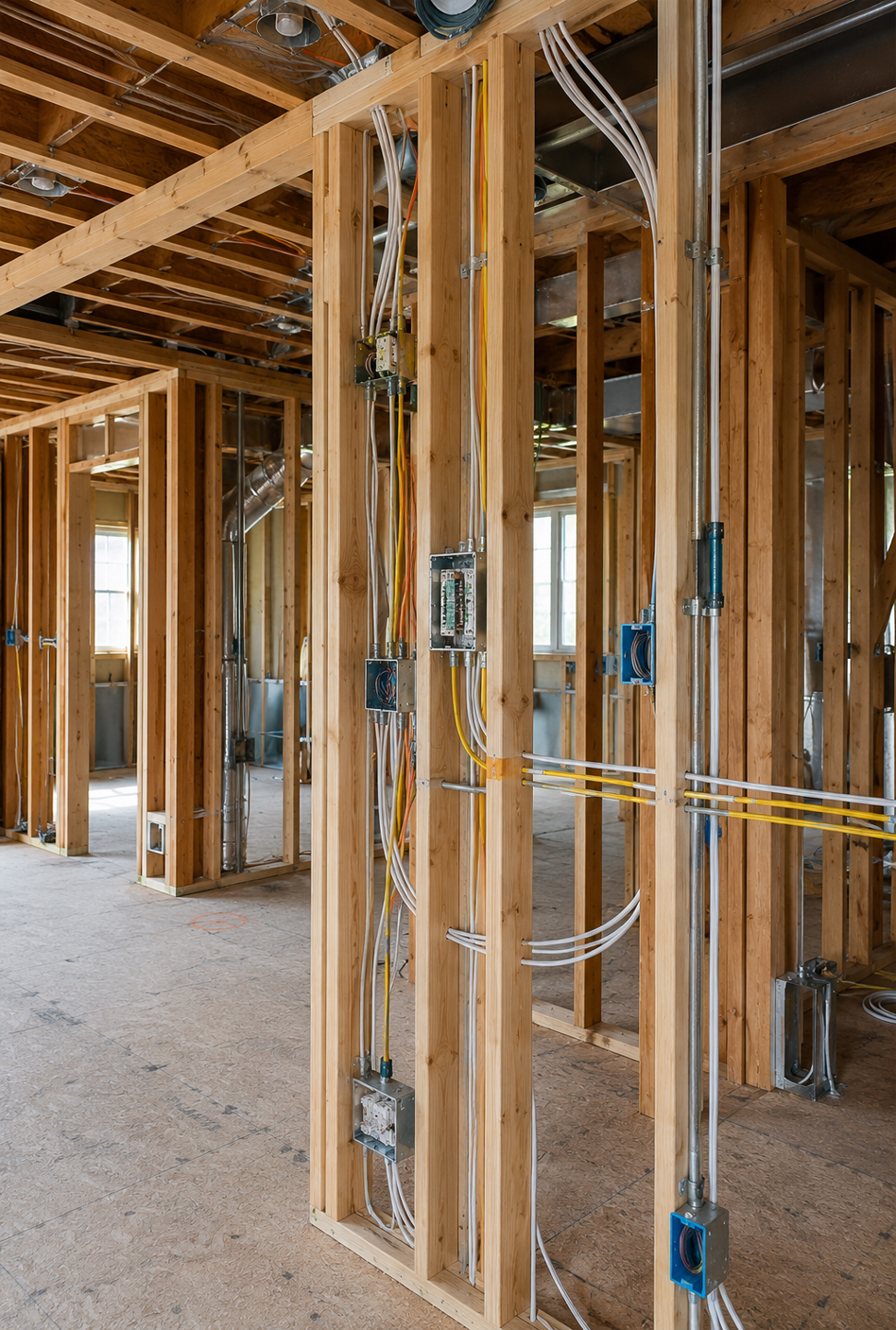
All wire runs, box locations, panel wiring, and low-voltage cabling are installed inside framing before drywall. Requires city rough-in inspection approval before walls close. This is where circuit design decisions are locked in permanently.

Phase 2 — Finish / Trim-Out

After paint and surfaces are complete: outlets, switches, and covers installed; fixtures hung; panel circuits landed and labeled; all circuits tested. What the homeowner touches every day.

The Standard: Inspect Before Close

RainFire Builders never closes walls before electrical rough-in inspection approval. Every circuit is verified before drywall — because no wall should ever be reopened to fix a wire that was in the wrong box.

SCOPE OF WORK

OUR ELECTRICAL SERVICES

RainFire Builders’ licensed electricians handle the complete interior electrical scope — from load calculation and panel selection through finish devices and panel labeling — as a coordinated part of the interior construction sequence.

Complete electrical for new homes — service entrance, panel, all branch circuit rough-in, low-voltage pre-wire, and finish electrical — designed from a full load calculation and coordinated with every other interior trade.

Electrical for kitchen and bathroom remodels, additions, and whole-home rewires — including panel upgrades from 100A to 200A that restore capacity to Utah’s aging residential stock.

Recessed lighting layout optimized for room function and ceiling height, pendant and fixture rough-in, under-cabinet lighting circuits, and dimmer-compatible circuits throughout — designed before rough-in, not added after drywall.

Level 2 (240V, 50A) EV charger installation with dedicated circuit, NEMA 14-50 outlet or hardwired charger connection, and load calculation to confirm panel capacity — with panel upgrade coordination where needed.

Solar conduit stub-out from roof to panel location, battery backup sub-panel pre-wire, and main panel sizing that anticipates future solar interconnection — future-proofing the electrical system for Utah’s strong solar market.

Electrical for office build-outs, retail spaces, and mixed-use projects — panel sizing, circuit design, lighting layout, and data infrastructure coordinated with the tenant’s specific operational requirements.

Recruitment Features
HOW WE WORK

The RAINFIRE ELECTRICAL PROCESS

Electrical done well starts with a circuit plan — not with a wire spool and a staple gun. Every project begins with load calculation and layout review before rough-in begins.

UTAH-SPECIFIC ELECTRICAL CONSIDERATIONS

Electrical Built for Utah’s Future

Utah’s residential electrical landscape is changing faster than most states. EV adoption rates in Salt Lake, Utah, and Davis Counties are among the highest in the Mountain West — driven by strong incentives, tech-industry employment, and environmental awareness. A new home without an EV charger rough-in in the garage is already behind the curve at the time of delivery.

Rocky Mountain Power’s net metering program and Utah’s 300+ days of annual sunshine make residential solar one of the most financially compelling home investments in the state. Installing solar conduit from the roof to the panel location — a $200–$400 expense at new construction — saves $1,500–$3,000 in retrofit labor when solar is added. RainFire Builders installs solar conduit stub-out and ensures panel sizing accommodates future interconnection as a standard practice on new builds.

Utah’s adoption of the 2020 NEC significantly expanded AFCI requirements — now covering virtually all living space circuits. Many production builders and smaller electrical contractors are still routing projects under prior code versions. RainFire Builders designs and inspects to the currently adopted code in every Utah jurisdiction, confirmed at project start.


EV CHARGER STANDARD

RainFire Builders rough-ins a 50A/240V circuit in the garage as a standard recommendation on every new Utah home — whether or not the client currently owns an EV. The cost difference is minimal; the retrofit cost is not.

SOLAR CONDUIT STUD-OUT

A $200–$400 conduit run from roof to panel location at new construction saves $1,500–$3,000 in solar retrofit labor. RainFire Builders installs solar conduit and panel sizing for solar-ready homes as a standard option.

2020 NEC AFCI COMPLIANCE

Utah’s adoption of the 2020 NEC expanded AFCI requirements to nearly all living space circuits. RainFire Builders designs to the current adopted code in every jurisdiction — not the prior version that some contractors still reference.

ROCKY MOUNTAIN POWER COORDINATION

Service entrance inspections, meter socket coordination, and 400A service upgrade applications all require direct coordination with RMP. RainFire Builders handles this process on every project — it is not the homeowner’s problem to manage.

COMMON QUESTIONS

ELECTRICAL FAQs

Straight answers about panels, circuits, code, and what it takes to wire a Utah home correctly.

What size electrical panel do I need for a new home in Utah?2026-05-30T16:00:10+00:00

For most new single-family homes in Utah, a 200-amp main panel is the current standard and minimum RainFire Builders specifies for new residential construction. 200A supports all standard residential loads — HVAC, electric appliances, general circuits — plus one EV Level 2 charger. Homes with all-electric heating, multiple EV chargers, large shop equipment, or solar-plus-battery storage may benefit from 400A service or a main panel with a sub-panel. 100A service — common in pre-1990 Utah homes — is insufficient for modern loads and should be upgraded during any significant remodel. RainFire Builders performs a load calculation on every new build to confirm correct sizing.

What is the difference between AFCI and GFCI protection?2026-05-30T16:00:50+00:00

GFCI (Ground Fault Circuit Interrupter) detects current leaking to ground — typically from water contact — and trips in 1/40th of a second to prevent electrocution. Required in bathrooms, kitchens within 6 feet of a sink, garages, outdoors, and other wet locations. AFCI (Arc Fault Circuit Interrupter) detects arcing faults in wiring — abnormal electrical discharges that can ignite fires — and trips the circuit before a fire starts. The 2020 NEC (Utah’s current adopted code) requires AFCI protection on virtually all 15- and 20-amp 120V branch circuits in dwelling units, including bedrooms, living areas, hallways, and kitchens. Some locations require both GFCI and AFCI protection simultaneously via dual-function breakers.

Do I need to upgrade my electrical panel to install an EV charger in Utah?2026-05-30T16:01:52+00:00

It depends on your current panel capacity and existing load. A Level 2 EV charger requires a dedicated 240V, 50A circuit — drawing up to 9,600 watts. Homes with 200A service and available panel capacity can usually add one EV charger without an upgrade. Homes with 100A service or heavily loaded 200A panels will likely need either a panel upgrade or a smart charger with load management. RainFire Builders performs a load calculation before every EV charger installation to confirm capacity and advise on upgrade needs. For new construction, we rough-in a 50A EV circuit in the garage as a standard recommendation regardless of whether the client currently owns an EV.

What is low-voltage wiring and what should I pre-wire in a new Utah home?2026-05-30T16:02:36+00:00

Low-voltage covers all home systems operating below 50 volts: structured data cabling (Cat6A Ethernet to every room), coaxial cable for video, speaker wire for whole-home audio, security system wiring, and home automation control wiring. Pre-wiring during construction costs a fraction of retrofitting after walls close — typically $800–$2,500 for a complete low-voltage rough-in versus $3,000–$8,000+ to run cable through finished walls. RainFire Builders recommends, at minimum: Cat6A to every bedroom, home office, TV location, and network closet; speaker pre-wire in main living areas and primary bedroom; and security sensor wiring at all exterior doors and windows.

What electrical work requires a permit in Utah?2026-05-30T16:03:15+00:00

In Utah, a permit is required for any new electrical installation or modification beyond simple device replacement — new circuits, panel upgrades, service changes, EV charger installation, subpanel installation, rewiring, and adding outlets or fixtures in a remodel. Permits require a rough-in inspection (after wiring, before walls close) and a final inspection (after devices are installed and the panel is energized). Working without permits creates insurance complications, liability exposure, and resale disclosure obligations. RainFire Builders pulls all required permits and coordinates all city inspections as a standard part of every electrical scope.

What is the difference between a 15-amp and 20-amp circuit?2026-05-30T16:04:02+00:00

A 15-amp circuit uses 14-gauge wire protected by a 15-amp breaker, with a safe continuous load of 1,440 watts. A 20-amp circuit uses 12-gauge wire protected by a 20-amp breaker, with a safe continuous load of 1,920 watts. NEC requires 20-amp circuits for kitchen countertop receptacles, bathroom receptacles, and laundry rooms. General living areas and bedrooms can use 15-amp circuits, though 20-amp circuits throughout are common in quality construction. The critical rule: 14-gauge wire can never be protected by a 20-amp breaker — wire gauge and breaker ampacity must always match. RainFire Builders uses 12-gauge wire and 20-amp circuits throughout most of the home as a quality standard.

How many electrical outlets are required per room by NEC code?2026-05-30T16:04:39+00:00

The NEC requires that no point along any wall in a habitable room is more than 6 feet from an outlet — the “6-foot rule.” In practice, this means one outlet roughly every 12 feet of wall length. Kitchens require receptacles every 4 feet along countertop walls. Bathrooms require at least one GFCI-protected outlet. Hallways 10 feet or longer need at least one outlet. Outdoor spaces require GFCI-protected weatherproof outlets. These are code minimums — RainFire Builders exceeds them throughout, particularly in kitchens, home offices, and primary bedrooms, based on modern usage patterns where the code minimums are genuinely insufficient.

What is a dedicated electrical circuit and when is one required?2026-05-30T16:05:23+00:00

A dedicated circuit serves only one appliance — no other outlets or devices share it. NEC and appliance manufacturers require dedicated circuits for: refrigerators (15–20A), dishwashers (20A), microwaves over 1,200W (20A), electric ranges (50A 240V), electric dryers (30A 240V), HVAC equipment (per nameplate), water heaters, garbage disposals, and EV chargers. Home offices and home theaters also benefit from dedicated circuits to prevent tripped breakers and interference. RainFire Builders designs the circuit plan to include all required and recommended dedicated circuits before rough-in begins — not as an afterthought when an appliance doesn’t work at move-in.

The RainFire Difference

WHY CHOOSE RAINFIRE BUILDERS FOR ELECTRICAL?

Load Calc Before Every Panel

Every panel size is confirmed by a load calculation, not a guess or a default. The right panel at new construction costs almost the same as the wrong one — and avoids a $3,000–$8,000 upgrade the first time someone adds a significant load.

Licensed Utah Electricians

All electrical work is performed by Utah-licensed electricians current with the 2020 NEC as adopted in Utah — not unlicensed laborers supervised by a license holder. The license matters when the inspector arrives.

Line & Low-Voltage Together

Low-voltage pre-wire is planned and installed alongside line-voltage rough-in — not subcontracted separately or scheduled after the walls are already closed. One rough-in window, complete infrastructure.

Future-Ready by Default

EV charger rough-in, solar conduit stub-out, and panel sizing for battery backup are presented as standard options on every new build. The home that’s ready for what’s coming costs almost nothing more than one that isn’t.

CONTINUE BUILDING:

RELATED INTERIOR SERVICES

Drywall & Plaster

Drywall never goes up before electrical rough-in inspection approval – that sequence is enforced on every project  |  Explore Drywall & Plaster

Framing

Electrical rough-in runs through framing – box placement and drilling are coordinated with framing layout  |  Explore Framing

Cabinetry & Countertops

Under-cabinet lighting circuits, outer placement and appliance circuits are coordinated with cabinet layout before rough-in  |  Explore Cabinetry & Countertops

Insulation

Electrical boxes in exterior walls are air-sealed as part of the insulation scope – a critical detail for energy performance  |  Explore Insulation

HVAC

HVAC equipment requires dedicated circuits specified and roughed in alongside the mechanical system layout  |  Explore HVAC

Indoor Plumbing

Electrical and plumbing rough-in happen simultaneously – coordinated to avoid conflicts in shared wall cavities  |  Explore Indoor Plumbing


POWER YOUR HOME RIGHT

Wired for Today. Ready for Tomorrow

From the load calculation that sizes the panel correctly to the EV charger rough-in, you’ll thank yourself in three years. RainFire Builders designs and installs interior electrical that serves the home you’re building and the life you’ll live in it — inspected, tested, and warranted at every stage.

Call us now at (385) 336-7246 or request an estimate online. We’ll start on your property’s project and your future with care.

We Make It Happen – 

Request a Quote

Schedule your in-person consultation. Let’s get your project started

Go to Top