
Insulation2026-05-30T17:24:36+00:00
INTERIOR CONSTRUCTION – INSULATION

INSULATION INSTALLATION
With RAINFIRE BUILDERS
About Avada Recruitment Agency

GET A FREE INSULATION ESTIMATE

LEARN MORE BELOW

Insulation is the trade nobody sees, and everybody feels. It determines whether your home is warm in January and cool in August, whether your utility bill is reasonable or punishing, whether the bedroom next to the living room is quiet or not. RainFire Builders specifies and installs insulation as a building science decision — not a material commodity — designed around Utah’s climate zones, your home’s assembly, and your energy goals.

WHAT WE INSTALL
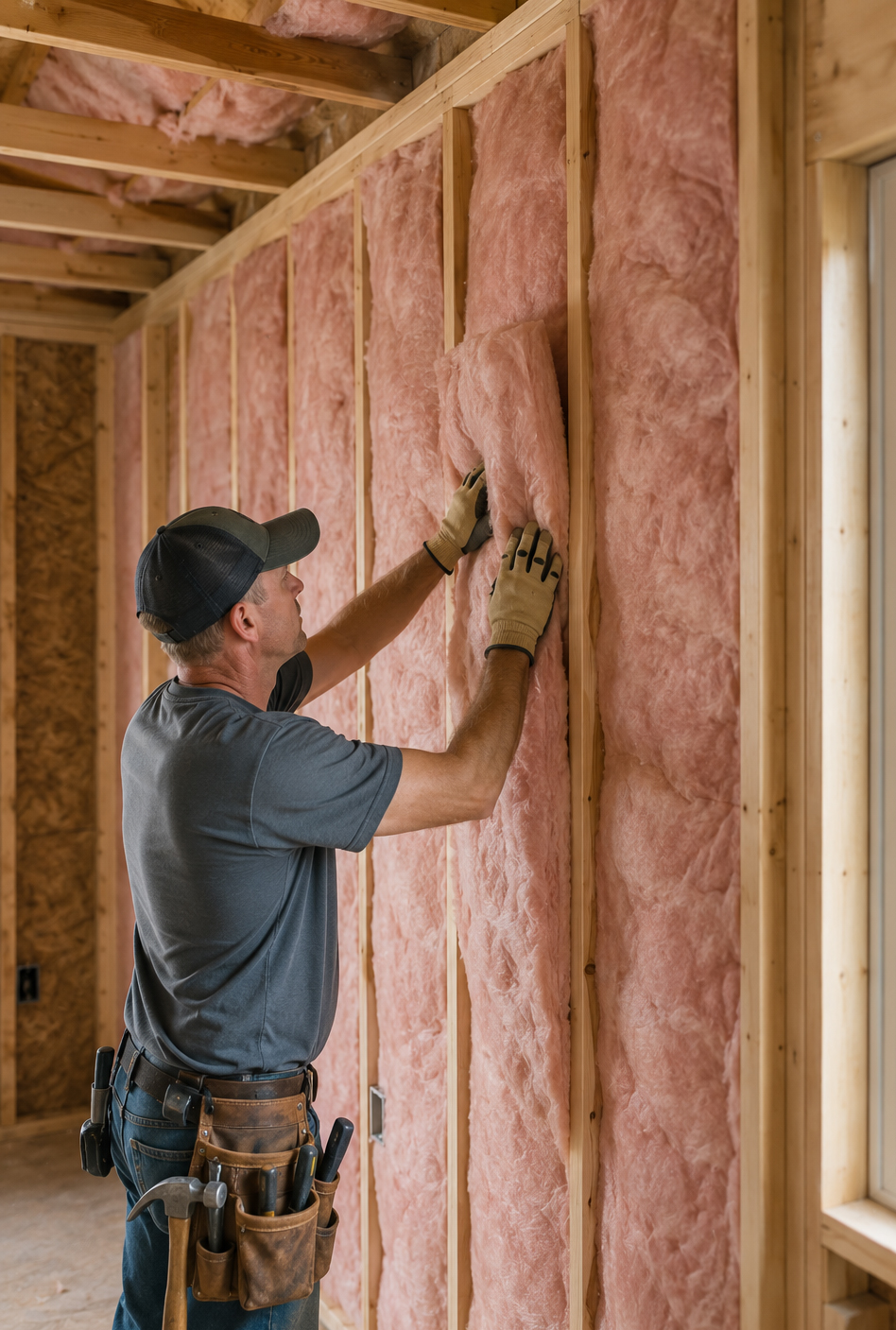
  • Fiberglass batt — walls, attics & floors

  • Mineral wool (rock wool) batt

  • Blown cellulose — attic & retrofit

  • Blown fiberglass — attic & walls

  • Open-cell spray foam

  • Closed-cell spray foam

  • Rigid foam continuous insulation

  • Sound attenuation — interior walls

BUILDING SCIENCE, NOT GUESSWORK

What Does Insulation Actually Do?

Insulation slows the transfer of heat through building assemblies — walls, ceilings, floors, and foundations — keeping conditioned air in and unconditioned air out. Its effectiveness is measured in R-value: the higher the R-value, the greater the resistance to heat flow. But R-value alone is only part of the equation.

Air sealing is the other half of the insulation equation — and the one most frequently neglected in production construction. An R-20 wall with gaps at electrical boxes, top plates, and penetrations performs far below its rated value because air carries heat through those gaps regardless of how much insulation surrounds them. RainFire Builders treats air sealing and insulation as inseparable systems.

Thermal bridging — the heat loss through framing members that bypasses cavity insulation — further reduces real-world wall performance. A nominal R-20 2×6 wall loses enough heat through wood studs to achieve only R-14 to R-15 effective whole-wall performance. Continuous insulation on the exterior of framing breaks that thermal bridge — and is required by the current Utah energy code for Climate Zone 5 compliance.

Getting insulation right is not about using more of the same material. It is about specifying the right material, in the right assembly, with the right air sealing, for the climate zone the building sits in.

Thermal Resistance (R-Value)

Measures resistance to conductive heat flow through the insulation material itself. Higher R-value = slower heat transfer. R-value stacks when insulation layers are combined — R-13 batt + R-5 rigid = R-18 assembly value.

Air Sealing

Eliminates gaps and pathways that allow conditioned air to escape and outdoor air to infiltrate. Air sealing is where most insulation value is lost in production homes — and where retrofit energy improvements deliver the highest ROI.

Thermal Bridging Control

Continuous insulation on the exterior face of framing interrupts the heat path through wood studs, which conduct heat at a rate far above that of fiberglass or cellulose. Required in Utah’s Climate Zone 5 for code-compliant wall assemblies.

Vapor Management

Controls moisture-laden air moving through assemblies. Utah’s predominantly heating-dominated climate requires a Class II vapor retarder (kraft facing) on the warm-in-winter side of exterior wall insulation per IECC requirements.

SCOPE OF WORK

OUR INSULATION SERVICES

RainFire Builders handles the complete insulation scope — from new construction thermal envelopes to retrofit upgrades in existing Utah homes — with products and methods matched to each assembly and climate zone.

Complete thermal envelope installation for new homes — walls, attic, floors, rim joists, and slab perimeter — coordinated with framing inspection and scheduled before drywall, never after.

Dense-pack blown cellulose or fiberglass into existing wall cavities through small access holes. Attic blown insulation to meet current code R-values. Crawl space encapsulation — all without full demolition.

Mineral wool batt in interior walls and ceilings between rooms where sound separation matters — home theaters, primary bedrooms, home offices, and music rooms — combined with air sealing at all flanking paths.

Closed-cell spray foam on crawl space walls and rim joists, ground cover vapor barrier, and conditioned air introduction — eliminating cold floors and moisture infiltration in Utah’s crawl-space-heavy residential stock.

Blower door-guided air sealing at all top plate penetrations, electrical boxes, plumbing chases, and framing gaps — the step most insulation contractors skip and the one that delivers the most energy savings per dollar.

Zone 6 specification for Park City, Heber, Midway, and other mountain community projects — higher R-values, more aggressive air sealing, and vapor management appropriate for the more extreme climate conditions.

Recruitment Features
HOW WE WORK

The RAINFIRE INSULATION PROCESS

Insulation must be installed in the right sequence, at the right time, with the right inspection coordination — it is the last trade that can be corrected before the walls close forever.

DESIGNED FOR UTAH’S EXTREMES

Insulation Built for Utah’s Climate

Utah’s geography creates an unusually demanding thermal environment. The Wasatch Front communities — Salt Lake City, Sandy, Draper, Lehi, and Provo — experience winter lows below 0°F and summer highs above 100°F, a 100-degree swing that stresses every building envelope element. Mountain communities above 6,000 feet face even more extreme conditions: colder winters, heavier snow loads, and lower average temperatures year-round.

Utah’s energy costs are moderate by national standards today, but an under-insulated Utah home compounds costs every single year — and the cost gap between code minimum and the next tier of performance is often less than $1,500 on a new build, with payback measured in years rather than decades. RainFire Builders presents the incremental cost of upgrading insulation at the time of construction — not after the walls are closed.

Utah’s wildfire smoke seasons and winter temperature inversions mean that indoor air quality matters as much as thermal performance. A well-air-sealed home with a properly designed ventilation system (HRV or ERV) delivers better indoor air quality than a leaky home during smoke events — one more reason that air sealing is part of every insulation scope we deliver.


CLIMATE ZONE MATTERS

A Park City home (Zone 6) requires meaningfully different insulation than a Salt Lake City home (Zone 5). RainFire Builders verifies zone assignment before specifying any product — not after the permit is pulled.

UPGRADE COST vs. LIFETIME SAVINGS

Upgrading from R-49 to R-60 attic insulation at new construction costs roughly $400–$800. The energy savings payback in a Utah home is typically 3–5 years. RainFire Builders presents these numbers — you make the decision.

AIR QUALITY & SEALING

During Utah’s wildfire smoke and inversion events, a well-air-sealed home with balanced mechanical ventilation protects occupants better than any air purifier alone. Air sealing is health infrastructure.

COLD FLOORS & CRAWL SPACES

Cold floors in winter are Utah’s most common comfort complaint — and almost always trace to an under-insulated or unencapsulated crawl space. Closed-cell spray foam encapsulation solves this permanently.

COMMON QUESTIONS

INSULATION FAQs

Answers to the insulation questions Utah homeowners and builders ask most — specific, technical, and honest.

What R-value insulation do I need for a home in Utah?2026-05-30T00:28:41+00:00

Utah’s Wasatch Front (Salt Lake City, Sandy, Draper, Provo) sits in IECC Climate Zone 5, requiring: exterior walls R-20 continuous or R-13 cavity plus R-5 continuous insulation; ceilings and attics R-49; floors over unconditioned spaces R-30; slab perimeter R-10 to 2 ft depth. Utah mountain communities — Park City, Heber City, and elevations above roughly 7,000 ft — fall in Climate Zone 6, requiring R-20+5 or R-13+10 walls, R-49 ceilings, and R-30 floors. RainFire Builders verifies climate zone and current adopted code for every project location before specifying insulation products.

What is the difference between open-cell and closed-cell spray foam?2026-05-30T00:29:27+00:00

Open-cell spray foam expands dramatically, filling cavities completely, and cures soft and spongy — approximately R-3.7 per inch, excellent air sealing, good acoustic benefit, but vapor-permeable and not moisture-resistant. Closed-cell cures rigid and dense — approximately R-6.5 per inch, exceptional air and vapor barrier performance, and significant structural rigidity — at roughly twice the cost. For Utah: closed-cell is preferred in crawl spaces, rim joists, and unvented roof assemblies where moisture resistance and maximum R-value per inch matter; open-cell is effective in interior walls and conditioned attic decks where vapor permeability is acceptable.

Is spray foam insulation worth the extra cost in Utah homes?2026-05-30T00:33:03+00:00

In specific applications, absolutely. Crawl space and rim joist closed-cell spray foam encapsulation eliminates the cold-floor complaints that affect a large percentage of Utah homes with crawl spaces — permanently. Unvented attic spray foam brings HVAC equipment into conditioned space, reducing equipment temperature extremes and duct losses. Spraying all wall cavities is not always the highest-value use of the spray foam budget, however. RainFire Builders will identify where spray foam delivers the most impact versus where batt or blown insulation achieves equivalent performance at lower cost — and present both options clearly.

What is the best insulation for soundproofing between rooms in a Utah home?2026-05-30T00:33:44+00:00

Mineral wool (rock wool) batt significantly outperforms fiberglass for acoustic separation — its higher density absorbs sound energy rather than merely resisting thermal transfer. Mineral wool in interior walls, combined with resilient channel mounting for drywall and acoustic caulk at all penetrations (electrical boxes, top plates, plumbing), creates a meaningfully quieter home. Adding insulation alone without sealing flanking paths limits the acoustic improvement — RainFire Builders addresses both as part of every acoustic wall scope.

Does insulation require a vapor barrier in Utah?2026-05-30T00:34:33+00:00

Utah’s heating-dominated climate creates vapor drive from warm interior toward the cold exterior in winter. IECC requires a Class II vapor retarder (kraft-faced batt or equivalent) on the warm-in-winter side of exterior wall insulation in both Climate Zones 5 and 6. Vapor retarders are not required on interior partition walls. Crawl spaces require a minimum 6-mil polyethylene ground cover vapor barrier on all exposed soil, extending up foundation walls and sealed at edges. RainFire Builders specifies and installs the correct vapor control layer for each assembly — not the same product everywhere regardless of application.

What is thermal bridging and why does it matter for Utah homes?2026-05-30T00:35:24+00:00

Thermal bridging occurs when a material with higher thermal conductivity than the surrounding insulation creates a heat pathway that bypasses the insulation layer. Wood studs in a 2×6 wall at 16″ OC occupy about 25% of wall area and conduct heat at a much higher rate than the fiberglass batts between them — reducing effective whole-wall R-value from the nominal R-20 to approximately R-14 to R-15. In Utah’s 100-degree seasonal temperature swing, that difference shows up as both higher utility bills and cold spots on walls in winter. Continuous insulation on the exterior face of framing is the code-accepted solution — and is required in Utah’s Climate Zone 5 walls to achieve code compliance via the R-13+5 CI pathway.

Can insulation be added to an existing Utah home without opening the walls?2026-05-30T00:36:05+00:00

Yes. Dense-pack blown cellulose or fiberglass can be installed in existing wall cavities through small holes drilled from either the exterior (through siding) or the interior (through drywall patches), without full wall demolition. Attic floors can typically be accessed and blown to current R-49 without any interior work. Crawl spaces can be insulated or encapsulated without disturbing finished floors above. RainFire Builders performs standalone retrofit insulation scopes for existing Utah homes across the Wasatch Front — improving comfort and reducing energy costs without the disruption of a full remodel.

What is the difference between thermal and acoustic insulation?2026-05-30T00:36:58+00:00

Thermal insulation resists heat transfer — measured in R-value — required in all exterior assemblies by building code. Acoustic insulation reduces sound transmission between spaces — measured by STC (Sound Transmission Class) — not required by code but increasingly specified in quality construction. Mineral wool batt serves both functions simultaneously: excellent thermal performance in exterior walls and meaningful acoustic separation in interior walls. Fiberglass batt provides strong thermal performance but modest acoustic benefit. Spray foam provides excellent thermal and air-sealing performance but limited acoustic benefit due to its rigid nature. RainFire Builders identifies which walls benefit from acoustic treatment and specifies the appropriate product for each location.

The RainFire Difference

WHY CHOOSE RAINFIRE BUILDERS FOR INSULATION?

Building Science First

Insulation is specified as a building science decision — R-value, vapor control, air sealing, and thermal bridging are all addressed together. We don’t install insulation the way it has always been done. We install it the way it should be done.

Zone-Verified Specs

The climate zone is confirmed before a single product is specified. A Park City project and a Salt Lake City project get different insulation specifications — because they are in different climate zones with different code requirements.

Sequenced Correctly

Because RainFire Builders manages all ten interior trades, insulation goes in at the right time — after all rough-in inspections pass, before drywall begins. No insulation removed for MEP access. No drywall hung before insulation inspection approval.

Upgrade Options at Bid

Every insulation estimate includes the cost to upgrade — from code minimum to enhanced performance, with the energy savings payback period calculated. You see both options. You make the call. We build to whatever you decide.

CONTINUE BUILDING:

RELATED INTERIOR SERVICES

Drywall & Plaster

Drywall never goes up until insulation is installed and the insulation inspection is passed  |  Explore Drywall & Plaster

Framing

2×6 exterior framing creates the cavity depth needed for Utah’s code – required R-20 insulation  |  Explore Framing

Flooring

Crawl space encapsulation eliminates cold floors – one of Utah’s most common home comfort complaints, solved at the source  |  Explore Flooring

Electrical

Electrical rough-in is completed and inspected before insulation – electrical box sealing is a part of our air-sealing scope  |  Explore Electrical

HVAC

Insulation performance and HVAC sizing are directly linked – a well-insulated envelope needs a smaller, more efficient system  |  Explore HVAC

Indoor Plumbing

Plumbing rough-in and pressure tests precede insulation – pipes in exterior walls need specific insulation detailing to prevent freezing  |  Explore Indoor Plumbing


COMFORT THROUGH EVERY SEASON

The Right Insulation for Utah’s Extremes

From sub-zero January nights on the Wasatch Front to triple-digit August afternoons — RainFire Builders insulates every home to perform in the climate it actually lives in. Code minimum, performance upgrade, or full building science envelope — we present your options and build to your decision.

Call us now at (385) 336-7246 or request an estimate online. We’ll start on your property’s project and your future with care.

We Make It Happen – 

Request a Quote

Schedule your in-person consultation. Let’s get your project started

Go to Top