
Project Management – Job Costing
You Should Always Know
Where Your Money Is
The most common complaint in construction isn’t bad work. It’s a financial surprise — the final invoice that’s $40,000 higher than expected, with no warning and no explanation. RainFire Builders tracks every dollar of every project against the estimate in real time, with monthly reports that show you exactly what’s been spent, what’s committed, and what the current projection-to-complete is. No surprises at the end.
OUR JOB COSTING SERVICES
Budget Development & Tracking
Cost Code Systems
Labor Cost Tracking
Material Cost Tracking
Subcontractor Cost Management
Monthly Job Cost Reports
Committed Cost Tracking
Open-Book Reporting
Cost-to-Complete Projections
Earned Value Management

Licensed & Insured
WHAT THE NUMBERS MEAN
Budget, Actual, Committed, Remaining –
The Four Numbers That Tell The Full Story
A job cost report that only shows “budget vs. actual” is missing the most important number on the page. Here is what each of the four core metrics means, why it matters, and what it should tell a client about their project’s financial health.
THE PLAN
Budget – The approved cost for a scope of work from the estimate — updated by every executed change order. The budget is not fixed forever; it is the current approved amount, which changes every time a change order is signed. A project manager who quotes the “original budget” after multiple change orders have been executed is quoting fiction. The current approved budget is the only number that matters..
WHAT’S BEEN SPENT
Actual Cost – The total cost incurred and recorded to date — labor hours worked and priced, materials received and invoiced, subcontractor invoices received. Actual cost is a historical number: it shows what has happened. Budget minus actual does not equal remaining available budget — it equals remaining available budget minus committed costs, which can be significantly less than it appears.
WHAT’S OBLIGATED
Committed Cost – Actual cost plus contractually obligated costs that haven’t been incurred yet — subcontractor purchase orders, material orders placed but not received, labor on ongoing phases. A subcontractor purchase order for $45,000, where $20,000 of work is complete, creates $20,000 actual cost and $25,000 additional committed cost. Tracking only actual cost without committed cost systematically overstates the remaining budget until the committed costs become invoices.
WHAT’S LEFT
Remaining Budget – Budget minus total committed cost (actual plus pending). This is the only number that tells you how much money is genuinely available for the remaining work. When the remaining budget goes negative on a cost code, that cost code is over its approved budget — and a change order or budget reallocation decision needs to happen. This number, updated monthly and shared with the client, is the early warning system that prevents end-of-project financial surprises.
THE FIFTH NUMBER: ESTIMATE-AT-COMPLETION (EAC)
Estimate-at-completion is actual cost to date plus cost-to-complete — the current best projection of the project’s total final cost. If EAC exceeds the approved budget, the project is projected to overrun. This projection, calculated monthly and included in the job cost report, gives both parties the information needed to make decisions while there is still time to make them. A project with a $600,000 approved budget, $200,000 spent, and a cost-to-complete of $440,000 has an EAC of $640,000 — a projected $40,000 overrun that is visible at month three, not at final invoice.

OUR JOB COSTING SERVICES
Every element of RainFire Builders’ job costing system — from budget setup through monthly reporting and cost-to-complete projection — is applied on every qualifying project to eliminate financial surprises.
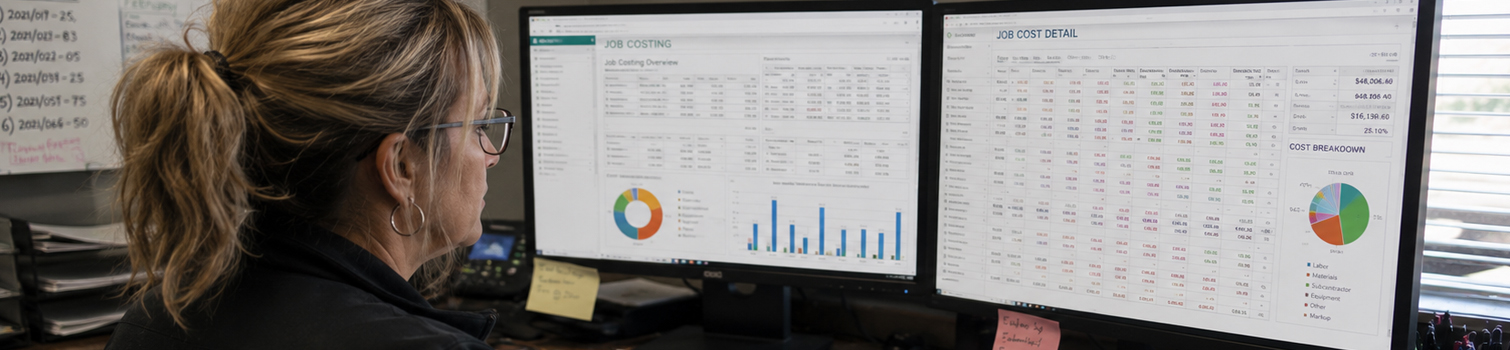
Project budgets are established from the approved estimate and organized by CSI MasterFormat cost division before mobilization. Every cost incurred during construction — labor hours worked at crew rates, materials received, subcontractor invoices, equipment charges — is recorded against the appropriate cost code as it is incurred. The budget is updated to reflect every executed change order, so the current approved budget is always visible. Cost tracking is the foundation that makes every other reporting output meaningful: without accurate cost recording, the job cost report is fiction.
Labor is the most variable cost on any construction project and the most commonly understated in low bids — because labor hours are invisible to the client and easy to misrepresent. RainFire Builders tracks labor costs by phase and trade, comparing actual hours worked against the estimate to identify productivity variances before they become overruns. Labor burden rate (the cost of benefits, payroll taxes, workers’ compensation insurance, and general liability insurance on top of the base wage) is included in the labor cost for every worker — the true cost of labor, not the misleadingly low straight-wage figure.
Material costs are recorded as received, reconciled against purchase orders, and tracked against the estimate specification and quantity for each cost code. Material substitutions — where a product other than the estimated specification is used — are documented, and the cost impact is reflected in the job cost system, not absorbed silently. Subcontractor costs are tracked against the purchase order value and the subcontractor’s approved scope, with committed cost updated when purchase orders are executed and actual cost updated when invoices are received and approved. Subcontractor invoices are reviewed for scope compliance before approval.
Written monthly job cost reports are shared with the client on every qualifying project — showing original budget, current approved budget (after change orders), actual cost-to-date, committed cost-to-date, and remaining available budget for every cost code. Cost codes trending over budget are highlighted with an explanation. Cost-to-complete projections are updated monthly, and the estimate-at-completion is shown on the summary page. The report is delivered as part of the monthly project update — not provided only on request. Monthly job cost reporting is the primary mechanism that prevents the construction industry’s most common client complaint: no one told me it was going to cost this much.
On cost-plus projects, RainFire Builders provides fully open-book reporting — the client has access to the complete cost tracking for their project, including labor rates, material invoices, subcontractor purchase orders, and overhead allocation. Open-book reporting is the client’s primary financial protection on a cost-plus contract, where they are paying actual costs rather than a fixed price. It is also available on fixed-price projects for clients who prefer maximum transparency. No contractor cost data is hidden from the client on their own project — overhead and profit are stated explicitly in the contract and in the monthly report.
Cost-to-complete (CTC) projections assess the estimated cost of finishing the remaining scope at the current point in the project — producing an estimate-at-completion (EAC) that projects the total final project cost. CTC is updated monthly, using actual production rates to date to refine the estimate for remaining work. When EAC begins trending above the approved budget, the project manager prepares a written variance explanation and a menu of response options — scope reduction, budget increase, or acceptance — before the overrun becomes a final invoice. The forward-looking component of job costing that turns financial tracking into financial management.

HOW WE TRACK
The RainFire Builders Job Costing Process
Job costing is a continuous process — not a one-time report generated at project closeout. Here is how RainFire Builders establishes and maintains financial visibility from contract execution through final invoice.
Budget Setup from Approved Estimate
When the contract is executed, the approved estimate becomes the project budget — organized by CSI MasterFormat cost code in the job cost system before the first crew mobilizes. Every line item from the estimate is entered against its appropriate cost division: framing labor and materials to Division 06, plumbing rough-in to Division 22, general conditions to Division 01, contingency to its own visible line. The budget setup converts the static estimate document into a live tracking system. Change orders are entered when executed, updating the approved budget for the affected cost codes. The budget in the job cost system is always the current approved budget — not the original estimate, not a mental approximation.
Real-Time Cost Entry as Work Is Performed
Costs are entered into the job cost system as they are incurred — not batched weekly or monthly when invoices are processed. Labor hours are entered daily from time cards, priced at full burden rate (base wage plus payroll taxes, workers’ compensation, general liability, and benefits). Material costs are entered when materials are received, and delivery tickets are signed, with the purchase order committed cost already recorded from the time the PO was issued. Subcontractor committed costs are entered when purchase orders are executed; actual costs are updated when invoices are received and approved. This real-time approach means the job cost report reflects current conditions, not last month’s data.
Weekly Cost Code Review
The project manager reviews the job cost report weekly — scanning every cost code for variance trends that warrant attention before they become overruns. A cost code that has consumed 60% of its budget with 30% of its scope complete is flagged for investigation: is the scope larger than estimated? Is there a labor productivity problem? Is there a material specification change that wasn’t documented as a change order? The weekly review catches these trends early — when the corrective option is to adjust the approach, not to present the client with a change order after the overrun has already occurred. Cost codes with active variances are discussed with the client in the weekly project update.
Monthly Report Generation & Client Distribution
At month-end, the project manager generates the monthly job cost report — a formatted document showing the full cost picture for the month: original budget, current approved budget (with change orders applied), actual cost-to-date, committed cost-to-date, remaining available budget, and the percent-spent indicator for each cost code. The report includes a brief narrative on any cost codes with material variances — the reason for the variance and the projected impact on the estimate-at-completion. The cost-to-complete estimate is updated and the estimate-at-completion is shown on the summary page. This report is delivered to the client as part of the monthly project update package — not available only on request, not withheld because the numbers are inconvenient to share.
Final Job Cost Reconciliation at Closeout
At project closeout, the final job cost reconciliation shows the complete financial history of the project — every dollar spent and committed, organized by cost code, compared to the final approved budget (original plus all executed change orders). The reconciliation documents the final variance on every cost code — positive variances (under budget) and negative variances (over budget) — and explains any material differences from the estimate. On cost-plus projects, the final reconciliation is the document that determines the final client billing: actual costs plus the agreed contractor fee. On fixed-price projects, it is the internal financial record that informs future estimating accuracy. Every client receives the final job cost reconciliation at project closeout as part of the closeout documentation package.

Why Job Costing Matters Especially in Utah’s Construction Market
The most common source of Utah construction budget overruns is not contractor dishonesty — it is scope discovered during construction that was not accounted for in the original estimate. Expansive clay soils that require engineered fill replacement. Rock was encountered at 3 feet in a foothill lot where the estimate assumed clear excavation to 8 feet. Moisture damage behind a wall opened for renovation. Upgraded material selections that exceed allowances set at entry-level prices. On a project where job costing is active, every one of these discoveries produces a change order with a documented cost and client signature before work proceeds. On a project without job costing, they accumulate silently until the final invoice arrives and the client learns for the first time that their $280,000 project cost $348,000.
Utah’s hard water (200–400 ppm) and high construction activity create a market where material costs are local and specific — not national averages. Job costing using current local supplier quotes rather than RSMeans national averages with Utah adjustment factors produces more accurate budget tracking. When a concrete pour comes in above estimate, the job cost report shows the variance immediately, and the project manager can determine whether it reflects a material cost increase, a quantity overrun, or a specification change — and document the cause before the next pour.
The Wasatch Front’s construction market has seen meaningful cost escalation over the past several years. For cost-plus projects in a rising cost environment, real-time job costing is especially valuable: the client sees actual current market costs as they are incurred rather than discovering a cost-environment delta at project closeout. Open-book reporting on cost-plus projects means Utah homeowners building in an active escalation market can see exactly what the current costs are — not what the estimate predicted they would be six months earlier.
Job cost reports are delivered to every qualifying project client monthly as part of the standard project update — not available only on request. The financial position of a project should not require the client to chase their contractor. If you are not receiving monthly cost reporting on an active construction project, you are not getting the minimum standard of financial transparency.
RainFire Builders tracks committed cost (actual plus contractually obligated but not yet incurred) alongside actual cost for every cost code. Budget minus committed cost is the only number that accurately represents the remaining available budget. A job cost system that tracks only paid invoices will systematically overstate the remaining budget until committed costs become invoices.
On a fixed-price contract, items that were omitted or incorrectly priced in the original estimate are RainFire Builders’ responsibility — they are absorbed, not billed to the client as change orders. The job cost system makes this distinction visible: every change order is documented with its cause (client-initiated scope change vs. field condition vs. estimating error), and the cost responsibility is clear before work proceeds.
Estimate-at-completion — the current best projection of the project’s total final cost — is updated every month based on actual production rates and current cost-to-complete assessment. When EAC begins trending above the approved budget, the client learns about it in the monthly report, not in the final invoice. Early visibility enables decisions; late disclosure produces disputes.
FINANCIAL FUNDAMENTALS
Job Costing is Not Accounting. It’s Real-Time Financial Visibility
Accounting records what has been paid. Job costing records what has been spent and committed — whether the invoice has been paid or not. These are not the same thing, and the difference is consequential. A subcontractor who has completed $60,000 of work and submitted a $60,000 invoice represents $60,000 of committed cost on a job cost report regardless of when the check is written. A contractor who tracks only paid invoices will systematically show more available budget than actually exists, until the committed costs are paid and the overrun appears suddenly.
The purpose of job costing is to know the project’s financial position at any point during construction — not just at the end. A project where $400,000 has been spent and committed against a $600,000 budget, with a cost-to-complete estimate of $250,000, has a projected overrun of $50,000. That information, available at the midpoint, allows both the contractor and client to make a decision: reduce scope, add budget, or accept the overrun. The same information discovered at the final invoice produces only one option: a dispute. Job costing is the difference between a managed project and a financial surprise.
Open-book job costing takes this discipline one step further: the client has access to the contractor’s cost tracking on their project. On cost-plus contracts, this is the client’s primary financial protection — they are paying actual costs, and the monthly job cost report is how they verify what those costs are. On fixed-price contracts, open-book reporting builds the trust that comes from transparency: the client knows the project’s financial position without having to infer it from invoices and hope that the final number matches what they were told it would be.
RainFire Builders applies job costing to every project above a defined contract value — organized by CSI MasterFormat cost divisions (the industry-standard numbering system that assigns each type of construction work to a specific division number), updated as costs are incurred, and reported to the client monthly. The monthly job cost report shows the original budget, the approved budget after change orders, actual cost-to-date, committed cost-to-date, and remaining available budget — for every cost code. The financial position of your project is not a secret we keep until it’s inconvenient to share.
COMMON QUESTIONS
JOB COSTING FAQs
Clear, honest answers to the financial transparency questions every construction client should be asking — but most don’t know to ask.
Job costing is the discipline of tracking every cost on a specific project — labor, materials, subcontractors, equipment, and overhead — against the approved estimate, organized by cost code. The purpose is to know, at any point during construction, how much of the budget has been spent, how much is committed, and how much remains. Job costing is distinct from accounting: accounting records what has been paid; job costing records what has been spent and obligated, regardless of payment timing. Without job costing, a project’s financial position is unknown until the final invoice, at which point nothing can be done about overruns. With job costing, overruns are visible while there is still time to respond to them.
Open-book job costing means the client has direct access to the contractor’s cost tracking — actual costs, committed costs, budget by cost code, and the current projection-to-complete. On a standard construction contract, cost data is internal to the contractor; the client sees only invoices. Open-book reporting gives the client direct visibility into the project’s financial position rather than requiring them to infer it from invoices and change orders. For cost-plus contracts, open-book reporting is the client’s primary financial protection — they are paying actual costs, and the monthly job cost report is how they verify what those costs are. RainFire Builders provides open-book reporting on cost-plus contracts as a standard practice and makes it available on fixed-price contracts for clients who prefer maximum transparency.
A cost code is a number that categorizes every construction cost by the type of work it represents. RainFire Builders uses the CSI MasterFormat system — a 50-division numbering standard covering all construction work. Common residential cost codes include Division 01 (General Requirements — supervision, temporary facilities), Division 03 (Concrete — foundation, flatwork), Division 06 (Wood & Framing), Division 07 (Thermal & Moisture — insulation, roofing), Division 08 (Openings — windows, doors), Division 09 (Finishes — drywall, flooring, painting), Division 22 (Plumbing), Division 23 (HVAC), and Division 26 (Electrical). When a cost is recorded, it’s assigned to the appropriate division — so the job cost report shows budget versus actual for each trade scope separately, making it immediately visible which areas are tracking on budget and which are not.
Budget is the approved cost for a scope of work — updated by every executed change order. Actual cost is the total incurred and recorded to date — labor hours worked, materials received, invoices approved. Committed cost is actual plus contractually obligated costs not yet incurred — a subcontractor PO for $45,000 where $20,000 is complete creates $20,000 actual and $25,000 additional committed, for $45,000 total committed. Budget minus committed is the only accurate remaining budget figure. Budget minus actual alone consistently overstates the remaining budget until committed costs become invoices. A job cost system that tracks only paid invoices will make a project appear to have more budget remaining than it actually does — until the committed costs arrive as invoices and the apparent overrun appears suddenly.
Monthly on any active project above a defined contract value. The monthly job cost report should show: original budget by cost code, current approved budget after change orders, actual cost-to-date, committed cost-to-date, remaining available budget, and estimate-at-completion. It should be delivered as part of the monthly project update — not provided only when the client requests it. If your current contractor doesn’t provide monthly job cost reports, you don’t know whether your project is on budget. You can ask — and if they can’t or won’t provide it, that tells you something important about how they manage projects financially.
Cost-to-complete (CTC) is the estimated cost of finishing the remaining scope. Added to actual costs to date, it produces the estimate-at-completion (EAC) — the current projection of the project’s total final cost. If EAC exceeds the approved budget, the project is projected to overrun. This projection, calculated monthly, gives both parties the information needed to make decisions while there is still time to make them. A project with a $600,000 budget where $200,000 has been spent, and the cost-to-complete is $440,000, has an EAC of $640,000 — a projected $40,000 overrun visible at month three, not at the final invoice. The earlier this information is visible, the more options are available for responding to it.
Five primary causes: incomplete scope in the original estimate (items not included appear as change orders after work begins); allowances set below market-realistic levels (actual selections exceed placeholder amounts); undocumented verbal scope changes that accumulate without client approval; material cost increases for long-duration projects; and the absence of real-time cost tracking (overruns are not visible until the final invoice). The first three are estimates and change order management failures. The fourth is mitigated by early ordering. The fifth is what job costing specifically addresses — a project with real-time tracking produces early warning when actual costs diverge from budget, while a project without it produces the same information only at final invoice, when intervention is impossible. RainFire Builders applies countermeasures to all five causes.
On a cost-plus contract, unused contingency is returned to the client — they pay actual costs plus the agreed fee, and any contingency not consumed reduces the final cost. On a fixed-price contract, the contractor retains unused contingency as part of project margin — the client pays the agreed fixed price. In both cases, contingency should be visible in the estimate and tracked as a separate cost code throughout the project. Contingency embedded invisibly in line item pricing is not contingency — it is undisclosed markup. On RainFire Builders projects, contingency is labeled explicitly in the estimate and tracked as its own cost code in the job cost system so both parties can see how much is remaining throughout the project.
The RainFire Standard
WHY CHOOSE RAINFIRE BUILDERS FOR FINANCIAL TRANSPARENCY?
Monthly Reports, Always
Job cost reports are delivered monthly on every qualifying project — not available only on request. The financial position of your project is not a secret we hold until it’s inconvenient to share. You should receive this report from any contractor you work with.
Committed Cost Tracked
We track committed cost (actual plus contractually obligated) alongside actual cost. Budget minus committed is the only accurate remaining budget figure. Tracking only paid invoices systematically overstates remaining budget until the committed costs arrive — and by then, it’s too late to respond.
EAC Every Month
Estimate-at-completion is updated monthly and included in the job cost report. When EAC begins trending above the approved budget, the client sees it in the monthly report — with the cause explained and response options outlined. Not in the final invoice with no options remaining.
Estimating Errors Are Ours
On fixed-price contracts, items we omitted or incorrectly priced are absorbed — not billed as change orders. The job cost system makes this distinction visible: every cost variance is documented with its cause, and the difference between contractor error and legitimate scope change is clear before work proceeds.
CONTINUE THE PROCESS:
RELATED PROJECT MANAGEMENT SERVICES
Scheduling
Schedule and cost are linked: general conditions costs extend when projects run long, and the monthly job cost report and weekly schedule together give the client complete financial and timeline visibility. | Explore More About Scheduling
Estimates
The estimate is the document that becomes the project budget. A line-item estimate organized by CSI cost code converts directly to the job cost system’s budget structure – making budget tracking accurate from day one instead of requiring translation. | Explore Estimate
Change Orders
Every change order updates the approved budget in the job cost system before work proceeds. Without written change orders, the budget becomes inaccurate – cost codes appear over budget because the budget was never updated to give the client complete financial and timeline visibility. | Explore Change Orders
Quality Assurance
Rework is the most expensive cost overrun in construction – it doesn’t appear as a change order, it appears as unexpected labor charges in the job cost report. Phase-by-phase QA prevents the rework costs that undermine otherwise well-managed project budgets. | Explore Quality Assurance
Start Your Project
Ready to work with a contractor who tracks your project budget in real time and tells you what’s happening financially before you have to ask? Contact RainFire Builders to start the conversation. | Get Your Free Estimate
All Project Management
Return to the complete project management overview – estimates, scheduling, job costing, change orders, inspections, and quality assurance. | Go Back to the Beginning
Open-Book. Monthly Reports. No End-of-Project Surprises.
Know Where Your Money Is Going. Every Month.
The most common complaint in construction isn’t shoddy work — it’s financial blindness. A final invoice that’s $60,000 higher than the last thing the client heard, with no warning and no explanation. RainFire Builders manages every qualifying project with real-time cost tracking, committed cost visibility, monthly job cost reports, and estimate-at-completion projections that give you the information you need to make decisions while there is still time to make them. No surprises at the end. No invoices that arrive before the explanation. Just a clear, honest picture of where your money is — every month, for the life of the project.
Call us now at (385) 336-7246 or request an estimate online. We’ll start on your property’s project and your future with care.
We Make It Happen –
Request an Estimate
Schedule your in-person consultation. Let’s get your project started
